Odonata Chinese Levelled Reading Series: Review

This post is a review of Odonata Graded readers (红蜻蜓学前阅读计划), which are a well written series for learning 1200 Chinese characters.  The books are a nice quality, with clear layout, large font, and no HYPY. Importantly, these books will not break the bank (unlike some other famous levelled readers, which are quite an investment).

What is Odonata Books?

Odonata Books is a Malaysian publishing company who (among other things) have produced 红蜻蜓学前阅读计划 Odonata Chinese Levelled Reading Series.  This is a set of books which progressively go from 100 words to 1200 characters, and builds vocabulary through stories.  The first 24 books in the series revolve around two children –  Ming Ming and Li Li -and their adventures, which each book containing a small set of Simplified Chinese characters, used in various contexts.   It’s equivalent to something like the English Peter & Jane series to start out with in Sets 1 & 2, but then becomes rapidly more complex, into more like an “I Can Read” or “Read It Yourself” simple story for Sets 3 and beyond.

There are 5 separate series, and each series has 8 books. After finishing all the 5 series, children are exposed to 1200 words (40 books in total).  It has no pinyin, but it does have an audio CD option and also compatible with Luka for audio.

Unlike many other popular levelled readers (such as either Sage 500 or Le Le), Odonata also comes with its own supporting workbook and flashcards, making is a wholistic curriculum for character learning.   For this reason, the Odonata Books curriculum is a mainstay of many kindergartens in Malaysia. In fact, I have it on good account that some of the fancier preschools in Singapore actually use Odonata as their base curriculum too (shhhh!).

What’s great about Odonata Chinese Levelled Reading Series?

  • Minimal pinyin – in fact, there’s almost none, apart from the pages where new characters are introduced.  I like this, as it really helps to avoid dependence on the pinyin, and encourages children to really read the text
  • Big clear font:  no overlapping text and pictures
  • Holistic curriculum – can be supplemented with writing books, additional stories, and flash cards (at minimal extra cost)
  • Introduces new characters systematically:  each new character comes with Chinese pinyin and stroke order, and a graphical clue, to assist both the child and parent.  The new character lists are also displayed on the front page of each book, so can be used for other reinforcement through games.
  • Value for money:  It’s relatively cheaper than Le Le and Sage 500, and the books/sets can be purchased individually, so it doesn’t mean a massive upfront investment.  It’s also possible to jump-in at the level which best suits your child.
  • Compact:  the books are paperback, thin and easy to store.
  • Luka Compatible – for families who need the audio support, the first 4 sets can be used with Luka. 

Considerations

  • Only the first four sets have audio:  Set 5 (900 – 1200 characters) has neither audio CD nor Luka audio options.  That said, with an iFlyTek Alpha Egg or Youdao Dictionary Pen, you’ll be able to read these effortlessly too. 
  • Not as much repetition as Sage 500: the unique selling point of Sage books are the amount of repetition that a small child can get through reading the stories, with only on new character introduced per chapter.  This is not the same with Odonata…. But our solution for my youngest is to simply read the same book several times over.
  • I’m not sure graded readers really need to on this far:  getting up to 1200 characters is quite easy for the parent, to just keep passing the child the next book in the series, but I would suggest that at about the 800 word mark (Set 4), it would be a good idea to start broadening the reading into other materials as well, such as some simple bridging books.

What are the different Odonata Chinese Levelled Reading series:

Stage 1: First 100 Words:  8 story books that are written using only 100 characters.  Each page has a short sentence.

Stage 2: First 200 words:  again divided into 8 story books, systematically introducing new characters to get up to 216 words.   Each page still contains 2 – 3 sentences.

Stage 3: First 400 words:  the next 8 books jump quite fast from 217 to 423 common characters. The stories are longer, but the plot around Ming Ming and Li Li remains.

Stage 4:  First 800 words: this is where the learning gets accelerated, with the next 8 books covering 424 to 812 common words. The stories are no longer restricted to Ming Ming and Li Li.

Stage 5: Final 1200 words:  the first four books go from 812 – 1000 characters, covering the Ming Ming and Li Li adventure.  The final four books go from 1000 to 1210 words, and introduce new short stories, consisting of full pages of text.  It’s a final step to encourage a child to be comfortable with larger passages.

What supporting material do the Odonata Graded Readers come with?

Readers: obviously!

Workbooks: 红蜻蜓学前阅读计划作业 – 幼儿学写字/华语 Odonata Graded Learning Workbooks are specifically designed to complement the readers, by mirroring the vocabulary, with written activities (character grids, character recognition activities, etc).  Whilst I love the concept of these, There are two workbooks for each level, being 学写字一上 (Learn to write) and 学华语一下 (Learn Mandarin).  The first is for handwriting practice of new characters that are learnt in the readers.  The later has activities like fill in the blanks, reading exercises, and suggested classroom activities.  I’d recommend they’re only truly valuable for use under the guidance of a Chinese speaking adult.  If that’s not you, perhaps these could be used as materials with a home tutor or a friend, to support the independent reading at home. 

Short stories:  Odonata Graded Learning Short Stories: essentially these are just more stories, covering in greater detail the characters used in the readers.  These are not Luka compatible, and the layout is more designed for an adult to read alongside a child, so it has large size font (for the child) and smaller font (for the adult).  I think it would be quite fun, for an adult who can read Chinese.  The intention is to consolidate knowledge of the new words, and encourage parents to read stories with their children.

Flashcards: 红蜻蜓学前阅读计划字卡 Odonata Graded Learning Flash Cards: covering 600 most common characters from the readers

Audio option: in the form of CDs or Luka

Free online Quizlet sets available for each book:  a fun online Odonata quiz game to pair with the books, which is made freely available from a Malaysian Chinese school

How does it compare to other graded readers?

Our family has accumulated quite a collection of Chinese readers over the years – all of them have been immensely helpful, both for the children and for me in learning to read.  There are obviously lots of great Chinese readers available in Singapore to read together with your child.  I wrote an earlier blog post with quick comparison of eight well known Chinese levelled reading series (including Sage, Le Le, 四五快读, etc) noting which ones we have enjoyed the most. The earlier post contains some photographs, to help in your journey of finding appropriate books for beginning readers. 

For a quick summary of how Odonata Readers compare to the other famous series:

  • Sage 500:  Odonata Books concept it really similar to Sage 500, in that is introduces characters systematically in order, but instead of one at a time, it does about 10 – 15 characters at a time.  This means the stories actually have more of a sensical storyline, and are less repetitive than Sage Chinese 500 (which can be verging on boring for an older child).  Sets 1 to 3 of Odonata essentially cover a similar wordset to Sage 500.
  • Le Le Chinese: The entertainment value of the Odonata storylines is on-par with Le Le Chinese, so they’re interesting to read, but with slightly longer sentences than Le Le.  Towards the final series in Odonata, the pages have many sentences on them, whereas Le Le books still stay relatively short throughout.  My kids feel a sense of satisfaction with Le Le, because they can finish a few books in one sitting by themselves, even the hardest level books (at about 1200 character knowledge).  In comparison, the hardest end of the Odonata books (also 1200 characters) is something that needs to be taken in small chunks each day, perhaps even only 1 or 2 pages.

Choosing the right series differs a lot by your own competency in reading Chinese, and also whether this is the only syllabus being used, or you simply want to use the books as stories to support a love of literacy.  The image below has an (overly simplified…) summary of the main options:

Comparison of Chinse graded reading books
Schematic on choosing a good Chinese reader for your family situation

 The other readers we have used and would recommend considering (depending on circumstances!) are listed below with links to more detail:

Why did we do Le Le and Sage before Odonata Chinese?

It was circumstance, rather than design.

As a mother who cannot read Chinese, I am constrained to books which had an audio option.  Odonata Books has this now, but it’s only a recent development.  When I was first on the pursuit for graded readers with my eldest, I really appreciated that Le Le Chinese comes with a reading pen, which can slowly and (fairly) accurately pronounce each of the characters, and gets us up to about 1300 characters.   Sage 500 was also a good initial option for my second daughter, because it was relatively simple enough for my elder daughter to assist my toddler with, as it didn’t go beyond 500 characters. 

Odonata just never seemed to be doable for a non-Chinese speaking mother ……. That was, until this year, when it became compatible with Luka Reading Robot.  And hence, we have given it a go, and been pleasantly surprised!  It’s actually been nice for my #2 and #3 to read Odonata alongside their Sage 500 journey, and they complement each other nicely (Sage gives the repetition, and Odonata gives the more interesting stories).  However, if I had my time again, we might just run with Odonata, since it’s SO much cheaper than investing in Sage 500 and also goes up to 1200 characters, which is well beyond Sage. 

The key thing with investing in a graded reading series is that you can use it consistently, and that the child is enjoying the experience. Then you’ll likely have success in creating a reader!

Where to buy?

In Singapore, it retails from many places.  Our set came from Luka Reads.  I’ve made a list of all our favourite places in Singapore to buy Chinese books for children in my earlier post:

Specifically for Odonata series, you can find them:

  • Singapore: Luka Reads, Shoppee, Maya Yuyi [My blog readers can enjoy a 10% discount on books from Luka Reads, using using “lahlah10offbooks” at check out]
  • Malaysia:  Odonatabooks.com (the publisher)
  • UK: Deziremi [If you quote promo code “LAHLAHSPECIAL” on checkout, my blog readers will receive 10% off]

I would love to hear from you!

Please let me know any questions of comments you might have. I’d love to help you if I can. That’s the reason this blog exists – it’s a passion project, designed to assist other parents like myself in navigating the bilingual Chinese learning journey (and ideally not to spend too much money in the process!).

Other posts I have written which might be of interest:

Disclaimer: Our Odonata set was kindly gifted to us from Luka Reads in Singapore. Of all our graded readers, this is the only set which we haven’t purchased ourselves at full price. We’re grateful to the Luka Reads team for introducing this book to us, and encouraging us to give it a try, despite already having a plethora of existing levelled readers at our place. All the opinions shared are genuine, and I hope this review has been helpful for your family.

Parent Review: Alpha Egg Dictionary Pen Q3

iFlyTek Alpha Egg Dictionary Pen 科大讯飞扫描笔   

This post is a review of iFlyTek Alpha Egg Q3 Reading Pen – a handheld dictionary pen, which can read any printed Chinese or English text.  It’s specifically designed to be kid friendly, accurate, and allows the user to effectively read and/or translate between the two languages.

Technology just keeps getting better! I used to wonder why there wasn’t a simple hand-held device which can read any Chinese text in the same way that Google Translate can.  I now know several devices and apps which can do this, and FlyTek Alpha Egg is certainly a standout.

This post covers:

Features of iFlyTek Alpha Dictionary Pen
Pros of iFlyTek Alpha Pen
Cons of iFlyTek Alpha Pen
FAQ & Comparison with other Chinese pens

What is the iFlyTek Alpha Egg Q3 Dictionary Pen?

The two main stream dictionary pens currently on the market are NetEase Youdao Dictionary and iFlyTek Alpha Egg Dictionary Pen.    Let me start by saying the Alpha Egg pen can do everything the much heralded Youdao pen can do, but better.  Moreover, it’s claimed to be current Number 1 bestselling dictionary pen in China right now.

This clever pen will can scan any Chinese written text (from an individual character to a full paragraph), and then it will:

  • read it out in Chinese
  • read it out in English (in a very fluent and sensible translation)
  • show the pinyin
  • provide dictionary definition of individual words in the sentence/paragraph.

Previously, we’ve used other devices which ‘translate’ text between languages – such as Google Translate camera function, Pleco OCR, and Youdao.  Each of these do work, but in some cases not well enough to enjoy the reading experience or be certain 100% of the nitty gritty details.  A dictionary pen is undoubtedly the best way to do this, but not all of them are designed for use by children.  Unlike Youdao, the Alpha Egg is specifically designed for younger users.

This pen literally is an answer to all the flaws which we’d noted about the Yaodao Dictionary Pen, in an earlier review.  Previously I’d called Yaodao pen as the ‘holy grail’ gadget for translating Chinese-English text ……. For children, iFlyTek now wins this prize, since it’s designed to be much more kid friendly and robust, and easier for an inpatient child to use accurately. 

Alpha egg versus Youdao
Our Youdao Dictionary Pen and iFlyTek Alpha Egg both can translate printed Chinese into english, and also pronounce the sentence in Chinese

Why does our family use Chinese Dictionary Pens?

Some family background:  all my daughters study Mandarin at school as their “mother tongue”, but we have no Chinese speaking adults in our house. For me, as a monolingual mother raising bilingual children, this means I cannot understand the homework, or help with weekly tingxie (Chinese spelling) revision, or even bedtime reading.  Having a dictionary pen in the house gives me some sanity!

We use our dictionary pens for two main purposes:

  1. To assist my children to read independent:  when reading a book by themselves, the Dictionary Pen helps them to understand a particular words or phrases they don’t know.  Rather than needing to me madly look it up for them on Pleco or Google Translate (or calling our neighbour!), this pen lets the child do it themselves instantly and effortlessly.  They simply need to gently swipe and they get the pronunciation and explanation to appear (a great help for a busy parent, or a parent who doesn’t read the language). This really encourages the kids with their independent wider reading.  It’s primarily for Chinese, although I noticed my youngest has started to use this for her English too. They tend to read books where they know 90 – 95% of the words, and use the dictionary pen to fill in the unknown characters (for Chinese, it’s much harder to guess the missing character than in English, when a word can often be deciphered phonetically given the surrounding context).

  2. For non-Chinese speaking adult to understand printed Chinese:  a Dictionary pen is also a good tool for a non-Chinese reading adult.  For example, if there’s ever a whole page of Chinese text which I’ve wanted to translate, it’s not a good feeling doing this with Google Translate as it’s time-consuming, and still produces a sub optimal result.  Dictionary pens such as iFlyTek Alpha Egg will work instantly and give translations of whole paragraphs which actually do make sense. 
Alpha Egg Chinese text scanner
It’s always nice to know what’s written on the materials my kids bring home from school!

Pros of iFlyTek Alpha Egg Dictionary Pen

  1. Designed with children as key user:  sleek and cute shape, with easily graspable pen barrel, and big buttons
  2. One-swipe, fast translation: recognizing words and sentence automatically.  It instantly translates at about 15 characters per second (which is faster than Youdao Pen, as we’ve raced ours together, and iFlyTek has less of an awkward pause after scanning)
  3. User friendly:  clear voice (both male & female) that are easy to understand, with adjustable volume, comfortable to hold, multidirectional scanning for left or right handers, and very portable.
  4. High quality translation:  the translation is miles better than Google Translate, and noticeably better than Youdao too.   I thought Youdao was good, but based on feedback from several Chinese speaking friends, Alpha Egg does an even better job, especially on more intangible phrases such as a idioms or colloquialisms. 
  5. Not too fragile:  it’s an optical reader, so it’s never going to be a toy which can be thrown around.  But the design is robust and good for small hands to hold, and it feels sturdy enough to handover to my toddler. 
  6. Many options on touch screen:  provides Chinese audio, English audio, written English, and Pinyin translations, and also option for voice recording, and translating spoken voice inputs too (which makes for a fun game of testing pronunciations!).
  7. Works on nearly all written text less than 1.5cm wide:  Support standard fonts in textbooks, children’s Chinese picture books, newspapers and magazines, restaurant menus, etc.  It will even read very neat handwriting(another incentive for a child to write neatly!).
  8. Includes stroke order: the screen will illustrate stroke order
  9. It can read Hanyu Pinyin and recognises Traditional Chinese characters also
  10. Reading speed can be adjusted:  when we first tried out this pen, my daughter’s comment was that is read too fast. Then, we realised there is a ‘slow down’ option, which is a thoughtful feature for a younger user to help them really understand the phrasing/intonation.
  11. Oxford dictionary: contains 9th Edition Oxford dictionary, Oxford Advanced Learner’s English-Chinese Dictionary, and 20 key reference books, which can be used for looking up definitions of words and facts. Searching for any word explanation and translation is a cinch, either with a text scan or voice command. 
  12. Advanced AI voice command, and recognition of child voice too: it’s possible to ask the pen trivia questions (like “how many planets are in the solar system?”) and the pen will answer it, with a large library of facts from 20 reference books. This works in Chinese only.
Alpha Egg iFlytek pen
Reading speed adjustment feature! And yes, the operating system is only in Chinese, which is a little drawback. However, there are English FAQs on Youtube.

Cons of iFlyTek Alpha Dictionary Dictionary Pen

  1. The operating system language is Chinese:  Instructions and set up are fully in Chinese, as are all menus on the pen itself (it’s reasonably intuitive if you play around for a bit).  In comparison, it’s now possible to get the Youdao 2.0 pen which both English instructions and English operating system. 
  2. It will read only printed text which is less than 1.5 cm wide: this rules out some popular children’s books, like Sage 500 Books or Elephant & Piggie which have oversized fonts in them.  (In comparison, a tool like Luka Hero can read large size text). 
  3. It doesn’t work very well on phone or tablet screens: to get it to work best, the screen needs to be set on a VERY bright level.
  4. For an adult, the pen might be a bit clunky to hold: like a chunky crayon, but it really gets the job done well.
Alpha Egg Chinese Reader
The added features of the pen are really innovative learning features ….. but it’s all navigated only in Chinese. This is an example of a question my daughter asked the pen about which is the largest star in the universe. The pen was able to give her an answer! But obviously using these features is constrained to fairly proficient Chinese speakers.

Technical Specifications

Model: TYP03 Alpha Egg (by iFlyTek)

Battery:  USB rechargeable; 8 hours of continuous use; charges in about 2 – 3 hours

Weight: 0.18lbs

Connectivity: 2.4gHz WiFi (support offline use too)

Screen: 1.4-inch square color RGB LCD screen

Voice Mode: Real voice (American accent, Male & Female voices)

Orientation: Left & Right-handed

Languages: Simplified Chinese, Traditional Chinese, English

User interface: Mandarin

Most of the information online about this pen is written in Chinese, but there’s a page of FAQs in English available here along with some videos.

How does iFlyTek Alpha Egg compare to Yaodao and other Chinese reading pens?

We have various Chinese reading pens in our household – both my daughters, and myself, for different purposes. We read in Simplified Chinese, and generally have books with no pinyin.  Different reading pens and curriculums suit different learning stages, ages, family situations, and intended learning outcomes.

This iFlyTek Alpha Egg pen addresses several of the concerns that we had identified with our heavily used Youdao dictionary pen.  In particular the improvements are:

  • Screen size:  The iFlytek standard screen is bigger than the standard Youdao 2.0 screen.   It’s the same size as the Youdao 3.0 screen, but at a cheaper price point.
  • Voice: I think it’s helpful to hear a variety of different voices and genders, which this pen allows.  In comparison, Youdao only has a female voice.
  • Translation accuracy:  This is ever so slightly better than Youdao.  It’s hard for me to always know, as a non-Chinese speaker.  But, I feel the translations tend to make more sense from Alpha Egg, especially on more intangible phrases such as a idioms or colloquialisms.   This has been corroborated by Chinese speaking friends.  It’s translations – especially specific things like idioms or name of Emperors, dynasties, or biblical texts etc etc –  which it does a slightly better effort at than Youdao  (and infinitely better than Google Translate or Pleco).
  • Pointing accuracy:  Alpha Egg is more likely to get is right the first time, versus Youdao, when sometimes I’ve watched my daughter needing to make multiple attempts to scan the same character. It seems less fiddly, and easier to swipe at any angle, from either hand.
  • Speed:  iFlyTek is instant.  With Youdao, there’s the slightest gap, which can become frustrating when repeating something a few times over.
  • Ergonomics: The iFlytek is highly conducive for small hands, with its large sized pen shape, well protected optical lens.  It’s not as fiddly for a child to use as Youdao, and comes with its own silicone protective cover.
  • Stroke order and Hanyu Pinyin: additional handy features which Youdao doesn’t have
This is a page from my daughter’s favourite series Mi Xiao Quan. The Alpha Egg (at the bottom) does a much better job at the English translation!

The main (only?) drawback of iFlytek Alpha Egg versus Youdao is that it doesn’t have an English operating system, whereas there is an International Youdao 2.0 version or Youdao Version 3 which comes with full English User Interface and Instructions manual.

I have written a more detailed head-to-head comparison between features of the iFlytek Alpha Egg and Youdao in a comparison post here.

There is also a newer version of the Alpha Egg called the Alpha Egg T10 and Alpha Egg T10 Pro, which I’ve reviewed in a separate post. A quick comparison table is shown below.

The Alpha Egg and Youdao are each only a dictionary pens, so they have no accompanying materials – it’s literally just for translating.  They will read/translate any printed text, but it’s not an enjoyable way to narrate entire books.  It’s really there for translating characters or paragraphs, to assist an advanced Chinese learner (or their illiterate parents!), and you’ll never need a Chinese dictionary again.

We have quite a few other reading pens (they are extremely helpful). If you’re looking for an option for young children to gain audio exposure in a fun literary context, our other reading pens (like Le Le Chinese,  Habbi Habbi Reading Wand, etc) would be more relevant than Alpha Egg Dictionary pen, as they seamlessly narrate specific books and have beautiful audio.  Or even better still, a Luka Reading Companion which can narrate nearly 100,000 picture books!

I’ve written a more detailed post comparing key features of other Chinese reading robots and pens which our family has here.

Where to buy?

The pen has just been launched in Singapore by Sagesaurus: https://www.sagesaurus.com . Whatsapp customer service at +6584820542

Each pen comes with a complimentary silicone cover, 1 year warranty, and free local delivery service. International shipping services can be arranged.

PROMO CODE FOR ALPHA EGG: My blog readers can get a $10 discount code using <lahlah10off> at checkout from Sagesaurus.

Which Chinese dictionaries and optical readers have you tried?

I would love to hear from you, especially if you have experience with other Chinese reading pens and dictionaries. It’s only through meeting other wonderful parents virtually, that this shared language journey becomes a more valuable one. All comments welcomed!

Note:   This is an authentic, honest, and unaffiliated review (as are all reviews on my blog). The iFlyTek Alpha Egg pen was loaned to us to beta test from Sagesaurus. 

I have no affiliation with iFlyTek or any of the importers into Singapore.  This is a fully independent review, and I recommend talking to the distributer/importer/local retailer to be sure of what they’re offering, especially with regards to local warranties.

Where to buy excellent Chinese books for children in Singapore?

Singapore is 100% blessed with a plethora of lovely Chinese bookstores, and many of our favourite ones have passionate owners who will be able to curate the perfect books for your family too.  

As a mother who doesn’t read or speak Chinese, I’m really thankful for the amazing options out there, mainly run by passionate mums who have helped to build out our Chinese home library, and instil a love for Chinese literature in our family. Whether you are a native speaker or not, I think the below bookstores will satisfy all your needs (and make you realise you discover even more needs!). Many of them have exciting Instagram accounts too, which will keep you inspired and up-to-date with beautiful literature.

The selection in Popular bookstores isn’t very attractive and the ones selling at Kino are so expensive, so please do consider these 10 alternative great places to get great Chinese books for children in Singapore, including some generous promo codes exclusively for Lah Lah Banana readers:

  1. My Story Treasury
  2. Books4Tots
  3. Flip for Joy
  4. Under the Moonlight
  5. Luka Reads
  6. Little Book Dot
  7. Read With Us Lah
  8. Maha Yuyi
  9. Lingzi Media
  10. Singapore NLB

My Story Treasury

My Story Treasury has a wealth of books that nurture curiosity and character

If you’re looking for a one-stop solution,  My Story Treasury is a lovingly curated collection of Chinese picture story books for toddler and younger kids.  We know from experience that anything in their collection will be excellent! The bookstore founder is Linxin, a passionate educator with a huge heart.  She writes a review of each book in her store, including helpful suggestions of how to use the books effectively.  The site also encourages buyers to post their own reviews and ratings too, which I find helpful.

Most of her collection is designed to instil a growth mindset, strong morals (including great Christian titles), and a deeper understanding of Chinese culture.  In Linxin’s own words, “we curate fun and meaningful children’s books, that nuture curiosity and character”.  She also has a stunning Instagram feed / FB feed which is well worth following.   

  • Promo code: 10% discount if you use LahLahBanana10 at checkout from their store (thank you Linxin for the generosity).
  • Favourite use:  browsing Linxin’s thoughtful reviews, and being inspired to read more widely! She also has excellent Singaporean authors in her collection, with aim for children 0 – 12 years (more in the younger category).  Her website also has some very cool free tools, like a Chinese Soduko generator and some character card games.  For Christian books, it’s hard to beat this site too.
  • Website language: English

Books4Tots 

Wow, Books4Tots has a LOT of great books, both Chinese and English.  In fact, too many to keep listing on their website. This is our go-to option in case we read about a particular book we’re keen for, but cannot find it anywhere else in Singapore.  Angeline has an endless array of excellent books, and will also do pre-orders of books from her suppliers in China.  We’ve found a few gems from here.  She also has some helpful book recommendations – when I’ve given her specific books we like, Angeline will also chime in with a couple of other similar titles to recommend too, and they’ve generally been winners.

  • Promo code: 10% discount if you use  lahlahbanana for all regular-priced items (thank you Angeline for blessing my blog readers!). Valid till 31st August 2021.
  • Favourite use:  requesting for specific obscure Chinese titles we’d like to pre-order (it’s much easier than trying to find the books on Taobao); also they have beautifully selected parenting books in English. It’s well worth a browse.
  • Website language: English

Flip for Joy

Flip For Joy is a fun collection, with books that ooze with love and playfulness

Flip for Joy is another Singapore-based children’s online bookstore, dedicated to sourcing the best Chinese books around the world. Their collection is not big, but it’s cute and thoughtful, and they’re on a mission to keep bring in great new titles.  The shop is run by the passionate Meiru, a trained Chinese language teacher and a mother of two. She is passionate about reading and raising bilingual children, and her curation is hard to beat.  Delivery is fast!  They stock Simplified Chinese versions of many popular English books (like Herve Tullet, Rod Campbell, Roald Dahl, Sam McBratney etc), and also a great place to find presents for others.

  • Our favourite books from there: Eric Carle Collection, Guess How Much I Love You, Doreen Cronin books and of course Magnatiles.
  • Favourite use: looking at their new titles and toys, and finding birthday gifts for others. They also have e-gift cards which are nice.
  • Website language: English

Under the Moonlight

There are so many great children’s picture books which have been translated from Japanese.

Under the Moonlight is run by Li Ann, an inspiring mum of two kids working in the wee hours of night, to share Chinese books that her children love.  Her eldest is 12 and youngest is 2.5 years old, so her expertise spans from babies to teens. Under the Moonlight has a wide selection of books, with lovingly written reviews – in both English and Chinese.  The books are sorted by theme, which I enjoy.  The business was started because Li Ann and a few friends truly feel there was a lack of quality and affordable Mandarin books for their children when they reached lower primary level. So she worked with two Chinese educators, and curated a collection. Li Ann says “At the time when we started the business, our children were all at the lower primary level hence we feel very strongly that we could do something to source for interesting books and make them available here in Singapore. Right now we are mainly selling books on the online webshop. We do curated gift boxes upon requests, based on customers’ budget.”  

  • Promo code: 10% discount code if you enter lahlahbanana10 on checkout, valid till 30 Sep 2021.
  • Our favourite books from there:  This is the only bookstore on the list which we haven’t actually bought from, but they’re highly recommended from others, and I totally see why.  I love their collection, and looking at the book there, many are the type we love to borrow from the Singapore library, like Taro Gomo and Miyanishi Tatsuya classics, or that we already have (seriously we must own 30% of the books they sell!).  I literally spent 2 years searching for Chinese character dominoes (which we now have after asking dozens of people), and there they are sitting right under my nose on the Under the Moon website!  The same with some amazing dot-to-dot books they have.  I also ADORE the fact that they have an entire page dedicated to Chinese booked translated from Japanese.  These are our favourite kind of books.
  • Favourite use: Clearly lots of excellent titles here for any family! Li Ann also told me that that with their curated gift boxes, popular requests are full month gift box or a birthday gift box. What a meaningful gift!
  • Website language: English (predominantrely) & Chinese

Luka Reads

It’s no surprise that Luka Reads is on this list, as we love our Luka Reading Robot, and most of the picture books we read are using Luka (a necessity without a Chinese reading adult in the family).  The great thing about Luka Reads bookshop is that they are based in Singapore, and you can be sure that every title they stock will be compatible with Luka.  The titles are well priced, and delivered fast.  It’s a lovely passionate team there, and they personally test out all their titles with their children. We bought a lot of our picture books from China prior to Luka Reads opening in Singapore, and it was quite a gamble whether they would be comptaile or not. It’s reassuring to know we’ll never need to do that again, and their booksets represent great value. Luka can read 70,000 + picture books, from a variety of great authors ad publishers.

  • Promo code: 10% off for books using lahlah10offbooks. There’s another discount code for the Reading Robot itself, if you look at my earlier posts.
  • Favourite use:  Great for picture books, with added bonus they’re all compatible with Luka!
  • Website language: English

Little Book Dot

Little Book Dot has been a go-to source for our Chinese bridging books

Little Book Dot has books sorted by age group (this age group is more like an ‘interest’ level age, as I find from a reading perspective they’re still quite hard without an adult to assist in the reading).  I also find the website has more of a Chinese slant, but what I love is that they have multiple full-page spreads of the insides of the books, which I will often show to my daughters and ask them to read it.  It’s a nice way to sample books.

  • Promo discount code: Two codes: $10 off purchase above $100, use discount code LBD$10. Then, 10% off purchases above $150, use discount code LBD10%
  • Our favourite books from there: Books based on TV shows like Paw Patrol or Peppa Pig, along with famous English series including Curious George, Miffy, Clifford the Big Red Dog, Dr Suess, Wimpy Kid, Geronimo Stilton, Julia Donaldson, and Mr Men. They also stock tremendous bridging books like Wilma the Elephant, Les P’tites Poules & Laura’s Star Series.
  • Favourite use:  browsing age-appropriate books, and also finding translations of popular English titles in Chinese. Great for harder books.
  • Website language: English & Chinese

Read With Us Lah

Read With Us Lah has been an excellent way to get entire sets of books

Read With Us Lah is a very small online Carousell retailer, with an ever-changing collection of great reads in English and Chinese.  In fact, we’ve bought more English books from them than Chinese, probably because the reading level is aimed at mid-primary (titles like Roald Dahl, etc).  Service is lovely and fast, and it’s possible to combine shipping.  There are actually lots of emerging small businesses now on Carousell, Shoppee and Lazada platforms, which I know are keeping all the other online bookstores on their toes, and ensuring that great value products are available in Singapore from a variety of sources.

  • Favourite use:  for cheap deals for popular sets of books!!   
  • Website language: English through Carousell

Maha Yuyi

Maha Yuyi has a physical store as Bras Basah which is welcoming and you’re sure to find something of interest

Maya Yuyi will have just about any book you could want, from toddlers to teens, and adults too!  Maya Yuyi have a physical store in Bras Basah, along with an extensive online store.  They often have sales at their store, so be sure to go along with an empty bag.  It’s a bit like going to Ikea – you’ll end up wanting to buy way too many things.  What we really like about their website is their suggested ‘booklists’ which have been designed for specific schools in Singapore (like the CHIJ Toa Payoh Primary reading corner, which is split out by school year level).

Website: https://yuyi.com.sg/

  • Favourite use:  browsing their primary school booklists! Great for finding year-level appropriate reading which is unlikely to have an English equivalent.
  • Website language: Chinese (but it’s seamless to use in English when browsing with Google using live translate, and ordering is a cinch too)

Lingzi Media

The books above are from Lingzi Media, which came from My Story Treasury, as recommend by Irene when we asked her about some good books to read around Singapore National Day

Lingzi Media is a publishing and distribution company established with the aim of promoting the Chinese language in Singapore.Their site is fully in Chinese; it’s quite a minefield for a non-Chinese parent.  The reason we persist is that they stock some lovely local Singaporean titles. Lingzi produced a wide range of literary and non-fiction titles with local writers, and they also stock some international content mainly through co-publishing.

  • Favourite use:  local Singaporean content …. although I must admit whilst their collection is lovely, it’s impossible for a non-Chinese parent to know how good (or how complicated) these books are, and even attempt to read them, as most don’t have any audio translate options.  Best tip would be that most of their kid-friendly books are also stocked by My Story Treasury (reviewed above), which is how we were blessed with all of our Lingzi Media books.
  • Website language: Chinese

Singapore NLB Collection

The Singapore NLB collection also contains an excellent array of Chinese books.  

You might ask why we don’t just borrow everything from the library?  Two reasons:  firstly, for my elder daughter who now reads bridging books, it’s basically impossible to be able to get a full set of books, in order, from the library when you want it.  Secondly, I have kids that when they fall in love with something, the really like to read it over and over again, be it with Luka, with a friend, by themselves, for school silent reading, or for a thematic study we might be doing.  I have three kids, so the effective price of buying a good bookset is quite low, versus the opportunity cost of trying to keep finding it at the library.

That said, we do borrow about thirty books a month from the library, to match topics we’re learing about at home.  We also use the library as our “try before we buy” option.  We borrow it from the library first, and then buy the full set if it’s a real winner for the family.

  • Promo code: Are you joking? This free resource is the best deal in town. But you should sign up for Book Bugs and enjoy the free trading cards with books you borrow.
  • Our favourite books: again, way too many to name.   I know the Chinese section in the library can be a little daunting for non-Chinese parents, so I wrote an earlier post with some suggestions on how to find great Chinese books in Singapore library. If you really feel intimidated browsing in the Chinese section, consider a visit to Tampines Regional Library where the books are laid out so beautifully, on shelves where you can see the front covers and easily browse.
  • Favourite use:  For borrowing picture books on specific themes, and checking out series of interest
  • Website language: English, but their Chinese book collection is written in Chinese

What if I’m not in Singapore?

In the course of writing this blog, I’ve been lucky enough to meet some passionate parents in other parts of the world, who have bookstores too.

In United Kingdom / Europe:  De Ziremi is an online bookstore for Chinese literature for children, including many Christian books.  Their collection is growing daily, and they’re hoping to stock some of the titles in this post.  If you quote promo code “LAHLAHSPECIAL” on checkout, my blog readers will receive 10% off. This is a really kind gesture from the four sister team behind De Ziremi. Additionally, in UK there is Lantern Books, who aim to bring greater awareness of underrepresented East and Southeast Asian voices within children’s books, in both English and Chinese. They stock Habbi Habbi titles, which wins our vote!  Wishing something like this existed locally in Singapore.

In Australia & New ZealandLuka Reads has a local presence in Australia & New Zealand, with many wonderful books at great prices. Mandarin Readers is another Australian bookstore and toy collection.  Browsing both of their sites always makes me smile.  Mandarin Readers has an exquisite selection, with an assortment of sound books, Luka books and fun flash cards.   Along with great books, they have excellent thematic play toys like felt dim sum, and magnetic tiles.

On Taobao – Taobao is a mega retailer out of China, with a collection of various small independent sellers.   if you really must do this option, look at the end of my Taobao post for recommended bookstores through Taobao’s TMall, and ideally go through an English-speaking agent if you don’t read Chinese yourself.  For specific titles, I also occasionally bundle them up together and order from Taobao / EZ Buy, although have been sometimes disappointed by the quality (like very thin pages) or by the books having different covers from what Luka can recognise.  On the contrary, we’ve never been disappointed by the local stores in Singapore, and I think most of what you could dream of from Taobao will be available in Singapore from one of the bookstores I’ve recommended above.

On JD – This is another Chinese e-retailer of books, music, movies and more.  I haven’t used it myself (my friends have!), and wouldn’t use this option unless you can read Chinese yourself.  They do have fantastic 11/11 sales to get best prices.  Most of my Chinese-speaking friends make bulk orders at this time.

Which bookstores would you recommend?

I’ve love to hear from you about your thoughts and recommendations. Reading widely is a key to attaining fluency in Chinese, and it’s something I’m passionate about. I love connecting with other book-loving comrades, and if you’re in Singapore, perhaps you might even like to join the Ni Hao Singapore Primary School Chinese FB Group created by a few local bloggers just for this purpose, and it includes the ability to buy and sell used books!

If you’ve reached the end and still wanting more ….. I’ve also written detailed reviews of great books we’ve enjoyed and how to encourage literacy in Chinese for children:

Chinese Book Review: Butt Detective Series  屁屁侦探

Name: Butt Detective Series  屁屁侦探
Author: Writer/illustrator team known as Troll
Country of original publication: Japan
Language: Simplified Chinese
Pages per book: 35
Lines per page: 3 – 6
Books in the series: 7 in each set (6 translated into Simplified Chinese)
Pinyin: No
Audio available:  
Luka compatible
Available in Singapore NLB libraries: Yes
Total length of the book: ~1500 characters
Character knowledge required by child to read it independently: 1200 ~ 1400

The Butt Detective Series has both pictures books (屁屁侦探 噗噗) and graded readers (aka bridging books 屁屁侦探读本) which have been translated into Chinese. The name is ever so slightly off putting, but thankfully the rest is quite clean, and rather fun.

I resisted for the longest time buying the Butt Detective (aka Detective Pi Pi) books, because at first glance, they seemed a little unsavoury.  However, after reading one from a friend, we quickly developed a collection of these at our place too.  My opposition to the series turned into an excitement when I now see my daughter is happy to read them over and over again in Chinese (even after having the books for six months, they still get leafed through at least weekly).  Better still, there is no English equivalent, so there’s no risk of her secretly borrowing the English versions from the school library and spoiling the fun.  Now I know why Motherly Notes and Hands on Fun Chinese recommended them! My kids really do find them hilarious.

What is the Butt Detective series?

Essentially these are kid-friendly mystery detective books, with bright colours, fun plot, and not too much text.  The 屁屁侦探 series originates from Japan, written in 2012.   Cumulative sales in Japan have exceeded 1.7 million copies.  In 2017, the series was #1 on Amazon Japan’s bestseller list for children’s books.

The series is now available in both Japanese and Chinese (traditional and simplified versions)  It’s also become an animated series too, which too has a Mandarin edition.    These are the first mystery detective books which my children have read, and it seems to be a favourite genre.

Each book has a separate mystery for Detective Pi Pi to solve, and the child searches for clues as his sidekick, using observation and logic.   

The illustrations (and the humour) are very Japanese – with a similar style to the renowned 100 Storey House series.  As an adult, I also enjoy the series, and always ask my children when they’re cackling out loud what the big joke is about.

Why Butt Detective is a good series for preschoolers / lower primary to read?

  • Highly interactive:  Almost every page contains a small game. It exercises children’s observation, judgment and analysis skills, and solves crimes while reading stories. A very interesting set of books!
  • Luka Compatible: an essential for our non-Chinese speaking family!
  • Kids’ detective genre:  We know very few detective series in Chinese.  One thing I like is how this series actively gets a child to play detective,  guessing combinations of colours through to observing odd things said by a certain character.
  • Introduces plenty of new vocab with good repetition:  Whilst each page has limited text, what it does contain is more advanced than other picture books we have  ….it introduces lots of detective vocab to a child, such as clues 线索, case 案件, kidnap 绑架, etc, which were new to us, but became familiar because they’re repeated many times.

Why is it gross?

Okay, it’s not *too* unsavoury.  For the most part, aside from the Butt Detective having an unfortunate shaped head which looks like a backside, he’s gentlemanly.  It’s only when the bad guy gets caught, and the Detective gives a puff from his mouth and in Japanese-style politeness then says “Excuse Me“.   It’s like his super power.   It’s enough to intrigue my kids, which is a good start for a Chinese book. 

Where can Butt Detective series be bought from in Simplified Chinese?

These books are all available to borrow in the Singapore NLB library collection.  We bought our books from two different stores in Singapore:

Then obviously the entire world is available through Taobao!

Titles of Butt Detective 屁屁侦探 Books

Butt Detective Picture books
EpisodeJapanese titleEnglish Title translation (very rough)Simplified Chinese Title
1おしりたんていButt detective: Retrieve the missing snacks屁屁侦探: 噗噗! 找回消失的人气点
2おしりたんていププッレインボーダイヤをさがせ!Butt detective:  Looking for a dreamy rainbow diamond屁屁侦探 噗噗!寻找梦幻的彩虹钻石
3おしりたんていププッちいさなしょちょうのだいピンチ!?Butt Detective: The big crisis of the little director!屁屁侦探 噗噗!小局长的大危机!
4おしりたんていププッきえたおべんとうのなぞ!Butt Detective: The mystery of the disappearing bento屁屁侦探 噗噗!消失的便当之谜
5おしりたんていププッおおどろぼうあらわる!Butt Detective: The thief of the century屁屁侦探 噗噗!世纪怪盗现身
6おしりたんていププッおしりたんていがふたりいる!?Butt Detective: There are two ass detectives屁屁侦探: 噗噗! 有两个屁屁侦探 [only in traditional]
7おしりたんていププッゆきやまのしろいかいぶつ! ?Butt Detective: The white monster of snow mountain屁屁侦探噗噗!雪山的白色怪物
Titles of Butt Detective Picture books 屁屁侦探 噗噗
Butt Detective Series  屁屁侦探
Titles of Butt Detective Picture books 屁屁侦探 噗噗
Butt Detective Readers / Bridging Books

These are unfortunately only available in Traditional Chinese at the moment, so we haven’t bought them – but Luka apparently does narrate these too, and the good news, they’re planning to be released in Simplified Chinese anytime soon.

EpisodeJapanese titleEnglish Title translation (very rough)Traditional Chinese Title
1おしりたんていむらさきふじんのあんごうじけんButt Detective Reader: The Incident of Mrs. Purple and the Code屁屁偵探讀本: 紫衣夫人的暗號事件
2おしりたんていやみよにきえるきょじんButt Detective Reader: The Giant Disappeared in the Dark Night屁屁偵探讀本: 消失在暗夜中的巨人
3おしりたんていふめつのせっとうだんButt Detective Reader: Sombra Invasion屁屁偵探讀本: 黑影竊盜團入侵
4おしりたんていかいとうVS たんていButt Detective Reader: Detective vs. Weird Thief屁屁偵探讀本: 偵探對上怪盜
5おしりたんていいせきからのSOSButt Detective Reader: A Distress Letter from the Ruins屁屁偵探讀本: 來自遺址的求救信
6おしりたんていあやうしたんていじむしょButt Detective Reader: The Weird Detective Agency屁屁偵探讀本: 怪怪偵探事務所
7おしりたんていみはらしそうのかいじけんButt Detective Reader: Haojingzhuang has monsters屁屁偵探讀本: 好景莊有妖怪
TItles of Butt Detective Graded Readers 屁屁偵探讀本

Other similar books to consider:

If your family enjoyed Butt Detective, there are some other similar books which I would recommend trying out (that are probably slightly more wholesome than Butt Detective too, if that was any concern).

  • Other mystery books:  Nate the Great is another detective set my daughter really enjoys.  We have a bilingual version, which has English at one end, and Simplified Chinese at the other.  It’s longer than Butt Detective, but the vocabulary used is not any harder.
  • Other picture books which also can be narrated by Luka Reading Robot: See my list of Luka compatible books at this link, sorted by age group.
  • Other books which have been translated from Japanese: There are some excellent picture books which have been translated in Chinese, and contain these really uniquely wonderful pictures (think manga / anime crossed with video games) and / or fantastic storylines.  Our favourites include 100 Storey House, Mr Crow’s Bakery, and the T-Rex series.  But there are seriously lots and lots!

For more book recommendations, see my collection of earlier reviews:

Review: ExploArt Chinese classes at home in Singapore

What is ExploArt?

Learn. Play. Grow. Exploart is a small Singapore-based business, which provides amazing Chinese-speaking teachers and babysitters for families in Singapore.   Exploart aims to be leading enrichment education, specialising in Mandarin classes for children learning as a second language.  Their driving vision is that every child can unlock their full potential and that every child deserves a champion teacher. This resonates with me: for a child to truly learn, I too believe they need an adult who will never give up on them.

We started using Exploart in 2018, when we were looking for someone to read Chinese story books to our children (this was before we bought our Luka Reading Robot!).  We weren’t looking for anything fancy, just a reliable and jovial Mandarin speaker who could regularly and reliably meet up.  After being let down by various other options, we joined Exploart and they have never disappointed us.    Over the last four years, we’ve had two different laoshis who have both been great, and we’ve recommended them to many others.

Exploart will make the programmes unique to your child. Other than Mandarin learning, there are programs for speech and drama to swimming, all being delivered dynamically onsite at your home, by teachers who are professionals and most importantly, with a heart to connect and inspire.  Classes are offered to children as young as 18 months to 19 years of age.  One thing which has been a tremendous benefit for us is that the teachers are much more than tutors, and very comfortable with engaging bigger groups. In our case, all my three kids all join in the fun, but it would be possible to combine with friends too for a group up to 4 in your own home.

Who runs it?

Exploart is run by Calista Lim (goes by the nickname ‘Kel’). Calista is an Early Childhood Education graduate, with ongoing postgraduate studies in applied psychology (Cognitive Behavioural Therapy & Neuro-linguistics). After just one conversation with Kel, you’ll realise she’s a wealth of cumulative teaching experience combined with pragmatism and passion.  She is a big believer that students thrive with human connection, and that this connection can drive a student to be empowered and successful in their language learning journey. 

Kel says “I have personally witnessed the power of how a personalised and engaging learning environment with a positive connection between between the learner and myself, has successfully helped my student to meet his potential and speaks the love of learning”.  With this vision of wanting to help more children foster their love of learning, Kel started Exploart (Exploring a child’s full potential through the Art of Play”).

She continues: “Through our growing years, some of us may have been lucky to be impacted by a teacher or an adult.  Who was the teacher that has changed your life?  In Exploart, all our teachers strive to be that one significant person”.

Why do we enjoy ExploArt?

  • Passion for the learner:  The thing which first struck me when we first did a trial class with Exploart was how the teacher assigned to us was briefed so well by Kel, and then there was excellent follow-up afterwards.  It”s continued to this day.
  • Bespoke:  The program was tailored specifically for our kids, as are all their programmes which are bespoke to the learner, their level, and their learning style. 
  • Hand-picked teachers:  Exploart isn’t just any tuition agency.   In order to deliver the best learning experience, they only recruit professional teachers who are not only passionate about their subject matter, but also ones who genuinely believe in their philosophy, and will encourage them to be the best they can be.
  • Feedback & Parental involvement:  Exploart value parent’s involvement in their education, and offer an open door approach where parents can discuss any points of interest of concern with them.  For example, we’re able to whatsapp our daughter’s spelling results each week, and the teacher will look at this and try to find an activity for the week which will suit this.  Likewise, when Circuit Breaker hit, I was concerned that doing the classes via screen would be too much screen time and not effective, so Kel worked with her teacher to explore different online class delivery styles, and then modified a slightly shorter length class to enable us to keep learning through the lockdown.  It was very sweet.
  • Values:  No matter which class, they aim to develop the child into a creative thinker, proficient problem solver, passionate speaker and empathetic listener.  Yes, you read that right …… there is not ay aim to make the children A+ students, or get them into an elite school.  That’s exactly my type of place.  A place where the focus is on making a difference to the learner’s life, not their grades.

How to contact ExploArt?

Exploart website is: https://www.exploart.org/

Classes typically cost about S$72 per hour, including all materials (this is really really reasonable compared to other home-based services in Singapore).  For my kids, all three do class together for 1.5 hours, and it’s been wonderful. For anyone looking for a reliable home teacher for Mandarin, I would highly recommend ExploArt (and so would my kids, which is really the key vote).

How else to help children fall in love with Chinese?

I really do think every child is different, and there isn’t a one-size-fits all solution. Which in a way, is why we love Exploart, because it’s bespoke, fun, and casual. My daughters all say that Chinese is their favourite subject, which by no means indicates they’re top students, but they are curious learners and enjoying the journey. For me, this is half the battle won.

We’ve tried some other tools, apps, and online fun classes which also might be worth considering if you want to boost exposure to Mandarin in a fun context. Some earlier posts of interest might be:

Youdao Dictionary Pen: Comparison of 2.0 vs 3.0 vs Pro Version for Chinese-English

We have a wonderful gadget to support Chinese reading, which is our Netease 有道 Youdao Dictionary Pen 2.0 that I first reviewed in Spring 2020. 

This posts compares the differences between the four key models of this portable pen: ( 有道 Youdao Dictionary Pen 2.0 vs 3.0, vs Pro vs International Version) which can all translate from simplified Chinese, traditional Chinese, and English, from individual words to entire sentences.

If you want to look at a specific review of the Youdao 3.0 version, please see this other post.

What are the key features of all 有道 Youdao Pens?

Refer to my earlier post for a detailed review of Youdao pen and how we used it. In short,   有道 Youdao Dictionary Pen enables my daughter to independently read books (in either Chinese and English, but mainly Chinese) and read unfamiliar words with the pen.  The pen also works as a great translation tool for me – as it will translate entire paragraphs from Chinese into English, with a much more accurate / fluent translation than Google Translate or Pleco has enabled.

Key features of Youdao Dictionary Reading Pen:

  • Translates Chinese text into English (both simplified and traditional, although simplified is best supported)
  • Translates English text into Chinese
  • Gives a definition of the scanned text, and breaks it down into words / phrases, with a definition of each character / word, using the touch screen
  • Shows Pinyin
  • Translates spoken Chinese / English into written and audio
  • Works for multiple font shapes, including neat handwriting
  • Had left handed and right handed usage modes

How do the different models of Youdao pen stack up?

The original Standard Version Youdao pen is a bestselling translation pen in China.  Keeping up with the versions is a bit like iPhone series ….. they’re each subtly different, and the latest models all get a high price tag.  It’s good to know what you need, and ensure you don’t overpay. 

Current versions are:

  • 有道 Youdao Dictionary Pen 2 (Standard Version)
  • 有道 Youdao Dictionary Pen 2 (International Version)
  • 有道 Youdao Dictionary Pen 2.0 Pro
  • 有道 Youdao Dictionary Pen 3.0 (Standard version)

Note – when I wrote this post, there was no 3.0 International Version (aka English version), but soon after posting this, I’ve heard it may have just been released! These things keep changing faster than iPhone models!

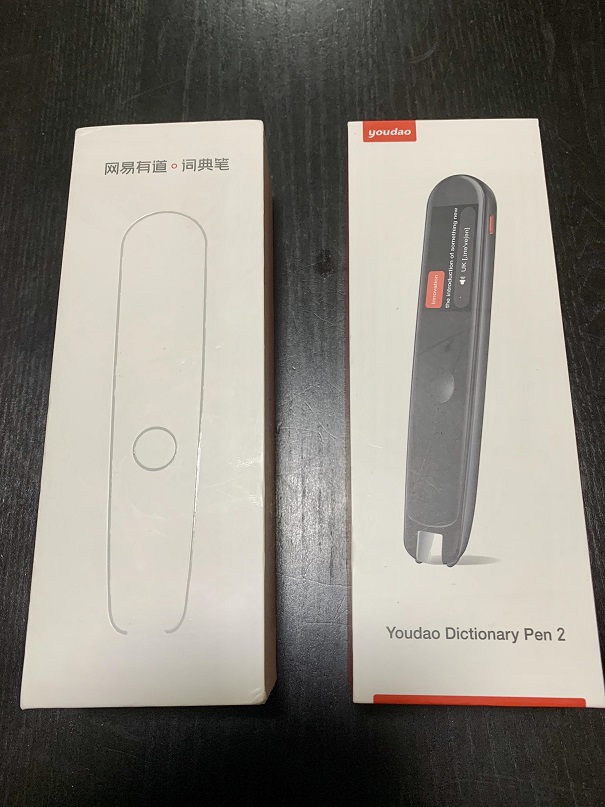
Comparison of Chinese version and English version (you can tell our pen …. the Chinese one…. has been used a lot!!)

Key difference between 有道 Youdao versions:

“Pro” Youdao pen will translate into Chinese, Japanese, and Korean. Comes at a significantly increased price tag.

“International Version” Youdao pen will have English instructions and English user interface

“Version 3”  Youdao pen comes with some more user-friendly features for kids (larger colour screen, and ability to narrate some specific books smoothly).  It also includes SPANISH along with Chinese and English.

Comparison of Youdao 2.0, 3.0, Pro and International Versions

Additional Benefits of 有道 Youdao 2.0 International Model

  • English Manual: First and foremost, the English user manual lets you actually understand every feature of the pen, and also how to troubleshoot when things go wrong.  I didn’t think I’d missed this, but now having read the full instruction manual, I realise we’ve not been making full use of all our pen’s features (such as the Chinese AI voice commands).
  • English User Interface: I didn’t think it would make a big difference, since we use a lot of gadgets at home without any English options, but after actually using the English UI, I see it makes it infinitely more accessible for non-Chinese speaking parents. and children alike. It takes the hassle / fear out of needing to upgrade the operating system, or swapping into the night mode, and not knowing how to get back out of it again. Functions such as changing from left-handed to right-handed modes, or updating the wifi settings are much easier with the English UI.  
Changing the reading mode from right-handed to left-handed is simple with the English operating system

Additional features of 有道 Youdao 2.0 Pro Models

Key Benefits of additional features on Pro version

  • Additional languages:  Chinese, Korean, and English, and it does this as CH-JP and CH-KR, which is a really interesting feature for a linguist. 
  • Additional dictionaries:  it’s possible to look up words in different dictionary versions and compare them (certainly well beyond our family’s usage case, but a very cool feature!)

There’s soon to be a 有道 Youdao Dictionary Pen 3.0 Pro launched!

Additional features on 有道 Youdao 3.0

  • Smoother reading: The pen reads a little more smoothly (but my children like the slower version on 2.0), for some selected books, in a more natural / human voice, so nicer to listen to….. however, this isn’t for all books,  I think this is a trap as it could become a crutch.  One reason I like Le Le Pen is that is reads very slowly, and thus the child only uses it when they really need to know a particular word.  So, that’s why I tend to prefer the Youdao 2.0 pen, as slower speed it helpful for a learner to really learn.
  • Single tap feature: with a tap, the pen will read a group of characters. And, for specific books, the pen will read whole phrases just with a single tap, rather than pulling the pen across all the text (for specifically linked books by Scholastic).  This makes it more like a Luka in functionality, rather than a simple a dictionary pen. For me, I’m a little uncertain about this use, as my daughter generally just uses the pen for an individual characters, as I wouldn’t want whole sentence narrated by default ordinarily. However, as for learning Chinese, a specific character can be VERY different to the meaning of the combined characters around it, an a child may not be aware. So, I’m intrigued by this feature (and hoping I know someone soon who owns the 3.0 Pen so I can really give it a try). For now, the old-fashioned slide over the text has worked just fine with our 2.0.
  • Screen size: slightly larger, colour screen (which also means battery lasts less)
  • Child lock: which stops a child from reading a full paragraph with the pen…. Although it’s never been an issue at our place, it’s a thoughtful feature.
  • Pronunciation correction feature: for English only ….. it’s designed for Chinese learners to practice speaking English words, and then performance is rated.  Again, this makes it a little like Luka (although Luka is just so much cuter and fun, in our view).
  • Spanish: all the same features for Chinese, but in a whole new language!

Cons of all 有道 Youdao Dictionary Pens

All the pens have the same cons as the original 有道 Youdao Dictionary Pen.  These include:

  • Text size: Only works on text less than 1.3 cm in size (so excludes some children’s picture books and readers)
The Chinese test in Sage Books is just slightly too large for the pen to be useful easily, but anything smaller it works a dream
  • Voice: Only has a female voice, and I do think it’s helpful to hear a variety of different voices and genders.
  • Translation accuracy: It’s really pretty good. But sometimes, just sometimes, the translations – especially specific things like idioms or name of Emperors, dynasties etc – can be incorrect, but it is SO much better than Google Translate or Pleco. One place we’ve really noticed this is when my daughter tries hopelessly to read her Chinese bible, and we get some crew/alarming translations. I’m hopeful that in future updates it will become even more seamless.
  • Pointing accuracy: sometimes I’ve watched my daughter needing to make multiple attempts to scan the same character. Whilst it’s fast, there still is a bit of a gap (versus other pens we’ve tried), which can become frustrating when repeating something a few times over.
  • Ergonomics: The pen isn’t conducive for small hands, and optical reader can be fragile (not a toddler toy!).  It’s actually really good, but it’s just not “perfect”.  Maybe what I’m looking for isn’t possible! I certainly wouldn’t be using this pen with a preschooler.
  • Fiddly to use: It takes a little bit of practice, especially for a child.
  • Lack of protective case: The pen by default doesn’t come with a protective case – this costs extra.  It’s like an iPhone, but the cases cannot be as readily bought from random vendors. Buy it at the same time if you can!
The pen struggles a bit with Biblical translations (… who doesn’t!!!). Some of the translations we’ve received has been too coarse to repeat to others, but suffice to say, it’s far from perfect

I’m still hopeful someone will come up with a pen which is *perfect* but Youdao is a nice second runner. [Post script May 2021: Yes, there is a new pen on the market which makes up for most of the downsides of the Youdao Pen. It’s called the iFlyTek Alpha Egg, and it’s currently the leading selling dictionary pen in China. Check out how we reviewed it! It’s certainly our preferred option for kids!]

Where do buy Youdao Dictionary Pen in Singapore?

in Singapore, these pens are now plentiful on Carousell, Lazada and Shopee, and most offer a 1 year local warranty. Find the best price, and go with that! Take note on the specific version you are buying though as some will have only a Chinese user interface, and others will offer English. Then some will come with written instructions in English, and others will not.

If you buy from @888flypig on Carousell, you can quote “lahlahbanana” for a further discount. There are many many authorised retailers in Singapore – one of which also includes Elite Linguistic Network (note – no affiliation, and my pen didn’t come from there either, but they dropped me a note after I made this blog post, again if you quote “LAHLAHBANANA” they will give you a 5% discount too.).

There are many authorised retailers in Singapore – one of which includes Elite Linguistic Network, who offer a local warranty of 1 year, during which a 1-1 exchange is offered for factory defects (note – no affiliation, and my pen didn’t come from there either, but they dropped me a note after I made this blog post).

Note, the cheapest options to get this pen will likely have all the interface and manual in Chinese, and it’s possible to get it all working as a non-Chinese speaker (because we certainly use ours effortlessly, without asking anyone how to get it working….. setting up the wifi and downloading the latest firmware was the toughest part).

For those OUTSIDE of Singapore, the pen can be bought from: Global: Taobao or Amazon

US: Jojo Learning

UK & Europe: Deziremi Bookstore, and special note that my blog readers in UK have a £12.00 discount if you use code YOUDAOLAH at checkout/

FAQs on 有道 Youdao Dictionary Pens

Which option do we prefer?
As we learn Spanish too, the 3.0 naturally is the best choice for our family as it contains both Chinese and Spanish.

Overall for just Chinese, the 2.0 and 3.0 are each great – I would go with the International Version for sure,  as having the English Instructions and the operating interface is a huge plus.

For the price point, I’m quite happy with our Model 2.0. We wouldn’t use any of the advanced features on the Pro or Version 3.0. Having the English Instructions in the International Version is a huge plus, so I’ve unashamedly photographed all the manuals from our friend. If I had a choice to buy again, I would choose the English Operating System, but we’re are very used to using the pen without it by now.

Does it do Traditional Chinese?
Yes, it will scan and translate from TC into English.   It will do vertically oriented text, and it will do right to left scanning.

However, it doesn’t do it in reverse, in that if you scan English, it will only convert it into SC (not TC).  Additionally, it won’t translate Zhuyin, and it gets a bit confused with vertical text if it has Zhuyin directly above it.  It’s really not compatible with this.

Will the software/dictionaries become outdated?
No, the pen connects to wifi to ensure latest system software updates, including new wods, voices, etc are included.  It’s as simple as clicking “Settings-Upgrade” and keeping the pen connected to the wifi during the upgrade (usually it doesn’t need wifi to function)

How long does the battery last?  How long does it take to charge fully?
For our Youdao 2.0 version, it lasts for about 8 full hours of continuous use (which is a really really long time, as likely a child will use it intermittently through reading …. for us, it lasts about 4 weeks!).  The battery fully charges in 3 hours.

For Youdao 3.0, it lasts for ~5 hours if used in on-line mode continuously (according to the manufacturer; we’ve not got this pen, so really unsure).

What are the options for pronunciation?
For English, it’s either British or American in a female voice.  You can choose this from  “Settings-Pronunciation” to set the default automatic pronunciation. For Chinese, it’s mainland Chinese in a female voice.

Will Youdao pen work for our family?

We’re a family where no parents speak any Chinese, and yes we use this pen daily – both my daughter, and my self, for different purposes. We read in Simplified Chinese, and generally have books with no pinyin.

I’ve read various reviews from others who use these pens in different family background. For example, Sunny from Spots of Sunshine is a fluent speaker, teaching her daughter in Traditional Chinese. Her review shows it’s less valuable in such a circumstance. Then again, Aime from Trilingual Texpats is a Taiwanese-American mother who teaches in Traditional Chinese and really likes the Youdao pen’s functionality. Chontelle from Bilingual Kidspot in Australia called it the “ultimate pen” for her children who being educated trilingually, despite not speaking any Chinese herself. I always love reading how others use the same device.

Which Chinese dictionaries and optical readers have you tried?

I would love to hear from you, especially if you have experience with other Chinese reading pens and dictionaries. It’s only through meeting other wonderful parents virtually, that this shared language journey becomes a more valuable one. All comments welcomed!

We own quite a few different reading pens (they are extremely helpful). The pen we have which is most similar to Youdao is the iFlyTek Dictionary Pen. Do refer to my previous posts for more information about other Chinese reading pens which are more suitable for younger children, especially preschoolers and encouraging early Chinese literacy – these include:

Note:   This is an authentic, honest, and unaffiliated review (as are all reviews on my blog). Our original pen came from Koala Mandarin in Novena. Refer to details in my original post… it retails at $179, although they said they’ll give you a $10 discount if you mention my blog post, I hope it works for you! 

I borrowed the other two Youdao pens from two friends to complete this post – they ordered the newer models from Youdao China, and Lazada respectively.   I have no affiliation with Youdao or any of the importers into Singapore, and neither do my friends.  This is a fully independent review, and I recommend talking to the distributer/importer/local retailer to be sure of what they’re offering, especially with regards to local warranties.

App comparison: iHuman Hongen Chinese (洪恩识字) versus Wukong Literacy (悟空识字) for learning Chinese characters

Our favourite Chinese literacy apps are iHuman Chinese Hong En Literacy (洪恩识字) and Wukong Literacy (悟空数学).  Both of iHuman app and Wukong Literacy app are designed for children who have a sound spoken understanding of Mandarin, and are starting to learn characters/words in Simplified Chinese form.  These are great apps for learning Chinese characters.

This review compares the key differences between these two apps.  

Why are apps helpful in learning Simplified Chinese characters?

Both Wukong Literacy and iHuman Go Play Chinese are games based on vivid imagery, which is helpful for memory retention of characters and radicals.   They systematically teach a child character-by-character, with iHuman going up to 1300 characters, and Wukong Literacy getting to beyond 5000 words.

Both apps are fairly similar in their design and games, and each include excellent 2 to 3 minute learning animations showing how the characters are used in words, and supported by graded e-books for the child to read.  The apps are suitable from about ages 3 upwards to tweens, although they do require a child to already be familiar with spoken Chinese.

Each of the app content covers 100% of the first-grade Chinese characters of the Mainland Chinese Education curriculum, and more than 80% of the second-grade new characters.  Think of these apps as being equivalent to the English learning apps of ABC Reading Eggs or Starfall, but obviously for Mandarin.

Note: The entire installation, payment and set up for Wukong and iHuman apps is in Chinese, so they can be hard for a non-Chinese reader to navigate (although it’s great for encouraging full language immersion!).  These post also share some tips and screenshots around how to download and use these apps.

What is Wukong Literacy (悟空识字)?

Wukong Literacy (悟空识字) is a combination of three Chinese literacy learning apps, being:

  • Wukong Literacy 悟空识字  (for learning characters)
  • Wukong Pinyin 悟空拼音 (for learning Pinyin)
  • Wukong Reading (for practicing reading passages)

(note – there is also a Wukong Math package, which we haven’t tried)

Wukong literacy app
Wukong App icons from app store

This software has been developed by Ningbo Qidian Education Technology Co., Ltd, and first written in 2009.  In China, for the last decade it’s maintained a top 10 position in the education app bestseller list.   There are more than 30 million registered users.

Wukong is named after Sun Wukong, (aka the Monkey King), who is one of the main characters in the 16th-century Chinese cult novel “Journey to the West”.  The app has been thoughtfully designed, and the illustrations and learning modules really bring the Chinese characters and words to life for a primary schooler, as the child completes their quest with the Monkey King.     

There are 15 scenes (or levels) with over 100 literacy games, and 1000 learning modules.  New words are introduced from animated stories with pictographs, which is a different approach from most other literacy apps.  Children learn a new character, and then through a combination of different exercise amd mini games, they use the character in words and sentences.

Best distinguishing aspects of Wukong Literacy

  • Child may be already familiar with the Monkey King fables, making it an instant win
  • It’s a fun way for your child to systematically learning characters, as it’s visually appealing and makes use of repetition and clever visual cues to reinforce character memorization and context.
  • Has some helpful 2 – 3 minute learning animations showing how the character is used in words, and supported by imagery to help remember the radicals.
  • Includes a weekly progress update email for parents
  • Includes a voice recognition feature to test a child’s pronunciation reading out written passages
  • It feels more like a video game than a learning tool for the most part (the screenshots below don’t do justice to the animations which are moving throughout – believe me, when I say the graphics are simply stellar)
  • This can be used on a PC too (Windows or Apple)

What is iHuman Hongen Shizi app ?

iHuman app is a combination of five different apps which can be bought/used together, or separately:

iHuman app
This is the main iHuman app you’ll want to be looking for (Hongen Shizi 洪恩识字 )
  • iHuman Hongen Chinese: (aka Hongen Shizi app 洪恩识字) for learning 1300 Simplified Characters. See picture above. This is the app you want to download!!!
  • iHuman Pinyin:  for learning the Hanyu Pinyin of all 63 elements, through interactive scenarios. This one is okay for a child who needs to learn pinyin. 
  • iHuman books: for interactive reading practice in Chinese. If you have other books, it’s probably not necessary, as the iHuman Hongen App also comes with a few ebooks too.
  • Go Play Chinese or iHuman Chinese: similar to Hongen Shizi 洪恩识字 but designed for English speaking families (i.e it’s not immersive Chinese, as instructions are in English and it’s a littler simpler). I would recommend you don’t need this.
  • iHuman Math: we haven’t used this

Below are photos of the other four apps. Please note the first one below here (“iHuman Chinese”) is not the right one. This is not immersive Chinese in the way that the one above Hongen Shizi 洪恩识字 is. It’s a little confusing. To make it even more confusing, on some App stores this english version is sometimes called GoPlay Chinese or GP Chinese. Neither is what you want. You need the tiger one!!!

Apps to learn Chinese characters for children
iHuman App icons (note the first icon is now called GoPlay Chinese ….. don’t use this one…. specifis)

The iHuman app suite has been created by Beijing Hongen Education Technology Co., Ltd, which has been making educational software for the last thirty years (quite a long time when you think about how long computers have been around for!).   There are more than 20 million registered users for iHuman.

Each of the iHuman apps is thoughtfully designed, showcasing gamified learning at its best, in a well polished and researched format. For iHuman Go Play Chinese, each level is divided into 4 units, covering each reading, writing, listening and lots of repetition.  It intended to be a comprehensive solution for children’s literacy in Mainland China, designed in consultation with 20,000 different kindergartens and schools.

Best distinguishing aspects of iHuman Hongen

  • Appealing design for younger kids (dancing penguins, pooping goats, dogs with stylish hairdos, aliens etc)
  • Includes 130 levelled online reader books, which can also be physically bought or printed
  • The company actually has an English version of their website
  • There is a progress tracker so the child can see how far through the 1300 characters or 63 Pinyin elements they are
  • iHuman follows a systematic linear map where each character is learnt, and then child progresses to the next one.
  • Not too many distractions or options to choose from, to a child stays focussed
  • App is designed to make full use of the a tablet touch screen to allow children to write out the characters and stroke order  

There’s a really detailed review of iHuman written by homeschooling mum Jean, at Mandarin Home School which is really helpful to understand full features of iHuman.

Main differences between iHuman Hongen Chinese and Wukong Literacy

 iHuman GoPlay HongEnWukong Literacy
Can a child skip levels or start at a higher grade?Yes (under parental controls)No (although a harder curriculum can be selected)
Can I select different word lists?NoYes (has several curriculums / textbooks used in mainland China)
Can I add in my own words?No No
Can I have two children on the one account? Yes No
Can be used from a PC?   No Yes
Does it enable practice of stroke order? Yes No
Does it enable voice recognition for pronunciation? No Yes
Does it include an optional Pinyin learning module? Yes Yes
Is there a version in Traditional Script? No No
Is there a version in Cantonese? No No
Number of characters covered?~1300~1300 characters; 5000 words
Cost to purchase?~USD 33 per year Or ~USD 90 for lifetime~USD 33 per 3 years
Free trial? Yes – first 20 characters Yes – first five days
Can I pay using iTunes? Yes Yes
Is there English customer support? Yes No
Are there supporting offline materials? Yes – physical books and worksheets can be bought or printed No
Comparison of key features of Wukong Literacy and iHuman Hongen

Content difference between iHuman Hongen Chinese and Wukong Literacy

Both apps are very similar, covering 1300 characters (Wukong goes a little further), using high quality animation and gamified learning.   Key differences:

  • Syllabus: iHuman goes character by character. Wukong goes sentence by sentence.
  • Stroke order:  iHuman shows this, Wukong Literacy doesn’t
  • Supporting online content: Wukong has more videos, books to read, and spoken content, which might make it more interesting for older children
  • Supporting offline learning: iHuman has worksheets for stroke writing which can be printed out, along with 130 physical graded readers/books which which follow the same curriculum as the app.
  • Quizzes: Both apps have testing to ensure a child has consolidated their learning before moving on to a harder level.  However, when there a “multiple choice” questions on character recognition, in iHuman the options make the answer quite obvious.  On contract, for Wukong Literacy, it shows really similar looking characters which increases the challenge.
  • Ability to skip levels:  This can be done under the parents portal on iHuman, but not on Wukong.  However, is a child is an advanced reader on Wukong, the adult has the option to change the entire syllabus to a harder option, so the child does’nt have to start at zero.
  • Maximum characters attainable per day: this can be specified by the parent as anywhere between 3 and 10 characters per day for both apps. 
  • Time required to meaningfully play:  iHuman can be done is very small doses (say 3 minutes to compete one game).  Wukong takes longer to complete each ‘game’ so it’s not a quick  “10 minutes a day” type of game.  Maybe 15 or 20 minutes is required in one session. iHuman also has a ‘time out’ function, where it stops the child every 20 minutes and plays a tune for 120 seconds, to encourage them to take a healthy break from the screen.

Ease of Use: iHuman Hongen versus Wukong Shizi

Both systems are fully written in Chinese, which creates a hurdle for a non-Chinese parent (but not an insurmountable hurdle). Key difference in usability functionality is:

  • Content map: iHuman follows a systematic linear map where each character is learnt, and then child progresses to the next one.  Wukong Literacy has a few different parts to where the child can play, which makes it more confusing for the adult to assess progress.   This could be a pro or con, depending on how you child likes to learn and their language competency.
  • Parent updates:  Wukong has the option for a weekly email on progress, which iHuman doesn’t really need to cater for this, as everything is easily visible within the app.
  • Customer service: iHuman offers some English customer service.  Wukong has no English support.
  • Sign up and payment:  iHuman is slightly easier for a non-Chinese reading parent to navigate, as the interface has less menus.
  • Ability to have more than one child on the same account:  for iHuman, yes.  For Wukong, no.
  • Operating system: iHuman is available on iOS and Andriod app.  Wukong Literacy is too, but additionally works on Windows PC.  This is a great benefit.

Here’s a screen shot comparing the “maps” for iHuman versus Wukong, and you’ll understand the difference in complexity:

Purchasing and Payment: iHuman Hongen versus Wukong Shizi

  • Where to download: Both are in the iTunes apps store, which makes it simple for Apple users. On android, it’s a little harder, but not too tough.

    For iHuman Hongen Shizi, go to iHuman Chinese website, and click either iTunes or Andriod to download.

    For Wukong Literacy, search 悟空识字 (Wukong Shizi) in your app store.

    Note: for Android users, you probably won’t find these simply in the app store. You’ll need to likely first need to install 应用宝 (the Chinese playstore equivalent) to download both of them, if they don’t show up in the app store automatically.
  • Cost:   iHuman is about US$33 for one year.  A lifetime subscription is ~US$80.     Wukong Literacy is cheaper, with a three-year subscription costing about US$30.  There is no lifetime option for Wukong.
  • Free trial: yes, both have this, without needing to enter any payment details.  iHuman gives a free trial for the first 20 characters, wheras Wukong gives a free trial for the first 5 days.
  • Payment methods: all instructions are in Chinese, so recommend you enlist the help of someone who can read Chinese well.  Otherwise, have Google Translate handy on your phone.  To actually sign-up as a non-Chinese reader is a minefield if you do it on anything other than an iPad or iPhone. 

    If you have access to the Apple store, you can pay through this, and then set up either a login (account number + password) or bind it with your WeChat account. You don’t need a Chinese mobile number, so just skip that step if it asks you.

    If you aren’t on an Apple, and don’t have a Chinese credit card, some readers suggest the solution is to sign up for “Alipay Tourpass” (a payment service intended for tourists to China).  We haven’t tried this personally.
iHuman app Hong En Shizi to learn Chinese characters

Tip for non-Chinese speaking Parents using iHuman Hongen Shizi

As an adult, when you try to download and pay for these apps, it can be a minefield.  Also, changing the settings in these apps can be difficult, as you’ll get a screen to verify that you’re a parent.  To verify it, you need to read the three Chinese characters, which sound similar in pronunciation to Chinese numerals, and enter the corresponding numbers to unlock the parental settings.   

Here’s a “cheat” table for that aspect:

1
2
3
4
5
6
7
8
9

If you want iHuman installation and download instructions in English,  including screenshots, I’ve written some more details on a guest post which I wrote for Bilingual Kidspot (another excellent bilingual parenting resource), which can be found here.

Which character learning app suits my child better?

Each app systematically covers 1300 words, focusing on character recognition through play, and it includes test reading, writing and comprehension activities.  Neither of them is a curriculum per se, but they are great for reinforcing character learning and give a fun outlet to practising Mandarin.

We used both apps together, essentially as alternative games for the children to play. However if only choosing one, I would recommend the following:

  • Wukong Literacy:  best suited for above 6 years old, given the game interface is more complicated (ie many different segments to play in, and a lot of choice given to the child).  Wukong Literacy also have the option of selecting specific curriculums and wordlists (such as HSK), which might make it a good companion to specific syllabus a primary age child is learning from.  Being able to use this on a PC could be helpful too, for families trying to limit tablet time.  Wukong also goes deeper in terms of using the characters in wider literature and reading, although the interface feels more like a game than iHuman.

  • iHuman Hongen Shizi: for a child anywhere from 4 years old, as simpler interface would be more appropriate for pre-primary (or a child who is not so familiar with apps and games).  iHuman also has the Pinyin model, which is great for kindergarten learning, along with character writing modules, which is great for learning stroke order.
    In iHuman, it’s also possible to go back and review characters again, which is a nice feature for adult-child learning and revision together.  This isn’t possible in Wukong.  For some reason, my kids gravitate more towards iHuman.

For a younger child (3 to 7 years old), I would highly recommend Maomi Stars – and this has the added feature of being able to add your own words.

Are you still reading?

This has been one LONG post. Thanks for sticking with me! If you have any thoughts or suggestions on apps, I’d love to hear from you. I always keen to hear what works for other families.    As an adult who speaks no Chinese, I’ve resorted to several smart technologies to enable my kids to become bilingual.  Perhaps some of my earlier posts might also be of interest:

Parent review: LingoAce online Chinese class

This is a detailed and genuine review of LingoAce, an online Chinese learning service.  In this post, I’ve tried to compare the differences between the various LingoAce offerings, and also make comparison to other online learning platforms that we have tried, to allow you to make an informed decision of the best fit for your family.

In 2020 we tried the LingoAce Singapore Online programme (which aligns to Singapore’s Ministry of Education curriculum), and this year, we’ve tried the LingoAce Advanced Program (which aligns with Mainland China’s Ministry of Education curriculum).  This post also compares the different syllabus options available at LingoAce. The options are actually incredibly different, and now having tried both versions out, I totally understand why so many blog readers were explaining their experience was different from ours!

[Post script: This original review was written in 2020, however see our update 2 years later to see how we’re continued our learning]

What is LingoAce?

LIngoAce review

LingoAce is a Singaporean edtech startup, providing an online platform for learning Chinese, in a fun and engaging way, targeted and children aged 4 – 15 years old.  It was founded by an entrepreneur and parent, Hugh Yao, who was endeavouring to make language-learning engaging for children.

First founded in 2017, the company has grown fast – and now has offices in China, United States, Indonesia and Thailand, along with Singapore.  They have taught nearly 100,000 students, and have close to 2000 current teaching staff, mainly in China and Singapore.  For a Singapore startup, this is a mightily impressive feat!

How did we discover LingoAce?

Certainly the COVID crisis caused many families to pivot to online learning, which was exactly how we discovered LingoAce too.  The experience was much better than we could have ever hoped for.

About a year ago, during the height of the Singapore lockdown, we started our journey to trial several online Chinese language tuition services.  For us, this was a necessity, as without it there was no one else that my children could converse with in Mandarin, and no way for us to continue with home-based learning (as it’s impossible to learn a spoken language from a textbook).

After our first Lingo Ace trial, my daughter had really wanted to sign-up for these classes after our successful trial, but at that stage, the sales consultant advised that classes must be a minimum of twice a week, and I realised it was all going to be too much for our timetable. 

However, after this very positive experience of LingoAce services, I’ve kept an eye on LingoAce and looked out for their online holiday programmes and other options which might fit our schedules better.  Last month, I was intrigued to see whilst walking in 111 Somerset to see a wall-sized advertisement advertising that LingoAce had a physical premises upstairs in the shopping centre.

It was from here that I wandered upstairs, and rang the doorbell of the newly renovated centre and learnt about LingoAce’s significantly revamped offerings in Singapore.  I found out this new physical centre is targeted at P5 & P6 for offline learning, meanwhile the entire online product suite has also been refined and repackaged from our initial trial.  Hence why we tried it out again!  And again, my daughter thoroughly enjoyed it (again!).

I took the above photos at the LingoAce Chinese Learning Centre in Singapore located centrally on Level 4 of 111 Somerset. the Luka Reading Robots on display too, which made me instantly feel at home!

What courses are offered by LingoAce?

LingoAce essentially has four main course streams for its online classes:

  1. Singapore programme: aligned to the Singapore MOE Chinese curriculum (called the ‘Bilingual’ programme when offered in other countries)
  2. Advanced programme: Chinese HSK syllabus: following the mainland Chinese elementary curriculum
  3. International syllabus: for non-native speakers, and nascent learners, aligned to YCT curriculum, focused on oral proficiency

The course and its delivery are substantially different depending on the stream chosen.

We tried the Singapore stream in 2019, and this year, we’ve tried the Mainland China stream (which surprisingly was closer to what I would be looking for in a Chinese enrichment class, although I also note I’m a bit of an anomaly in this regard, as many parents do just want to focus on acing the school work and focussing on PSLE outcomes). Each course options has its positives, depending on the learning outcomes desired by the family.

The table below compares the main course options offered by LingoAce.

Comparison of LingoAce Chinese classes
Comparison of class programs offered by LingoAce

In addition, to support the Singapore offering, they have a special pinyin course, a PSLE “blended learning” options with in-person classes at their Orchard campus, and one-off week-long camps during school holidays (focused on academic excellence such as Composition Writing, PSLE practice exams, etc workshops). For participants who sign up to the Singapore-based classes, there is a special “Welcome Pack” sent out, containing the written homework, and a few other treats.

Below is a comparison of the different class types within the Singapore Programme Suite:

Comparison of LingoAce Chinese classes
Comparison of specific class types offered by LingoAce specifically in Singapore

How did we find the MOE option versus the HSK option?

Singapore Online Programme (aka Bilingual stream)

My daughter just loved her trial class in early 2020, which was based on the Singapore LingoAce syllabus.  We did a P2 level class.  The trial class had two other participants, and the entire 55 minutes was filled with games to write characters and put them into sentences.  The online interface was stunning and visually appealing, with trophies and points being awarded interactively to the children throughout the lesson.   Their curriculum follows the Singapore MOE Chinese approach, and it’s a great source to revise the regular school classes.  If a child is competitive, and enjoys interactions with other children, this is a fun and interactive learning approach incorporating a lot of animation and gamification.

The 55 minutes is essentially just a long online game reiterating the primary school syllabus, including hanyu pinyin, composition writing, oral and even practice exams, etc.  Being banded by year level in MOE, it ensures that online learners are have a similar language proficiency, which is not necessarily the case in other online platforms.   Had we chosen to go ahead with these classes, they would have been 2 x per week, at fixed times weekly.  There’s also homework, including on physical paper.

This format of racing to get the ‘right’ answer, and filling in the blanks, etc is a fun way to practice ‘scoring well’ in typical school-based assessments in Singapore. 

LIngoace Homework
A physical book is provided for character writing practice, to complement the online learning, and homework is graded by the teacher
Advanced Programme (aka Mainland China stream)

We trialled this in early 2021.  My daughter (who is in P3 in local school) was recommended to try out the Grade 2 Mainland Chinese class, after doing an initial placement review with the course consultant.  The structure is less about games, and has more interaction with the teacher, and individual sentence construction and writing, including using pen and paper.  We were also able to choose the teacher from a list of suggested options (all native Chinese-speaking teachers with dual certification in Mandarin and teaching).

My daughter also really enjoyed the class, and I felt it went much deeper than the Singapore MOE options.  This was partly due to having less children in the class, but primarily because the format focuses on using the language rather than revising the school vocabulary and comprehension, etc.  The downside for us was that the class teacher herself didn’t speak any English, so for me, it was impossible to understand the feedback at the end of the class (however the English speaking sales consultant did assist afterwards to follow up).

They also provide the recordings of the lessons, short video stories, and online homework game that the child can complete and let the teacher check.

I’m showing below the character lists for the Grade 1 and Grade 2 LingoAce Advanced Programme.  You’ll understand from this how the Mainland Chinese level is above the equivalent year level in Singapore system.

Lingo Ace character list
Grade 1 characters from Mainland Chinese Ministry of Education syllabus
LingoAce character list
Grade 2 characters from Mainland Chinese Ministry of Education syllabus

What else is there to know about LingoAce?

Booking Process: Simple. Just contacted through website, and they followed up with SMS to schedule trial class timing.  They have English speaking sales consultants in Singapore, and also a physical office.  Bookings of the actual classes can be done through their portal, with selection of preferred teacher.

Software: Web interface (driven by Classin Software). Simple to login and use. Fast speed, not laggy.

Customer Service: All the interactions were very helpful, although you do get the feel this is a very big organisation, with lots of different staff member.  The sales initial rep we were assigned was very keen to follow-up, and had quite a strong “sell” strategy to offer me packages and discounts which were only valid “for today only, sign up now”.  Whilst I don’t like on-the-spot sales, I do feel they ultimately really listened, and tried to accommodate my request to only schedule a class once a week, not twice, and find a level which best suited my children. After signing up, the parent is assigned an ‘educational consultant’ which moves the focus away from sales, and more to class scheduling, follow up, etc.

Programme and pricing packages constantly updated:  LingoAce is a fast growing company, the different classes and offerings from LingoAce are rapidly evolving. We did their classes in mid 2020, and early 2021, and this recounts our experiences from the time.  Please do contact the company to get their updated offerings and be sure to ask for special promotions.

How does LingoAce compare with other online classes?

We’ve tried several online Chinese classes (see my earlier reviews here with a detailed head-to-head comparison of Lingo Ace, Lingo Bus, Koala Know, Vivaling and Speaking Duck).  I do feel the larger platforms like LingoAce or Koala Know have excellent models for delivering engaging content and gamified learning experience through the screen, and can be more effective than classroom learning. Who would have imagined one year ago that our lives would go totally online?

LingoAce Review from a Singapore perspective, LingoAce is the only online platform which focusses specifically on Singapore curriculum, and it’s the only one with MOE-accredited teachers. It goes from preschool through to PSLE level.  This would be a good programme for those looking for something to support and reinforce their child’s learning in the classroom.

LingoAce Review from a global perspective, LingoAce is the only online platform I’m aware of which goes all the way up to Grade 6 mainland Chinese elementary level.  The next closest option is LingoBus, which I understand has recently launched a Grade 5 pilot programme (in its Heritage Chinese stream).  The LingoAce Advanced programme is laregly similar to the LingoBus Heritage Programme; and the LingoAce International programme is similar to the LingoBus non-heritage programme. But, all LingoAce classes are 1-on-1, not group style.

We’ve also done a number of online non-academic classes taught in Chinese, ranging from art and craft, through to drama, and music.  If you’re interested in understanding other online offerings which we’ve tried and enjoyed, see my earlier posts with summarises different classes we’ve done.

Which LingoAce course would be best?

For a family with a student in a local Singapore school, who needs regular extra revision or support of the syllabus, then the Singapore stream is excellent.  It really mirrors the structure and learning pace of the MOE school syllabus, and gives a lot of exposure to exactly what would be taught in the school classroom. The structure systematically follows the MOE requirements of Oral, Comprehension and Composition.  It’s a lively small group class, at fixed times, and encourages interaction with the other students.  The focus is to achieve great marks in school, especially PSLE.  

For a family with a child who has an advanced level of Chinese, and needs a good curriculum to continue learning, the Advance Mainland Chinese stream is the best way to receive 1-on-1 class with the teacher, which goes deeper than the Singaporean MOE syllabus.  As my hope is for my daughter to be truly bilingual and biliterate, I prefer this as a programme for learning the language for life, rather than learning to ace the school exams.

For a family with a child who has an interest in Chinese, and perhaps learns it at a basic level at an international school, or would like to start learning it, then this is exactly what the International stream is designed for.  We didn’t trial it, as my children are more advanced than this, but I understand from others that it’s a fun-filled, theme-based class.

Here is a referral link to a LingoAce free class trial (worth $40), and if you like it and sign up for 24 classes this link will give you four free additional class credits. If you sign up for 96 classes, it will give you 15 free additional classes credits (and it will give the same to my kids which is much appreciated, as I spend way too much money on online Chinese classes for my 3 kids!).  Be sure to think about which class type would suit you best, so as to not waste the one free trial.

What about you?

Thanks for reading this LingoAce review. Which online classes have your family tried and enjoyed? I’d love to hear your view on LingoAce or other options which you have tried. All feedback and comments are welcome!

If you got to the end and found this helpful, maybe there are some other posts on my blog you might also enjoy. As a parent who doesn’t speak any Chinese, we’ve relied heavily on online tools, clever robots and recommendations of others in our Chinese learning journey. Some of my earlier posts are:

Disclosure: I only share products and services we have personally used and love. We did these classes as free trials initially (as we also did also did with Lingo Bus, Koala Know and Vivaling) – you can do this too! It’s not a privilege reserved for bloggers. Most online Chinese tutoring services will offer a free trial class. Try to use someone else’s referral code too, to get the most benefit. I would advocate that you also make the most of the variety of free trials available, to choose what works best for your family.

Please know that I only recommend learning resources on this blog which our family believes are genuinely helpful….. there’s no affiliation, commissions, or money being made here at all! It’s simply the passion of sharing!

Great Chinese Cartoons for Children to enjoy

Series originally written in Chinese (not dubbed)

This posts summarises our favourite animated series from YouTube in Mandarin, for children.  These are series which are all originally written in Chinese (i.e not translated from US), and have an subtle educational focus, relevant for aged 4 to 10. 

After my last post about non-animated television series for children in Chinese, a few readers asked about a list of resources for Chinese cartoons (aka 弟子規動畫卡通).   For non-native Chinese families like ours, television has been a key part in our journey to provide exposure to the spoken language, and serves as a good motivation for them to want to understand the language, and can be educational too. 

Whilst there are plenty of options to have Chinese audio on many Western cartoons (Netflix, Amazon Prime, Starhub, Disney Channel, etc), this list focuses exclusively on shows written in Chinese, which originate from China/Taiwan/Malaysia.  I favour this, as they tend to contain more Asian cultural context, and importantly, teach things like idioms, which are important for a child learning Chinese to understand.     Even elements like the landscapes or oriental soundtracks are a helpful touch to appreciating the beauty of the Chinese culture.

I’ve literally spent years looking for accessible content, and below are our best finds.  These are all appropriate for pre-schoolers, and whilst nascent learners may not understand everything, I found this an effective way for my children to increase their exposure to Chinese audio in the home. Non-animated shows have certainly been the most effective, but animations can be fun too.

The shows are divided broadly into topics of:

  1. Cartoons with slower/simpler dialogues for non-native speakers
  2. Cartoons featuring Chinese Culture
  3. Basic literacy
  4. Life skills
  5. Idioms

Please note: the links below are to Youtube content.  Youtube may contain advertisements (unless you pay to subscribe to the full Youtube app, or you have a good net nanny app).  Not all advertisements on Youtube are family friendly, so I would recommend using them with care, and putting appropriate filters on the access the children have.

Simpler and Slower Chinese Cartoons for non-native speakers

 Xi Yang Yang 喜羊羊与灰太狼

The Xi Yang Yang Chinese animated cartoon series is actually available free to air in Singapore, which is how we got started watching it.  The plot revolves around a group of goats who are continually threatened by a big, bad, clumsy wolf.  The show has been running since 2005, and rates as one of China’s most popular and lucrative cartoons.

Target age: 4 – 8

Why it’s good from a Chinese learning perspective:

  • Repetitive words, which is helpful for beginners
  • There are also other spinoffs (like a movie, books, etc) if children really like this show.
  • For some reason, this show is a real favourite in our household

Big Ear TuTu

Big Ear Tutu cartoon is designed for pre-schoolers in China (although my daughter was shown it first by her P2 Primary teacher), and features lots of silliness.  The story revolves around a curious young lad who asks a lot of questions, and his parents give him lots of opportunities to nurture his curiosity.

Target age: 4 – 8

Why it’s good from a Chinese learning perspective:

  • Short: only 12-minutes
  • Relevant to a child; each episode revolves around Hu TuTu, in situation a child can relate to like making new friends in school, and the family coping when Tu Tu’s mum goes back to work.  Large doses of humour included.

The Adventures of Little Carp小鲤鱼历险记

The Adventures of Little Carp is a show about the misadventures of a baby fish – it’s a little like Finding Nemo.  The cartoon has lovely graphics of the ocean and sealife.

Target age: 5 – 10

Why it’s good from a Chinese learning perspective:

  • This uplifting story is about resilient and positivity, based on a Chinese folktale (called “Carp jumps over the dragon gate”) with a fantastic musical backing
  • There are 52 episodes, so it will keep your child entertained for a very long time!

Google for the show, I’m unable to link it here

Little Fox

Many parents rave about Little Fox, which has a seemingly endless collection of animated stories and songs in Chinese. 

Target age: 3- 6

Why it’s good from a Chinese learning perspective:

  • So much content, and the videos are accompanied by Chinese subtitles and hanyu pinyin 
  • Comprehensive selection, with new content daily

A similar channel for older children is beimeicn. This has a wealth of content from songs to classic stories, and science explanations all in animated form.

Cartoons featuring Chinese Culture

Junior Master 少年师爷

Junior Master (also translated as Little Counselor) contains 520 episodes following a young boy fighting injustices in the Ming and Qing eras.  The shows are filled with Chinese culture, from their clothes and hairstyles, through to the soundtrack and landscapes (stone bridges, awning boats, etc).  This particular linked version has Chinese and English subtitles.

Target Ages: 7 – 10

Why it’s good from a Chinese learning perspective:

  • Great glimpse into Chinese history, and beautiful imagery from ancient China (especially the Jiangnan Water Village)
  • Written with a sound educational pedagogy, including references to many history legends and stories, along with Chinese culture and wisdom.
  • The plot is wonderfully creative, with some lovely background songs too

HeavenKid 弟子规 – 天庭小子-小乾坤

HeavenKid is an award winning series, produced in Taiwan.  It’s based on a Chinese novel called Di-Zi-Gui, which was written in the Qing Dynasty.  It’s based on the ancient teachings of Confucius, that emphasis good morals and living in harmony.  But, it’s not boring or preachy!

Target age: 4 – 8

Why it’s good from a Chinese learning perspective:

  • Really shows historical Chinese culture – I find this aspect of traditional Chinese culture is more prominent in Taiwanese origin cartoons than those from Mainland China, which tend to be more modern and cutting edge.
  • Teaches good lessons about morals, virtues and discipline in a fun way
HeavenKid, with English subtitles

Daddy, where are we going? 爸爸去哪儿

This is an animated version of the reality drama which features celebrity dads who go on outings with their kids, whilst the mothers are away.

If your children enjoy this, you could then transition to the non-animated drama series, once children are familiar with the story and key characters  

Target Age: 4 – 8

Why it’s good from a Chinese learning perspective:

  • It’s a good “baby step” to transition into non-animated dramas
  • The non-animated version is here
  • Animated version is here

These are Youku links, so I haven’t embedded them into this blog post

Journey to the West 西游记

Journey to the West is a simplified cartoon version of the classic Chinese novel about a shape-shifting monkey on a kung-fu quest for eternal life.  There are plenty of versions of this, but our favourite is found on  华语大动漫频道

Target Age: 4 – 8

Why it’s good from a Chinese learning perspective:

  • Relates to a classic of Chinese literature, and gives Chinese cultural context: Journey to the West is a cult classic, in fact, it’s said to be one of the world’s greatest fantasy novel.
  • Possible to reinforce other leaning:  this story is accessible in many forms of simplified books for children, and there are also non-animated versions of the show.  So, it’s possible to use this cartoon to encourage book reading (or vice versa) and the cartoon version might be a better way to get the children familiar with the story, prior to moving to the non-animated version which is here
  • Teaches values such as courage and perseverance

It’s worth noting that this does (very subtly) cover large elements of Buddhism, and history of Buddhism, with the plot focussed around a search for precious Buddhist sutras that will bring enlightenment to the Chinese empire.  It’s helpful to be aware of this, and it may not be relevant for all families.

Cartoons for basic Chinese literacy and Character learning

Sesame Street in Mandarin

“Fun Fun Elmo” is a ten-minute programme, entirely in Mandarin, designed to teach younger children the basics of the language, including basic Pinyin tones.  There are 26 episodes in total.

Target age: 3 – 5

Why it’s good from a Chinese learning perspective:

  • Designed by early childhood language experts
  • Episodes are short
  • Contain familiar characters from the US Sesame Street series

漢字說故事  Chinese Character Stories 

This channel has nearly 100 short animated videos giving background to individual Chinese characters.  Good for a child starting out the language.  Each goes for about 3 – 4 minutes.

Target age: 3 – 5

Why it’s good from a Chinese learning perspective:

  • Gives a pictorial grounding for the Chinese characters, with many of these animations based on from the historical oracle bones
  • Episodes are short
  • Characters are easy ones for a younger child to recognise

Cartoons emphasising life skills

Qiaohu (or Ciaohu) 巧虎TV 

Qiaohu is a popular educational show originating from Taiwan for children.  It’s largely designed as a subscription-based channel, although there are a few free clips on Youtube (on the official site, they’re all less than 8 minutes long, but it is possible to google and find full episodes).  Buying the DVD set in Singapore relatively cheap.   The show features a mix of animation, and live puppets/mascots, with plenty of rhymes and dancing, appropriate for younger age groups.  It features everyday routines and lifeskills for younger children (like handwashing, hair brushing, manners, etc)

(Note – this series actually originated in Japan.  It’s the only one on this list which doesn’t have a Chinese origin to it)

Target age: 2 – 4

Why it’s good from a Chinese learning perspective:

  • I love Taiwanese children’s shows as they have excellent way of engaging the audience, and it’s great having some real people & mascots mixed in amongst the animations
  • There is a matching magazine / bookset which can also be bought through subscription (although the Simplified Chinese version is a little hard to order direct into Singapore; you’ll likely have to go through an agent)
  • If you’re buying the DVDs, look out for the older episodes as  they have more of a studio ‘live tv’ approach, rather than the more recent which are computer animated cartoons.

Baby Bus 宝宝巴士  

My daughter told me that Baby Bus is one of the most popular Chinese kids shows in China, and I had to Google it, but she’s right.  This is an animated series targeted at pre-schoolers in China, featuring two pandas who teach simple life skills.  The shows has very simple animations with plenty of songs, stories and nursery rhymes.  It’s a good next step about Baby Shark!

Target age: 2 – 5

Why it’s good from a Chinese learning perspective:

  • Topics covered are broad, such as being neighbourly, arts and craft, health and safety (like brushing teeth, washing hands)
  • Very suitable for beginners, although episodes are long (one hour) so might be better split into a few viewings
  • Other apps and supporting games (if allowed in your family!)

UncleWhyTV

This channel is designed by a Malaysian Dad who prefers his child to watch educational shows on YouTube.  This series shares photographs of nature (not cartoons), overlayed with interesting facts about animals and nature.

Target age: 3 – 5

Why it’s good from a Chinese learning perspective:

  • It’s slow moving, and great for a child who isn’t used to much visual stimulus on the screen
  • Opportunity for a child to gain general knowledge learning and get the answers to many interesting questions, like “Why does an elephant have a trunk?” or “Why do people wear shoes?”.

Cartoons featuring Chinese idioms

Rock TV: 兄妹俩成语故事

These aren’t entirely ‘fun’, but if you’re trying to expose the children to idioms this is a relatively funny spin on them (….. it’s all relative).  The RockTV channel is created by a Malaysian, with a love or animation. Chinese idioms are introduced in short animation videos about a pair of sibling characters.

Target age: 5 – 8

Why it’s good from a Chinese learning perspective:

  • Light-hearted way to introduce idioms
  • Short videos, which are slow paced and clearly dictated

Another very similar channel is Yoyo TV:

For more great suggestions on free Youtube series relevant for children, see MamaBaby Mandarin, which lists lots and lots of Chinese series, although not all are Chinese origin. This previously was my go-to list to find Youtube series.

Other places to find great Chinese television content for children?

China’s a big country, so obviously they have a lot of excellent shows.. You can find great free content from CCTV Kids …. otherwise called CCTV Channel 14, which is a Mainland Chinese official media channel. They have tonnes of great programming to stream (like the equivalent of Sesame Street, Fat Cat, Teletubbies, Cooking shows, Wiggles, right through to soap dramas and content for older kids etc). One tip which a reader gave me is to put CCTV少儿 and 巧虎 on YouTube Kids and restrict it to only those channels.

Additionally the little red dot Singapore has some good Chinese series too, with local on-Demand TV series made freely available. Check out the Kids > Language > Chinese section. There are quiz shows, cooking shows, art, etc. Some favourite of ours are “Little Achievers” about children who overcome bad habits, and “Little Food Hunter” about favourite foods in South East Asia.

What are your favourites?

I would love to know your family’s favourites too.  Please share, and I’d love to add them into my blog, or link to your blog too.

If you have arrived at the end and found this helpful, maybe there are some other posts on my blog you might also enjoy. As a parent who doesn’t speak any Chinese, we’ve relied heavily on online tools, clever robots and recommendations of others in our Chinese learning journey. Some of my earlier posts are:

Chinese kids shows: best non-animated

This posts summarises our favourite non-animated Chinese kids shows and Youtube series for children in Mandarin Chinese, suitable for aged 3 to 10 year olds.

The value of watching kids shows in Chinese

For families like ours without any Chinese speaking adults in the home, television has been a key part in our journey to provide exposure to the spoken language, and serves as a good motivation for them to want to understand the language.  We’ve certainly noticed additional benefits from focussing on non-animated Chinese kids shows (as opposed to cartoons), as the content tends to feature more practical content, Chinese culture, modern conversational lingo, and show real people interacting with the language.

After reading a detailed post at Chinese Speaking Kids about their suggested non-animated shows, we started exploring these recommendations and discovered plenty more for ourselves.  Not every show we tried was a winner, but we’ve found a few series in Mandarin which we’re really enjoying. 

Here are our family favourites, and the matching YouTube. We must have tried >50 series, but these are our top ten finds, which are now on regular rotation, with some notable mentions to other similar shows. As an adult with no knowledge of Mandarin, I’ve also enjoyed watching Chinese kids shows and have picked up little bits here and there too.

The Chinese kids shows covered in this post cover a variety of genres and eras:

Chinese Drama:

  • Magic land 小伶魔法世界
  • Daddy, where are we going? 爸爸去哪
  • Journey to the West 西游记
  • Star of Tomorrow 小戏骨

Current Affairs for Children:

  • 小主播看天下WOW (Little Anchor See the World)
  • Mama Laoshi 媽媽老師

Game Shows:

  • Brothers on the Run 奔跑吧兄弟
  • YOYO Super Story

Lifestyle Shows:

  • Xiaoling Toy 小玲玩具
  • Happy Little Chef momo親子台 | 快樂小廚房
  • Lingco Family Summer: 伶可家族夏天

The content we have viewed is relevant and appropriate for younger children in terms of topics discussed and language used (please let me know if you see something your feel isn’t, and I’ll remove it).  Some of the Youtubers are on the more ‘chatty’ / ‘casual’ side of vocabulary, as they’re conversational reality TV style.

Please note: the links below are to original content by the original content creators.  Youtube may contain advertisements (unless you pay to subscribe to the full Youtube app, or you have a good net nanny app in use).  Not all advertisements on Youtube are family friendly, so I would recommend using them with care, and putting appropriate filters on the access the children have.

Chinese Dramas for Children in Mandarin

Magic land 小伶魔法世: Wizarding School

  • What: Think of it as a cross between Harry Potter and Glee.  Lots of songs and dancing, with storyline relating to young students at a school for magic.
  • Target Age: 4 – 12

YouTube link:

Why it’s good from a Chinese learning perspective:

  • Catchy music and lyrics: My children love the music in Magic land 小伶魔法世界 (both singing and dancing), and I’ve started to overhear them singing these songs to themselves whilst playing or having a meal.   Ms Claudia Lim wrote a great post this week with a list of Mandarin pop songs for children, which has been shown by research to be a highly effective language learning tool.
  • Ongoing dialogue:  the actors never stop talking or singing.  It’s an overload of spoken audio, recorded clearly and professionally.
  • Tonnes of episodes:  my job in finding new Youtube was done once we stumbled upon this series!  I like to find series which have enough content (say 40+ episodes) to last for weeks/months of viewing, and this one ticks those boxes.

I want to point out here for older tweens/teens that enjoy music drama, they may enjoy Produce Camp 创造营 which I discovered recently from the blog Karen’s Chronicles.  It’s a popular trending reality show in mainland China, featuring building a boy band or girl band (they alternate each season), and seems to have a good mix of engaging banter/storyline and singing.

Daddy, where are we going? 爸爸去哪

  • What: A reality drama featuring celebrity dads who go on outings (or just babysit) with their kids, whilst the mothers are away.  Parts of it are a little slow, but after I insisted the children just stick with it for an episode or two, we started to get into it.   The series is based on the original South Korean reality show “Dad! Where are we going?”.
  • Target Age: 4 – 8

Youtube link:

Why it’s good from a Chinese learning perspective:

  • Features real children:  My kids seem to respond well to shows which feature other children; it’s a way to show them that young children can speak Chinese well. 
  • Builds on from a cartoon show:  There is an animated version of this show (Baba qu nar? 爸爸去哪儿?  ) which might be a better way initially to get the children familiar with the story and key characters, prior to moving to a reality drama.

Journey to the West 西游记

  • What:  This one is included more for me than the kids.  It’s a dramatization of the classic novel about a shape-shifting monkey on a kung-fu quest for eternal life    As a child, I grew up watching Monkey Magic, and thinking the special effects are amazing.  My children have put up with me, as we’ve re-watched this again together.    
  • Target Age: 7+ (unless a child is really familiar with the story)

YouTube link:

Why it’s good from a Chinese learning perspective:

  • Give rich Chinese cultural context: Journey to the West is a classic of Chinese literature, and in fact, it’s said to be one of the world’s greatest fantasy novel. It’s alluded to in so many aspects of the Chinese culture, that it makes sense for a child to know this story.
  • Possible to reinforce other off-screen learning:  this story is accessible in many forms of simplified books for children, and there are also many animated version of this show (one we especially like is here 华语大动漫频道 -童真趣味 奇异冒险.)  It’s possible to use this video to encourage book reading (or vice versa) and the cartoon version might be a better way to get the children familiar with the story, prior to moving to the non-animated version.

It’s worth noting that this does (very subtly) cover large elements of Buddhism and the religion’s history, with the plot focussed around a search for precious Buddhist sutras that will bring enlightenment to the Chinese empire.  It’s helpful to be aware of this, and it may not be relevant for all families.

Star of Tomorrow 小戏骨

  • What: Star of Tomorrow 小戏骨 is a series started in 2015 by Hunan TV, using child actors (aged between 6 to 12) to remake successful Chinese TV series. These include Mulan, The Red Chamber, Legend of White Snake, etc.
  • Target age: 6 upwards (adults will enjoy it too)

Why it’s good from a Chinese learning perspective:

  • The child actors and the things they get up to are most inspiring:  For sure your child would want to appear on this series too, which means practising their Chinese!
  • Classical Chinese stories in an engaging format:   Whilst the story and setting are true to the original versions, the Star of Tomorrow includes upbeat music and many familiar Western songs too, which a child may be familiar with (for example, the Mulan remake includes songs from Frozen and Aladdin too).    

Current Affairs for Children in Chinese

小主播看天下WOW 

  • What: A Taiwanese current affairs shows for kids.  It’s a similar concept to the English show ‘Behind the News’ if you’re familiar with that.  Usually there are a few stories about world issues and topical events. 
  • Target Age: 7 – 12

YouTube link:

Why it’s good from a Chinese learning perspective:

  • Focuses on current affairs: Admittedly, this show is not a favourite at our place, but it’s tolerable, and a good way to get some focus on current world events.
  • Always has new content, purposefully researched for children:  New episodes are put out multiple times a week, and I can be sure that they’re all curated by experts and safe for children’s viewing

Mama Laoshi 媽媽老師 

  • What: Mama Laoshi Nancy uploads great short videos (~10 minutes) made with her daughter, about fun topics, usually with a real-world learning element, like picking apples, the snow season, science of germs, science of poop, biology of giraffes etc.  My younger children really enjoy this. 
  • Target Age: 2 – 7

Youtube Link:

Why it’s good from a Chinese learning perspective:

  • Clear engaging dialogue, without interruptions, and fully visible faces:   There’s no background noise, no talking over each other, no visual distractions.  It’s a thoughtfully recorded dialogue between a mother and child, and especially great for younger viewers and beginning language learners.
  • Sound educational focus in each video:   Mama Laoshi really has gone to large extremes to put sound pedagogy behind her videos – it’s really wholesome content.   Blogger Craig Watts wrote a great post about how he uses Mama Laoshi videos in his homeschooling approach .  He shares how a ten-minute Mama Laoshi video can be turned into a 20-minute lesson with his children.  The downside if that there aren’t many of these videos.

Chinese Game Shows for Children

Brothers on the Run 奔跑吧兄弟

  • What:  We learnt of this interesting game show concept from Singaporean blogger GrowingHearts123 .  It’s a family variety show, with lots of physical outdoor challenges and missions, with lots of mud, slide, underground tunnels, etc.   This is a spinoff of a popular Korean show “Running Man” from South Korea’s SBS TV .
  • Target Age: 7+ (adults may enjoy it too!)

Youtube Link:

Why it’s good from a learning perspective:

  • It’s both educational and entertaining:  So much so, that we forget we’re watching something in Mandarin!
  • It features the outdoors:  I’m always hoping my kids will spend more time outside, in the sunshine, and getting dirty.  This game show is shot in the great outdoors, in various settings around the world, including China, Australia,  Czech Republic, South Korea, Austria, United States, etc).

Another gameshow we tried watching is YOYO Super Story  which is a studio-based game show for younger children.  I was won over when I saw it featured classic cartoons like Astro Boy, however my children we less enamoured with it.  I suggest it’s worth a try through for a child who enjoys quiz style game shows. 

Lifestyle Shows for Children

小玲玩具 Xiaoling Toy:  

  • What: Short fun videos (5 – 15 minutes) featuring two dramatic sisters opening new toys, or getting dressed up, and trying new foods (mainly junk food).  My kids find is hilarious.  It’s an instant hit.
  • Target Age: 5 – 12

Youtube link:

Why it’s good from a Chinese learning perspective:

  • Non-stop Chinese dialogue:  The two main characters converse constantly in Mandarin, at quite a fast pace, with large doses of slang and laughter
  • Uses situations and words highly relevant to a child:   The content is so perfect for children, especially girls aged 4 – 10.   Jie Jie Xiaoling is doing things which many children would be excited about, such as ballet, craft, dressups, opening up new toys, putting on makeup,  etc.    

For children who like ‘toy unboxing’ shows, there’s a similar concept also called ShuShu Toy Review 乖宝奇趣秀 .

Happy Little Chef momo親子台 | 快樂小廚房   

  • What: A parent-child cooking show, and the contents are mainly healthy!
  • Target Age: 3 – 10

Youtube Link:

Why it’s good from a Chinese learning perspective:

  • Features children in very familiar scenes:  the children are cooking with their parents, and buying fresh produce from the markets, etc.  There is always an educational component, like the show a picture of the cooking ingredients and talk about what it is, why it is healthy, where is grows, etc.
  • Promotes healthy lifestyle and values:  These families cook to create delicious and healthy dishes, and also use good manners at the shops, etc. 

If you children enjoy cooking, another similar concept is also a Taiwanese show Let’s Cook 料理甜甜圈  

Lingco Family Summer: 伶可家族夏天

What:  This show features may of the same actors as Xiaoling Toy above (which is also a Lingco Family production).  Lingco Family Summer has the concept of designing healthy and positive fun content for children, including some craft (like how to tie die shirts, etc)

Target Age: 5 – 12

YouTube link:

Why it’s good from a Chinese learning perspective:

  • Designed to be educational: with intentional content to display health lifestyles, the series features simple science experiments, magic tricks and craft. The shows have been purposefully designed with children as the target audience.
  • Shows a modern Chinese childhood: The settings and concepts give a good glimpse into Chinese lifestyle. For example, the magic tricks use hong pows, or the pets studied included hermit crabs, etc.

For children who like this style of reality lifestyle show, another alternative is  Walker Dad  which is a famous Taiwanese Youtubing family.  Some of their older videos relate to daily life in a Taiwanese home with young children, and their holidays.  But these do need to be vetted carefully, and some of the newer content is not so appealing (eg some of the audio is drowned out by music, and in other ones, the family do some weird things, like ransacking a toy store)

Other places to find great Chinese kids shows and television content?

China’s a big country, so obviously they have a lot of excellent shows and official content. The list above are all independent Youtubers. However, you can find great content from CCTV Kids …. otherwise called CCTV Channel 14, which is a Mainland Chinese official media channel. They have tonnes of great programming to stream, including great non-animated children’s shows (like the equivalent of Sesame Street, Fat Cat, Teletubbies, Cooking shows, Wiggles, etc). One tip which a reader gave me is to put CCTV少儿 and 巧虎 on YouTube Kids and restrict it to only those channels.

Additionally the little red dot Singapore has some good Chinese kids shows and series too, with local on-Demand TV series made freely available for anyone in Singapore. Check out the Kids > Language > Chinese section. There are quiz shows, cooking shows, art, etc. Some favourite of ours are “Little Achievers” about children who overcome bad habits, and “Little Food Hunter” about favourite foods in South East Asia.

Which is your favourite?

These are our favourite discoveries from YouTube for non-animated Chinese children’s content (and with this, we have fully migrated away from all cartoons!). I would love to know your family’s favourite Chinese kids shows too.  Please share! 

One benefit I’ve noticed from our transition into Chinese kids shows which are non-animated, and feature real people, is that all of my three children have also become more interested in speaking Chinese and even making videos with themselves speaking the language too.  It’s like a light switched in their brains, and they realised they can be Youtubers too! However, we’ve also enjoyed our fair share of cartoons in our household – if you’re looking for more educational cartoons and animated series, which originate from China or Chinese speaking countries (as opposed to US shows with language dubbing) I wrote a separate post which our family’s favourite Chinese cartoons.

If you arrived at the end and have found this helpful, maybe there are some other posts on my blog you might also enjoy. As a parent who doesn’t speak any Chinese, we’ve relied heavily on online tools, clever robots and recommendations of others in our Chinese learning journey. Some of my earlier posts are: