Chinese Math Online Classes for Children – comparison

Head to Head Comparison of Major Online Mathematics Classes taught in Mandarin

This review compares our experience with six online Math classes taught in Chinese:

I bet you’re thinking, are we nuts?  Possibly.  When my eldest insisted she wanted to try out math class taught in Mandarin, I thought, “Follow the child. Let’s give it a shot“.

It was near to impossible to find anything written in English about most of these mathematics classes originating from Mainland China, but thankfully they offered free trials and we learnt through trial and error.  We went down a few rabbit holes, but ultimately found one particular class we loved so much that we bought a 6 month package in a heartbeat.  Probably we will buy a second package soon, as daughter #2 is also getting interested.  The classes are THAT fun!

Here is a quick comparison are the six online classes we considered.

Comparison of online math classes HouHua vs VIP Think vs Wukong vs Zhagnmen Kid

All these Mandarin Math classes mentioned have a one teacher to many kids approach, which is different from the online Chinese language classes we have trialled (apparently there used to be a company called Xuebajun which did offer 1:1 classes, but it was costly and difficult to scale, and recently became insolvent; I can see the appeal of having other children in the class).

Online classes in China have seen exponential growth in recent years, and math classes have been a key area of this.  It could be a Jack Ma effect.  Although a failure in maths himself,  he set up the Alibaba Global Mathematics Award and said that “The future of cannot do without mathematics.  Mathematics is a universal language and the future of mathematics is becoming more and more important”.  I think our goals as a family are very different to many Chinese families, but we were still able to find joy in their online Math classes.

Here’s our detailed experience of each service.

HouHua Siwei  火花思维

Also known as Spark Thinking

HouHua Siwei logo

Who:   Huohua Siwei is the leading online mathematics platform in China, for children aged about 3 to 10 years.  It focuses on core math skills (although they may need to say they don’t, in order to avoid a recent ban in China on academic tutoring for profit), logic and problem solving.  It’s gamified, interactive learning.  They also have offline classes in person in several cities in China.   They current have ~400,000 students enrolled.

Houhua Siwei is backed by Tencent and short video app company Kuaishou, and more recently US Private Equity giant KKR, and Sequoia Capital. 

Trial Class Experience:  Good, easy to set up, and an enjoyable class.  It was a fun, interactive and engaging experience, and 1:1 (although for the real course, it will be up to 8 children in the class).  The session comprised of a warm-up activities, main learning topic, practice questions and then a short discussion.  There is tonnes of animation and an ongoing story throughout (eg to help three animals crack a password to open a treasure chest).  This creates great opportunities for speaking Mandarin as well as practicing Math, and makes it feel like an extended game.  The teacher said that usual classes are also run in this same format.

Had we signed up for the real classes, there would have been exercises and activities to complete online as homework too. Students also can participate in “Carnivals,” where they answer practice questions and games to compete for virtual awards.

The teacher was engaging and smiled throughout.   Perhaps this reflects the company’s proprietary SparkleMe teacher training system which is said to train and nurture standardised, effective teaching with emphasis on practical professional skills, such as classroom management and student engagement, as well as theoretical knowledge.  

Additionally, we’re told that had we signed up for the course, we would also have been sent a comprehensive physical learning kit (including learning mat, flashcards, exercise book, tangram, origami paper,  manipulative blocks), which are used during each course session to facilitate learning.

Class Length and Schedule:  Course are structured with two x 35 – 40 minute classes each week, in a fixed schedule. This means 96 course sessions per year on fixed schedule with the same teacher and same group of classmates.  Classes are offered in either small class with a live teacher. 

  • Age 3 to 5:  Levels 1 to 3 are 35 minutes, with six children
  • Age 6 to 12: Levels 4 to 9 are 40 minutes with up to 8 children.

Note they also offer AI-enhanced formats (ie no live teacher, essentially a prerecorded class of 15 minutes with activities throughout, making it up to 30 minutes in total) which can be viewed on demand and are significantly cheaper. 

Teachers:  Full time staff in mainland China.  Requirement for bachelor degree, and 7 rounds of interviews/assessments.

Booking Process:  Trial class can be booked directly online, and a course consultant will contact you.  After that, the family will be paired with their own Learning Consultant who can answer questions and assist in arranging classes. After completing an initial assessment to place the child in the correct class level, the family essentially needs to choose two fixed times for the weekly classesHouHua say that they will respond to individual requests from students and parents about class time and teacher selection – we didn’t try this as we didn’t progress past the trial lesson.  They use a model of having full time permanent teaching staff, and had 3,803 full-time teachers as of March 31, 2021, so they have many classes timeslots throughout the day to choose from.

Software: Classes use their proprietary Spark Classroom system (an app) with standardised courseware.   It can be used on iPad or PC. Whilst it’s a group class, each of the students work on their own exercise questions, and the teacher will be able to see each student’s screen laid out on the teacher’s screen. Teachers can the to talk directly and privately with any individual student and provide one-on-one assistance and guidance as needed. 

The software includes > 44,000 minutes of animated course content and > 450,000 gamified and interactive puzzles and exercises.

Picture above is sent from the course consultant as an explanation of how the system works

Pricing: As at mid 2021, official price for an online small-class course package ranges RMB699 ~ RMB5,980 depending on the number of course units.  It works out US18 per class.  Payment is supported through PayPal.  Perhaps because it’s the most popular online Maths programme in mainland China, this can explain why it’s one of the most expensive of all the courses we trialled.

There is no expiry date on the classes/packages, but there is a limit on the number of suspensions and leave, which ultimately is the same thing as an expiry date as all the classes will be used up!

Customer Service:  All conducted in Mandarin.  Fast to respond.  Easy to followup with to answer questions and seek more information.

Content:  Maths is the core competency of HouHua.  They started their flagship mathematical thinking course (the one we trialled) in 2018, and this account for the majority of their revenue, despite also having Chinese language and English language courses introduced in 2019 & 2020.  The syllabus is designed around 20 core thinking methods (eg categorization, induction, graphical representation, substitution, etc) and 12 core thinking skills (eg spatial imagination skills, logical skills and arithmetic skills).   The course is broadly also based around three characters who go on missions throughout the course, called Abby, Benny and Casey.  These mascots are seen in every class.

Final Thoughts:  HouHua claim to be a service which teaches critical thinking, problem solving and creativity.  I would believe this from our trial class, but I think they also need to say this now (or adapt to it) to avoid being ‘banned’ by the Chinese state ban on core mathematical tuition.   They say they regularly and constantly update existing offerings and develop new courses, in different delivery formats and for different ages.  So please note that this review is written from experience in mid 2021, and there may be many changes since it occurred. 

VIP Think (Pea Thinking) 豌豆思维

Also known as: Happy Seeds, 广州豌豆思维科技有限公司, Wandou Siwei, or Pea Math

Who: Pea Thinking is the Math component of VIP Think, who are also an edutech company in China, offering a variety of online programmes including Maths (taught in Mandarin).   They claim to have over a quarter of a million current students enrolled in Math programmes, targeting children aged 3 to 10

Trial Class Experience:  The trial class was literally a guided game of minesweeper!  What more can I say!  Yes this is a mathematics class, but it’s more focused on problem solving logic than fundamental maths.   I actually asked the consultant afterwards if all the classes were games, and she assured me that whilst it’s all gamified learning, the curriculum covers core skills of multiplication, division, fractions, time telling, etc.  So far, it’s been exactly as she shared. 

For the real classes which we have since signed up for, they consist of:

  • Before class: 10 minute Preclass video and activity (eg short video, short introduction to the theme of the class)
  • 40 minute class:  Teach gives and live introduction and a video cartoon to set up the challenge, then jumps into problem solving.   The problems are solved individually, and the students cannot see or hear the other students, only the teach can.  During this time, the teacher checks in on what each student is doing.  The teacher can spotlight a student to everyone to have them explain their logic. 
  • After class: there is brief homework (3 – 4 online questions/games to reinforce the learning from class.  It’s also possible to rewatch the class and redo the exercise from the class itself.   The actual teacher also sends us a short summary of what the child has done during the lesson, and is approachable to discuss on WeChat.

There was less animation/video/gameplay than in the HouHua class, and more discrete problem solving.  I like it that they actually really set out the equations (eg multiplication) on the screen, and let the child fill out the numbers, and the carrying factors, etc to make it really clear how to approach these mathematical concepts.  The animation is based around Super Wing (Super Fei Xia) which is also a hit for our family.

Class Length and Schedule:   Course are structured with two x 30 – 40 minute classes each week, in a fixed schedule, with same teacher, and same classmates. Class times are hourly from 8:00-20:30 Beijing time, so it may not be a good match with US geographies.  We were able to get the timeslot exactly as we wanted them.

Class size and length differs slightly by child age.

  • 3 to 4 year olds:  4 students in class, 30 minutes
  • 4-8 years olds:  6 students in class, 40 minutes
  • 8-10 years old:  8 students in class, 40 minutes

You can also change the schedule if you something changes, or would like to swap teachers, although this isn’t encouraged to do regularly, as part of the concept is the teamwork and familiarity with others in the class.  

Pricing: As at mid 2021, official price for an online small-class course package ranges RMB800 ~ RMB5,500 depending on the number of course units.  It works out ~US12 per class.  Payment is supported through PayPal and international credit card options.  They will give makeup classes for missed lessons, and also (apparently) a refund if you pull out from the programme.

Pea Thinking package has a validity period (ours was 14 months for 54 classes, which is more than enough to get through them), and it will start counting after the start of the class.  However, classes can be suspended or there are replacement classes offered.

Teachers:  Full time staff in mainland China.  Requirement for bachelor degree, and 8 rounds of interview/assessment.  You can check the teacher’s teaching experience, teacher qualifications and other information on their website.

Booking Process: Trial class can be booked directly online, and a course consultant will contact you.  After that, the family will be paired with their own Learning Consultant who can answer questions and assist in arranging classes. After completing an initial assessment to place the child in the correct class level, the family essentially needs to choose two fixed times for the weekly classes.  It is essentially exactly the same as HouHua approach.

Software:  It’s done through the PeaThnking app (either tablet or PC), all in Chinese.  It’s fairly well laid out, and the Learning Partner sent me screenshots on how to navigate it, since I cannot read any Chinese.  After the first class, my daughter was able to set it all up by herself, and it pretty adapt at managing it all herself.

Excuse our old broken laptop!!!! The VIUP Think class still works fine on it 🙂

Customer Service:  We’re very happy with our Learning Consultant and her responsiveness. We were able to use the recommendation of a friend to get paired with an excellent Learning Consultant who has a good understanding of English, and also understands the needs for international families. 

Content:  The classes are primarily aimed at mainland Chinese students, to improve on logic-based assessments.  The syllabus broadly covers topics aligned to the elementary school subjects, and we found it also closely follows the Singapore Math topics too, although with a lot more variation, and emphasis on the logic/problem solving aspects.  They do incorporate core math skills like multiplication, long division, fractions, weight, time, etc.  They also have occasional additional free topical classes like Rubik’s Cube and Sudoko lessons.

Practice in reading Chinese is an added bonus!

Final Thoughts:  I have sat with my daughter through several of these classes now, although I really don’t need to.  I’m just curious about how it works and I love to watch my kids in their online classes!  The key challenge she has is sometimes with word problems, they’re written down in Chinese characters and she doesn’t quite get the meaning.  When she screenshots it with Google Translate, it also doesn’t quite work, as the order of activities make a big difference in deciphering the word activities.   Overall she’s getting much better at understanding the written phrases.  Initially when I signed up, I thought the primary intention of the course would assist with speaking /listening skills in Mandarin (which is does) but the reading is a real bonus.

Wukong Math 常青藤名师教学

Also called Wukong Academy or Wukong Education

Wukong Math logo

Who:  I really have no idea still who runs this company.  They claim to be “a fast growing online education institution, which started out in New Zealand and now serves students in >65 countries.”

Trial Class Experience:  This was a bit of a mess.  The first trial class we tried to join at the scheduled time, and then realised that because we already had a Classin account from a Chinese chess and callipgrahy course we’d done through Bilin Academy, we then couldn’t use our same phone number to login to Wukong class.  The consultant was very helpful (albeit in Chinse over whatsapp) and helped to troubleshoot for us, but by then it was too late to join and we needed to reschedule to one week later.     The trial class was a whopping 1.5 hours, with at least ten other children we could see online; the children came from Australia, Singapore, and China, all speaking in English (there was time before class for them to chat).  When the class started we were greeted by a English speaking teacher with an Aussie accent.   It ran like a typical school math class teaching us about ABA patterns and basic addition.  Within 10 minutes my daughter was bored, since her grade level was well ahead of this. 

Class Length and Schedule: 1.5 hours, once a week. Seemingly not too much flexibility on days/availability.  The free trial was also a very generous 1.5 hours…..but for us, that was a little too long on screen.

Booking Process: Through website, and then WeChat with course advisor (in Chinese).

Teachers:  No information provided on their backgrounds, but they’re not from mainland China.

Software: Classin App

Customer Service:  No English was spoken at allthe discussion with the course consultant were in Chinese via wechat, although their contact address and phone number is in New Zealand. 

Content:   There were no fancy animations or videos, simply a well-spoken teacher with a virtual whiteboard.  Their programme is said to be built on and beyond the Singapore school curriculum, with key areas are number facility, geometric reasoning, statistical skills, and problem solving.  The intention is for “a child to be well prepared to excel in Math competition in the near future”.

Final Thoughts:  We signed up for the trial because these online ads were flooding my social media streams.  The advertisement and website were in Chinese, so we had inadvertently assumed it was math class taught in Chinese.  It was the wrong fit for us language wise, as key intention was to target more speaking in Chinese.  I think for a family who might be looking simply for online tutoring for core mathematics, it could be a cost effective option (although we never even discussed pricing with them).

Zhangman Kid 掌门少儿

Also known as Master Children

Zhangman Kid logo

Who: Zhangmen Education is a company largely focusing on providing online 1-on-1 tutoring services, but they recently released online small-classes for maths and literacy. Zhangmen as a tutoring agency claim to have 40 million registered users within Mainland China, of which 1 million users have done their Math Thinking course.  Of all the companies, this is the main one which mentions their courses are suitable for children outside of China, and they claim to have students in more than 50 countries taking their math course.  It says it’s aimed for children 4 to 12, which is slightly beyond the other classes.

The company is backed by numerous recognised names like Canada Pension Plan Investment Board,   International Finance Corporation (IFC), Genesis Capital, and CMC Capital. It’s founder, Ben Zhang, left his job at McKinsey to found the company in 2014.  One would guess he’s earned a lot more this way!

Trial Class Experience:  We trialled this because another mother told us this is her child’s favourite class!  It’s much the same process to sign up as VIP Think and HouHua.   The class consists of cartoons to introduce the concept/preview prior to class (very mathematically driven, in our case it was about symmetrical and non-symmetrical shapes, not a fictional story), then a dive into the mathematical theory.  The exercises are interactive games which integrate classroom knowledge.  There is homework after class, which is actually in the form of what they called an “effectiveness test” or an assessment.  All in all, very similar to VIP Think and Houhua, but I would say targeted at a child who really LOVES math.  Our daughter found this one the hardest from a mathematical theory perspective – the level of multiplication needed was far beyond her ability.

Class Length and Schedule:   Classes are 45 minutes and can be taken on an adhoc schedule, and don’t require fixed time slots.  There are 4 -6 kids per class. 

Booking Process: Through website, and then WeChat with course advisor (in Chinese).

Teachers:  Full time staff in mainland China, with  undergraduate diploma and a teaching qualification certificate.  There are five assessment round, and a pass rate of 1% (…. Must mean there are a lot of hopeful math teachers in China!).  The teacher for our course seemed less interactive than the other courses.

Cost:  Average cost about US18 (42 classes is 3999 RMB and 60 classes 5199).  One unique aspect of this class is that the company also offers online Chinese classes too, and the credits can be used between Maths and Chinese classes.  They offer a full refund within 31 days if no more than three classes have been taken. 

Software: Classes are conducted over their own app (called Palm Core), which appears more in mathematics content, and less gamified than HouHua and Pea Thinking. 

Customer Service:  All conducted in Mandarin.  Fast to respond.  Easy to followup with to answer questions and seek more information.

Content:   Their curriculum is based on the American National Council of Teachers of Mathematics (NCTM) syllabus, using Jean Piaget Constructivism, IBL Inquiry Learning Theory and other diversified teaching methods.  There are five key areas of competency being Numbers, Algebra, Geometry, Measurement, and Probability.  Numeracy is the main focus for children aged 4 to 7, and algebra is the main focus for children 7+.  For primary school students, the exercises are supplementary related to Mathematical Olympiad. 

The biggest difference between this course and VIP Think and HouHoa is the goal.  The latter two state logical thinking or reasoning ability as the key outcome, but Zhangman Kid clearly states the purpose is “subject ability training”.

Final Thoughts:  I can see why this provider is highly recommended by mothers in Singapore.  It’s a very academic approach to maths, and trains a child for mathematics Olympiads.  It wasn’t for us, but it was interesting to try.

Mentorhood Math  中文数学游戏

Mentorhood Marhs

Who: A small business founded in 2009, with locations in Canada and Hong Kong, running both physical and virtual classes focussing on Singapore mathematics for pre primary and primary school age students.  They have classes conducted in both English and Chinese.   .

Trial Class Experience:  We didn’t actually trial this class, because the timings didn’t fit our geography (it’s designed mainly for North America).  I want to highlight it here though, because we’ve heard great reviews of these classes, and it’s designed to follow Singapore Math syllabus, but taught in Mandarin.  I talked online to their founder, and thought it was a great concept!  If they offer a class in a timing which suits us, we’d give it a go.

Class Length and Schedule: 45 minutes, twice per week, with fixed schedule and fixed teacher.  Classes are offered from Grade 1 to Grade 6 (although currently only Grade 1 to 3 is offered in Chinese), covering full Singapore syllabus.   Available timeslots are three days a week, and not suitable for our timezone.

Pricing: US$17 per class (US 34 per week).  There is also a Mandarin Math Game Club which is 30 minutes, and USD 10 per class.

Teachers:  Based Canada, Hong Kong and Singapore.  Bachelor and Masters degrees in education. 

Booking Process: through Outschool portal (all in English)

Software:  Outschool web portal.  If you haven’t used Outschool before, see this referral link to get credit for a free trial class of anything on Outschool, including Mentorhood Math.

Customer Service: Great! Fully in English.

Content: Singapore Math Style.   Singapore Mathematics is a very visual method of solving problems, and begins with a concrete/pictorial stage, and then expands to more abstract examples, for each theme. The class flow is:

  • Concept and strategies of the topic
  • Interactive Math games
  • Bilingual Worksheets (parents print the worksheets before hand, and work through them in class).

Topics cover full Singapore syllabus, eg addition, subtraction, multiplication, division, etc. Contents is written by Math Educators and Play Therapists who have been teaching Singapore Math over 15 years.

Final Thoughts: Singapore Math syllabus is a strong, stand alone, and world renowned curriculum. This would be great reinforcement for a family following this curriculum or wanting to homeschool. Worth noting though that in terms of opportunities for speaking/using Mandarin, I think the context means it’s more limited in this style of classes, because the questions are by nature less broad than something like VIP Think. Singapore Math will contain many more standard model answers. Therefore, I am guessing that the vocabulary encountered will be more repetitive, and less expansive. But overall, I imagine this course would be excellent, had we given it a go.

Zebra Thinking class 斑马

Also known as Yuandao or Yuanjiao

What:  This is another massive Mainland Chinese edutech brand, under Yuanjiao.  Zebra AI has become the second largest income segment of Yuanjiao, which piqued my interest to try it out.  It’s backed by Tencent, and more recently Warburg Pincus, among others.

Trial Class Experience:  It’s a pre-recorded class with an AI module (ie no real in-person teacher).   They call it a ‘pseudo live broadcast’.  Through some clever technology – such as the screen looking like a Zoom chat, with the teacher in the right hand corner, alongside a live video of your child also in the corner, it feels like there is a real person talking to them. 

The class is essentially a video cleverly recorded in advance. Through some technical means, people watching the video feel as if there is a real person talking to themselves. This type of AI broadcast class seems to be the most popular form of classes offered in China, which is perhaps driven by a mixture of price point and discipline of the students there.

Class Length and Schedule:  15 – 25 minute modules.  Class time is flexible and abundant.

Booking Process:  Flexible on-demand.

Teachers:  An AI smartbot.

Software: Custom app. You will also need a +86 China number to use it.

One selling point of this programme is that the class comes with a free app Xiaoyuan Kousuan, which somehow checks school homework. It claims to have checked an average of 70 million arithmetic problems per day!! That’s a lot of users, or a lot of math homework.

Customer Service:  Non existent.

Content: Content seemed good and well designed set of animated stories and learning materials.   

Pricing:  Much cheaper, about US$2 per class, and can be bought in packages as small at 10 lessons.   There is a package of RMB2800 for one full year, with unlimited access.

Final Thoughts:  Without a real teacher in class, the child may as well be spending time using any of the Chinese math apps we already have at home like iHuman Math app and 2Kids Math app.  I feel the class is *almost* like a live version of playing the app, with a need to actually voice out and speak about what one is up to.    It might work well as a supplement to a teacher-guided homeschool curriculum.

Other online Math classes

I’m sure there are many classes our there. One other large online math class I read about it Xueersi, which operated under the famed TAL group. We didn’t try it out – their website states the objective of the class is achieving better school scores (primarily in the American AMC8). You also need a +86 China number for Xuuersi (same as Zebra AI).

There is also a great FB group called Classes for Children in Chinese and Spanish where we regularly draw inspiration from regarding classes in Chinese for our family. There have been good discussion on there about several of the classes listed in this post too, along with other classes, if you’re looking for perspective of other families.

Some watch outs with any online classes for children

Language of communications: It’s likely that all the consultants who call will try to speak Mandarin, and the text messages / emails / We Chat/ class schedules etc will also be in Mandarin.  This can be a bit confusing; quite an upfront effort to get up to speed, but then at least with VIP Think we found the platform is simple to use and we did eventually get an English speaking Learning Partner, recommended by a friend.

Privacy Laws and Domicile of the businesses: Privacy laws and Child Protection regulations clearly differ by jurisdiction, as does the enforcement of such rules. It’s worth noting you wouldn’t EVER want to agree to T&Cs which you cannot personally read yourself, so be wary if you’re clicking a check box about disclosures and acceptances when you cannot read the accompanying policies. Remember these classes will collect a lot of information about your child (audio, visual, demographic, learning patterns etc) which can all be very valuable in the wrong hands. Ideally choose a company which at least has a sub office or presence in your own country (or state), so they should be more aware with the local requirements.

Platform Used: By nature of these classes being over video, there could be recordings of your child being retained by the company, and it’s worthwhile to think where these might be stored or what they could be used for. Over Zoom or Classin, it’s unlikely to go far and you’ll know whether the class has been recorded. But if it’s on a private app or platform, you cannot be so certain. If in doubt, ask the company about their policies, and perhaps you make a decision not to use them, or keep the camera off. For us, we do not use the real names of our children on online platforms, since even if the teacher isn’t recording it, what if another excited parent on the class takes a screen shot and shares it elsewhere. Always be mindful of who else might be accessing your personal data, including videos.

Computer vs iPad: some of the classes have a much better experience over computer than iPad, so be sure you’re using the medium which works best for that vendor.  For VIP Think, it has a phone app and a computer app.  We’ve favoured the computer app for the classes.

The outcome of our online Chinese math trial classes

Our experience showed that it can be engaging and fun to learn in a group Math class online, and that there many highly immersive and well-structured curriculum available. 

Please note this is simply our experience based on trial classes; some is luck of the draw in terms of which teachers and salespeople one encounters along the way.  Please do share in the comments if you have other observations of this math classes in Chinese.  As we’ve learnt with different online classes over the years, so much of the user experience is driven by how the company communicates with you and how simple the platform is to navigate.

Ultimately, we ended up signing up for six months of classes with VIP Think Pea Thinking, and are enjoying the experience.  We liked this because it’s more logic and problem solving, than textbook math.

HouHua is really hard to distinguish for Pea Thinking and was very similar in all respects – but with a higher price tag and larger class size, and potentially more intense with the required homework afterwards.   Zhangman Kid would be a similar option too, but better catered for a child who is strongly in maths and looking for extra challenges. The other classes we tried were either in the wrong timezone (Mentorhood Maths), or taught in the wrong language (Wukong Maths), or not taught at all (Zebra AI). 

If you would like to sign up for VIP Think, below is my referral code which will get you a free trial and an additional 6 classes if you sign up (full disclosure: if you do sign up, it will also credit six classes to my daughter too). The key reason for sharing this is that our Learning Partner is EXCELLENT and can communicate well in English, so it’s better to WeChat using the code below if you want someone to reply in English!.

VIP Think referral link …. use the QR code to sign up.

If you got to the end and found this helpful, maybe there are some other posts on my blog you might also enjoy. As a parent who doesn’t speak any Chinese, we’ve relied heavily on online tools, clever robots and recommendations of others in our Chinese learning journey. Some of my earlier posts are:

[Disclaimer: We have no affiliation with any of the companies above.  We did all the classes as free trials initially – you can do this too! It’s not a privilege reserved for bloggers. Most online large online Chinese tutoring services will offer a free class ….. they’re backed by millions of investment dollars, and trying to grow rapidly!. Try to use someone else’s referral code too, to get the most benefit.  If you want to use my referral code for VIP Think and Outschool, they’re included above]

Extensive Reading: The secret to learning Chinese

I wrote an article previously, about how to support children learning to Chinese when you can’t rear the language yourself.  It created a lot of questions from readers on how this is possible, and what is the magic.    The original article talks holistically about tips and tricks to include more Chinese into the daily schedule and learning environment.  This article expands on this concept, with a focus primarily on extensive reading.

People often as what we have done, and the simplest answer is “reading extensively in Chinese every night”.  Extensively doesn’t mean endlessly, it just means wide free reading, for pleasure.

Most of my blog posts are reviewing specific books, apps, classes, or products we have used in our Chinese learning journey. This post is none of that – simply an affirmation to the value and simplicity of learning through extensive reading.

Why reading is important for language learning

Initially when we begun the bilingual parenting journey, I thought that prioritising Chinese listening/speaking would be more than enough (and it’s certainly the first and most important step). 

But reading (followed eventually by writing) does need to be in close lockstep to the speaking.   Whilst it’s true that there are people the world over who can fluently speak a language without being literate, you’ll find these people have learnt the spoken language in an immersive environment, usually from a parent, rather than through classroom learning.  If the language is not being learnt via total immersion, it’s very difficult to progress without basic literacy.  Moreover, if it’s learnt in a class with others, there are even more limited opportunities for to one-on-one verbal interactions, which again diminishes the learning. 

That’s exactly why any language school or curriculum worth its salt, regardless of the target language, should tell you that reading is an essential part of second language acquisition.  Don’t overlook it like I did!   Reading gives wider vocabulary, grammar, pictorial clues, and much more individual satisfaction to the language learner.

I also did write an earlier blog piece entitled “Is Reaching Chinese Fluency a realistic goal for non-native children”?.   I perhaps should have renamed the previous post something like “Is being able to read Chinese necessary for fluency?”.  I know many non-Chinese speaking parents feel that in Chinse speaking is more important than writing, but this is a trap.

Is it hard to learn to read Chinese?

Yes and no.  Clearly it’s not that simple, as even those who learn it from young in mainland China will take many years before they can read a simple picture book, let alone a newspaper.

Not all reading is equal. The two main approaches to learning to read are Intensive Reading (精读) and Extensive Reading (泛读). These terms are not unique to Chinese, and are better defined in this Wikipedia article. According to research on learning the English language, both approaches have their benefits – intensive reading is essentially slow, careful reading of a challenging text with many new/unfamiliar words; versus the idea of extensive reading which is pleasurable reading of text which is at the level of the reader, where >98% of words/characters are known, and ideally the subject of the writing is aligned with the reader’s interest.

The idea of “Intensive Reading” is quite incongruous in a Chinese context, given it’s not a phonetic language. The Intensive Reading approach usually revolves around learning of flash cards, in a similar way to English “sight words”. But as the Chinese language doesn’t follow the phonetic grammar rules, it means large amounts of pictorial memorising and rote learning, and limited ability to “sound out” the word.   The Intensive Reading approach for Chinese is perhaps a bit of a scam that some Chinese tutors and teachers have to focus so much on character recognition and make everyone think it’s impossibly difficult to learn to read in Chinese. 

In contrast, “Extensive Reading” seems fairly doable. Find a text with very simple words and read it a few times to learn the vocabulary in a familiar context with hints provided by the pictures in the book, and the surrounding known characters. By way of example, my 2 year old and 4 year old could actually teach themselves to read many basic characters in Chinese before they knew ANY words in English, simply by virtue of it being a pictorial language.  This confidence of “cracking the puzzle” made them want to keep self learning, and thankfully, the journey to reading Chinese has been easier and more fun than we could have imagined.   Additionally, by using texts constructed from limited characters, it can focus their attention on the meaning of the same character in different contexts/combinations, and grammatical structures.

The difference between Intensive versus Extensive Reading is much bigger than I can put across here, and many others have documented this well. It’s the difference between needing to stop every couple of words to ask for help, or look the word up, or simply being able to read and understand what the entire passage on a page means, and deciphering one new word in it. The latter approach means much more pleasure, and much faster reading progress without frequent stopping or needing to memorise handfuls of characters inanely.  

This image is here simply so that non-Chinese readers can understand what simple sentences with picture cues look like and means in Chinese. Personally, I don’t let the children read books with Pinyin above (romanization of Chinese) nor the English translations, as both can become a crutch and also take away from the focus on characters. So we cover these up if reading books like Sage 500, as shown above.

How can extensive reading help?

I can only tell you my testimony (which is in no way unique), of how extensive reading was the magic with all my three kids.  But there is plenty of science behind it, including for Chinese literacy.

A few places to look externally from people who have really researched acquisition of second languages:

  • Jared Turner, the author of Mandarin Companion, has written a great explanation on the value of extensive reading to learn a second language.   Jared researched the benefits of extensive reading, and found demonstrable evidence from academic papers and programmes before becoming fluent in Chinese himself, and then writing wonderful Chinse novels for other beginners on the journey.  He encapsulates the magic very simply when he says that with this approach “he stopped translating in his head, and began to simply understand Chinese”.
  • Olle Linge of Hacking Chinese has written several detail packed posts on the benefits of extensive reading in Chinese, and compares this to other reading approaches. Olle contends that most Chinese learners are going about it the wrong way, and suggests a better way to learn Mandarin.  This ‘wrong way’ approach of focusing intensely on characters and specific learning goals form the textbook is a familiar story for many, unfortunately.
  • Professor Marc Helgesen has a long slide presentation on Extensive Reading in a foreign language.  It’s not specific to Chinese, but it’s a highly visual way to understand the theory about reading a lot of easy, enjoyable books, to learn to love a language.  John Pasden from Sinosplice actually summarises this research on his blog, and affirms it works for Chinese when he repeats the same experiment using Chinese characters.


Will it actually work for my child?

I reiterate, my kids are not geniuses and I am not a tiger mum.  Their Chinese language skills are nothing extraordinary, relative to other children from Chinese households.  However, they love the language and have done so in a non-Chinese literate family space, and without the stress of formal tuition.   Which for me, is affirmation of our approach, and a reason to celebrate. I really don’t think it’s a coincidence that I have three kids who are Chinese bookworms.

Every child has a different learning pace, and comparing your child to the others (even other siblings) is not necessarily helpful.  But, I do think the basics rules of extensive reading will work for most children, you just need to trust your child’s innate ability to learn. 


What to read?

I also recently wrote a post comparing in detail the character lists between three different and highly regarded Chinese graded readers syllabuses, namely Le Le Chinese, Sage Chinese, and Odonata Chinese.  Many readers, when they realised I’d actually written down in alphabetical order all the words contained in these well known series asked me if I would share the individual word lists; some even offered to buy them from me!  I didn’t share them, and actually felt a tinge of sadness that perhaps I had put across the wrong message and my earlier post might have made parents worry about the number of characters their child can recognise. That wasn’t my intention.

I reiterate, I was sharing the comparison of characters not so people would focus on the characters and literally learn them from 1 to 500 (or beyond), but to show that just going through one system from start to finish wasn’t necessarily the be all and end all, and that there is no harm in doing multiple of these readers, if you have access to them. 

The key point I wanted to get across is to read, and re-read.  Not that there is one right book, or one right character set to focus on memorising.  Simply that reading familiar materials, and materials which are of the same complexity over and over is all building up the brain.  So, reading graded readers like Sage and Le Le and Odonata all at once (if that’s what the child enjoys, and you have the budget for it!) is not a bad thing.  Conversely, finishing one graded reading system doesn’t mean you need to go back and start another. 

What a child needs is lots of resources at about their right reading level, meaning they can recognize >95% (ideally >98%) of the characters without assistance, enjoy the topic, and learn the unknown characters/grammar naturally and pleasurably. 

To be able to read, and enjoy reading, is the most important thing.  Character recognition is something which happens naturally along the way.   The more a child reads in any language, the more they will pick up….. if they can build a love of wanting to read first, then the learning step will come naturally.  If the child prefers to read on a totally different topic, there’s nothing wrong with that too.   At least, they are reading, and perhaps their first 500 characters they learn will be very different, because of an interest in that topic.  It’s not the books per se, but the method of reading.  Please don’t focus on the character counting.  That’s not reading.  Do you ever count how many words your child knows when reading English?  Just find books with are a developmentally appropriate age and take a step of faith and READ.

(Side note to astute readers:  character recognition and reading is totally different from character writing, which I feel needs to come MUCH later.  Much like learning to read involves actually reading, I think the only way to learn to write it to practice writing.   We do revise writing characters for tingxie using Skritter, but again, we don’t focus on how many characters we know and which ones.)

But where to start?

Choose anything, really.  If you’re able to read Chinese yourself and want to save some dollars, you’ll be more able to scan any book/series and understand whether is an appropriate level for your learner. 

However, if you’re like me, and can neither speak nor read the language (or like our dear neighbour who can read Chinese fluently but has not time to vet Chinese book!) that  you’ll need the external assistance of some good recommendations to follow.   

Levelled readers (or graded readers) are an easy way to achieve this (assuming the child is interested in reading them!), as you’ll know for sure that the language has been specifically constructed using a specific limited amount of words (or in the case of Mandarin, a certain amount of unique characters) and gets progressively harder, to suit readers at different levels.   My top tips for starting out on the extensive reading journey are below”

Le Le Chinese 樂樂文化

I can attribute a lot to the Le Le Chinese approach.  The cleverly authored Le Le books, combined with the ongoing free literary activities/challenges organised by the passionate team at Le Le has enabled families like ours to fully embrace Chinese literacy! 

Le Le have the analogy that supporting a child in learning to read is not like building lego, brick by brick, and following a set order.  It is more like putting together a puzzle, where there are certain tips and tricks (like find the corner pieces first!), then you work area by area in whatever order you can, and in the end, you have one big work of art.   This approach reiterates the extensive reading approach, and that learning to read is NOT about starting out with individual character recognition.   

Le Le philosophy is about learning to love literature, so characters are introduced in themes, rather than individually.   The books come in three different sets of 100, each set slightly harder and longer than the next, written from a restricted list of characters (the characters selected are the ~1100 most common in children’s picture books) to enable repetition and familiarity for the child.  I’ve written more detail on this Le Le Chinese series at this link.   

Le Le has been especially great for us, because in addition to the methodically written books, it also comes with an optional reading pen, which can read each character individually.  Even if there is a native Chinese reading adult in the house, it doesn’t necessarily mean you have the time or patience to devote to extensive reading with your kiddos.  So I would highly recommend Le Le Chinese books, to anyone interested in a low pressure, low stress way to teach their kids to read in Chinese.  I am not affiliated in any way with Le Le Chinese, and our books were purchases at full price, but I can share a 5% discount code with you, if you enter “LAHLAHBANANA” at checkout from their online store.

Odonata Chinese

Odonata Chinese Readers have a quasi-similar approach to Le Le, but they do build up character by character.  It happens quite fast though, to the point where you’ll be surrounded in characters and joyful stories in no time at all.   The set is very much based around two school children and their daily activities, hence the language includes much more more spoken language.  This series is very affordable, and a great way to find many books which would be at an appropriate level for many different stages of reading abilities.  More reviewed here.

Odonata does not come with a reading pen.  However, it has narration from Luka Reading Robot, and would also work (more clunkily) with Youdao or Alpha Egg, making it also approachable for a non-Chinese speaking family.

I’ve written more detail on Odonata Chinse Readers at this link.   

Mandarin Companion

Mandarin Companion are a great option for older children (older than 8) who already understand good spoken Chinese, and need interesting stories to read to fuel their love of reading.

Mandarin Companion are novels, not picture books, that are made up of either 150 or 300 characters, and contain more complex/interesting stories. For Levels 1 & 2, they take classics from English literature (like The Secret Garden, Sherlock Holmes, or Rip Van Winkle), and cleverly translate them into books with minimal characters, that can be read by a Mandarin beginner. This concept makes it quite appealing for an older learner, who can become a bit bored by the ‘Tom and Jane’ style beginning books, which Odonata is more similar to.


I feel this approach to designing a graded reader is quite a western concept to learning Chinese – in that there are so may simplified classical stories for English learners, and we’ve yet to find many of these in Chinese (apart from Monkey King). That’s why Mandarin Companion are great. This series is designed to combine simplicity of characters with an interesting storyline and a Chinese cultural twist.

I’ve written more detail on these easy to read Mandarin Companion Chinese Novels at this link.   And if these take your fancy, there are other similarly written books called Chinese Graded Novels: Reading practice for not-quite-beginners

Chinese eBooks

If you do not have physical access to the great titles mentioned above, another alternative is eBooks. The Mandarin Companion Readers all come in corresponding eBook format. Additionally, there are several eBook apps which are designed for adaptive extensive reading, and they can actively gauges the child’s reading level using AI and suggest appropriate books for the child. Personally, we prefer physical books, but in many family circumstances it may not be possible, and these are a good alternative.

Bridging Books for more advanced readers

If your child already has about 1000 characters under their belt (I know I said not to count specific characters learnt…. but the books listed above all do come with a number range of how many characters are contained in each level) then maybe you can move on to even broader and more extensive reading. These are sometimes called ‘Bridging Books’, and I’ve made a separate blog post of books to read after ~1000 characters are attained. Of course, these are just books my children have enjoyed. You children will likely have different interests, and that’s great too! .

Have I convinced you to try extensive reading in Chinese? 

Really the best thing to do is enjoy the process, and trust your child’s innate ability to learn through literary immersion. Most of our family’s Chinese learning comes from extensive reading, and we do it daily and consistently.

Don’t focus on teaching the child 500 words; focus on setting up a love of literacy for life. Characters are the bonus gift! I clearly didn’t teach my kids anything about reading in Chinese, as I cannot do it myself. But in enabling them to enjoy the process and get access to wide, and appropriate levelled materials, it’s happened organically and joyfully. Once your child knows 1000+ characters, you can then branch out into more mainstream bridging books, which are readily available online or perhaps in your local library.

“The more that you read, the more things you will know. The more that you learn, the more places you’ll go.”- Dr. Seuss


I would love to hear from you, especially if you have experience with using different graded readers. It’s only through meeting other wonderful parents virtually, that this shared language journey becomes a more valuable one. All comments welcomed! Feel free to also post on my Instagram or Facebook feeds. Or, if you’re in Singapore, join the conversation with other parents at the FB Group Ni Hao Singapore Primary School learning, which I host along with a few other Singapore-based bloggers.

1000+ Chinese Picture Books compatible with Luka Reading Robot

Our two year anniversary of owning our Luka Reading Robot is fast approaching. This post is a major update to my previous list of Luka compatible books, and lists out 1000+ noteworthy books which we have enjoyed reading through our Luka Reading Companion.

Our experience with Luka has been a love affair since the box was first opened, and we think we’ve read close to 1500 books in Mandarin using Luka during that time. For a family where no adults speak Chinese, this has enabled a most a dramatic shift in literacy and literary enjoyment in our home.

I will endeavor to slowly to keep linking in more detailed reviews of each of the series in the post which we’ve enjoyed the most. Luka can read >70,000 books, so we still have many years left of literary pleasure and new books to discover.

This post covers:

  1. How to choose a great Chinese picture book?
  2. Best Luka books for babies and toddlers
  3. Best Luka books for preschoolers
  4. Best Luka books for kindergarten and early primary
  5. Best Luka books for older primary
  6. Checking if a book is compatible with Luka

How to know if a Chinese picture book will be good to read with Luka?

Initially, we used to just borrow books from the Chinese picture book section of the local library and keep our fingers crossed, since with Luka Reading Robot knowing 70,000+ books, there was a good chance she could read whatever we borrowed. However, a far more enjoyable strategy has been to stick to books which have been recommend by our favourite Chinese bookstores, since I now realise there are also lots of ho-hum Chinese books too. A few of the pitfalls we have discovered in Chinese picture books with Luka are that:

  1. Some great English books have been translated poorly (e.g. the rhymes don’t carry through, such as for the well known Madeline series, or something which should be relatively simple text like Nate the Great becomes mammothly complex in Chinese version)
  2. Many of the Chinese origin books place a strong emphasis on moral values, which is not a bad thing, but it means they’re really not so fun or imaginative
  3. Some book types are better read by parents to their children, rather than by a robot like Luka, especially if the adult cannot engage with what is being read (eg books which raise a lot of open questions such as T-Rex series, or books which require explanations such as Full Moon)
  4. Sometimes the Chinese recording can be too fast (thankfully not too many in this category)

Something we now do regularly is that when we find a book the children like (if they enjoy the book, it generally avoids all the above issues) we then focus on finding more books from that same author.  You’ll notice from the book list that we have particularly enjoyed many series translated from Japanese, and for which many aren’t available in English.

In the booklist below, I’ve ranked each book using *stars* allocated by my kids. Note that my kids’ favourite doesn’t always mean my favourite, since Luka is for their own literary pleasure (in contrast to books I would select in order to assist them in learning to read, or books which I would choose to read with them to discuss certain behaviors, morals, learning themes, etc).

They’re ranked as:

  • One Star * : Mum didn’t approve of the story and removed it from the collection
  • Two Stars **: Kids didn’t enjoy the story as much as I’d hoped
  • Three Stars *** : They enjoyed the story once or twice, but not a keeper
  • Four Stars **** : They will ask to read it again
  • Five Stars ***** : They read it regularly, so very glad we bought our own copies

Best Luka Compatible Books for Babies and Toddlers (0 – 3 year olds)

I have less books in this category, because I don’t think Luka is ideal for a baby …. however after the launch of Luka Mini (much more toddler friendly version) in late 2020, my toddler did start to enjoy a few more books.

Best Luka Books for Preschoolers (4 – 6 year olds)

Note – this is the biggest category of books, as I think this is the ideal age for engaging with Luka. I have split the list into our top favourites (4 and 5 stars) and then the rest. My reason for including all “the rest” is that at this age group, I feel kids just need to read and read, so all of these books are great to borrow from the library. Most of them are actually award winning titles, and even if they’re not hits at our place, perhaps they will be at yours.

Our most favourite Luka compatible Chinese books for 3 – to 6 year olds (4 and 5 stars!)

Luka compatible books for preschoolers
Favorite picture books to read with Luka for preschoolers

Luka Compatible Picture Books we enjoyed for 3 – to 6 year olds (3 stars)

Luka compatible books for preschoolers
Other books which we enjoyed reading with with Luka for preschoolers

Other notable Luka Compatible Picture Books which Luka reads for 3 – to 6 year olds , but we didn’t enjoy as much (1 and 2 stars)

Luka compatible books for preschoolers
Books that we wished had been better for preschoolers

I’ve made some more detailed reviews of various books listed above for this age group including:

Best Luka Compatible Books for Kindergarten and Lower Primary age children (4 – 8 year olds)

Luka compatible books for lower primary
Chinese Picture Books for Lower Primary kids to read with Luka

I’ve made some more detailed reviews of various books listed above for this age group including:

Best Luka Compatible Books for older primary age children (6+)

There are some seriously brilliant series for older children. My elder child can sit for hours listening to these sets (some books take 30+ minutes to narrate), which is a great non-screen time activity.

Luka compatible books for older children
Chinese Picture Books for Lower Primary kids to read with Luka

How to check whether a book is compatible with Luka or Luka Hero

It’s easy peasy to check whether a book is compatible using the Luka App, if you have a physical copy of the book with you ….. simply scan the barcode/ISBN code on your phone, and it will tell you if Luka has a narration of the book. 

Use the scanner in top right of the Luka app to scan a book’s barcode and see if Luka recognises it

If you don’t have the book with you, I usually I go by a few general rules of thumb to find Luka compatible books:

  1. Focus on books published in mainland China (not Singapore, HK, or Taiwan)
  2. Focus on publishers like Scholastic, HarperCollins, Ladybird, or major Chinese publishing houses (in particular Beijing Limited Publishing Co and Qingdao Publishing House seem to be winners)
  3. Consider using an ISBN barcode generator app, and scanning this if you really want to be sure (one reader suggested this specific barcode generator)

Where to buy Luka compatible books

Our preferred option is ALWAYS to borrow from the library first.  We always check the Singapore NLB catalogue online for availability, and it’s even possible to request a book prior to going to the library.  I’ve written a detailed post about the secret to finding great Luka books in the NLB library collection, as I appreciate it’s not always easy,

However for Luka compatible book buying, a few options are listed below – I have no affiliations, simply sharing so you can access more books:

In Singapore: Most of the titles listed in this post are available from either My Story Treasury, Under the Moonlight, Flip for Joy, One Last Book or Books4Tots. Several of these stores have offered a 10% discount to my blog readers, which you can find on this page with our favorite bookstores in Singapore.

In Australia, Indonesia, Hong Kong, Malaysia & New Zealand:  Most of the titles are available through Luka Reads (online).  Luka Reads is the official retailer of Luka the Reading Robot in Australia, and they also stock great books which are Luka compatible.  If you use “LahLah20Off”, you’ll receive a $20 discount. Thank you Luka Reads for the kindness of blessing my readers!

In United Kingdom / Europe:  De Ziremi is a new online bookstore for Chinese literature for children.  Their collection is growing daily, and they’re hoping to stock some of the titles in this post.  If you quote “LAHLAHSPECIAL” on checkout, my blog reader will receive 10% off. This is a really kind gesture from the dynamic four sister team behind De Ziremi.

In United StatesJoJo Learning stocks many Luka compatible titles, as does JD.

Which great Luka Compatible books are we missing?

We’ve come across these books largely by trial and error, and recommendations from others. Which books have your family enjoyed reading through Luka? Feel free to leave any comments or questions.  I’d love to learn more about your favourite books to read along with Luka, either through add comments below, or my Instagram or Facebook feeds. It’s only through meeting other wonderful parents virtually, that this shared language journey becomes a more valuable one.

If you’re in Singapore and enjoy children’s Chinese literature and learning, join the conversation with other like-minded parents at the FB Group Ni Hao Singapore Primary School learning, which I host along with a few other Singapore-based bloggers, including the amazing Ms Claudia Lee Kimura.

Book Review: Frog and Toad Story Books 青蛙和蟾蜍

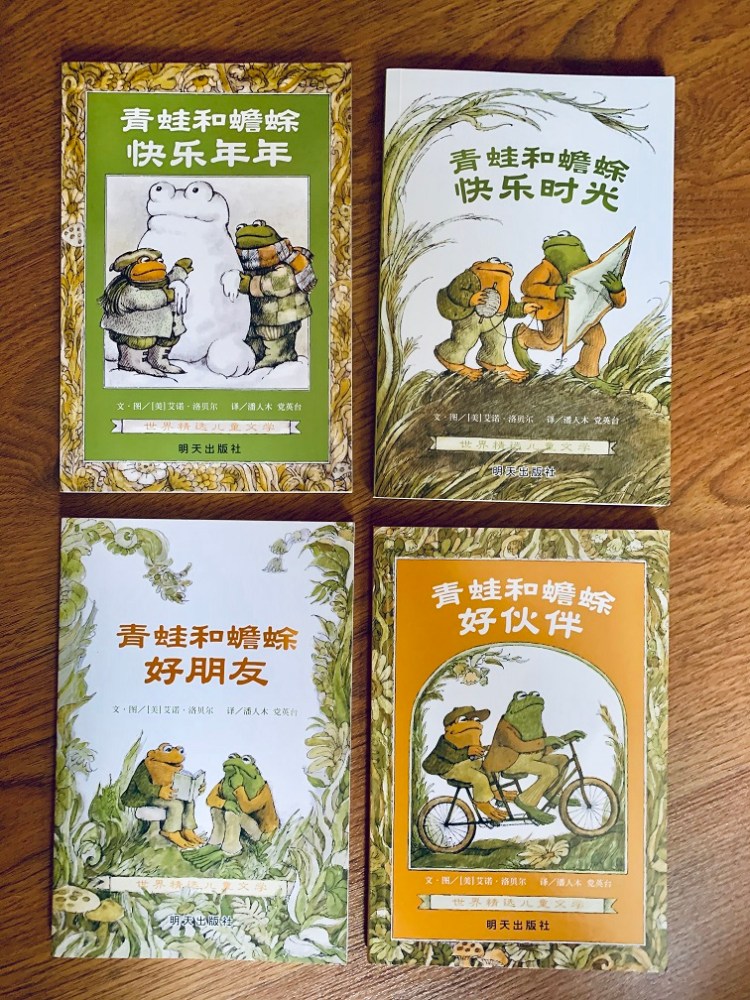
Frog and Toad (in Simplified Chinese) is a charming set of 4-books, which tells a timeless story of friendship, having been written over 50 years ago …. it’s perfect as an early chapter book for an emerging reader, with less pictures and more text.

The high level stats

Author: Arnold Lobel
Number of books in set: 4 books, each with 5 chapters/stories in each
Number of lines per page : 2 – 12
Number of pages per book: 64
Total length of the book: ~2500 characters (about 500 characters in each chapter)
Characters required by child to read it independently: 1000~1200
Luka compatible: Yes
Pinyin: No
Available in Singapore NLB: Yes
Original language of publication: English

Synopsis of Frog and Toad

A frog and toad (conveniently named Frog and Toad) are an odd couple – very different personalities, but best pals. Frog is practical and sensible, whilst Toad is emotional and disorganised.  In a way, they mirror the acclaimed Elephant & Piggie picture books, which also paint a loyal and compassionate animal friendship, but Frog and Toad is closer to a novel for a slightly more advanced reader. 

The stories are endearing because Frog and Toad’s adventures are simple every day activities – going for a walk, reading, cooking, cleaning the house or tending a garden. 

This book set was actually the second set of non-picture books that my daughter read (the first bookset was Little Fox).  She lapped them up.  Each Frog and Toad book contains five short stories, originally written in English, and they’ve been translated equally beautifully into Simplified Chinese.  For a child who knows 1000 characters, these will be a fairly easy, yet thought provoking read.

Mum’s view

I thought these books looked old fashioned, with dated pictures…. probably because the front cover looks like a cross between Little Bear Books (verging on boring) and Mr Toad from the century old Wind in the Willows (charmingly dull). Thankfully Arnold Lobel’s Frog & Toad is nothing like either of those titles (it’s much more funny and absurd) and I glad my daughter picked them up to read, even after my initial reluctance. Good lesson to mum: really don’t judge a book from its front cover!.

Like many children’s books from the 1960s & 1970s, Frog and Toad involves characters overcoming common problems which arise from vice activities…… like anger, envy, sloth, pride, and gluttony.   The stories demonstrate the ups and downs of human (and amphibian) relationships and life in general. Importantly they remind young readers to appreciate their unique individuality, and that selflessness, self control and sacrifice is part of making life enjoyable.  These are such big lessons that I really want to teach all the little people in my life.

I sound like I’m preaching now, but these stories are actually such a humorous and dramatic way to share these important life lessons and create discussions.  For example, when Frog makes fun of Toad’s impractical and oddly styled swimsuit, Toad responds to the mocking by calmly parading the bathing suit past the crowd.  Another nice one is when Toad bakes cookies, and they each overindulge…. for days!.  Finally after talking for hours about how to stop, they decide to share the cookies with some birds in an ingenious solution to control their cookie consumption.

Why it’s good

  • High repetition of characters: we learnt a few new characters like toad (蟾蜍) which is obviously repeated many times
  • Action packed but easy to follow short stories: to help young readers stay engaged across the 60+ pages
  • Audio available: Compatible with Luka audio or Ximalaya for high quality narration (we didn’t use it for this)
  • Layout: No pinyin or English; large, clear print on a plain white background; still has a few scattered simple pictures, to assist with making the leap from picture books to novels
  • Laugh-out-loud funny in places
  • Bonus:  parents will actually enjoy the stories and discussions the ensue too!

Frog & Toad Book Titles

  • Frog and Toad Are Friends 青蛙和蟾蜍-好朋友
  • Frog and Toad Together 青蛙和蟾蜍-好伙伴
  • Days With Frog and Toad 青蛙和蟾蜍-快乐时光
  • Frog and Toad All Year 青蛙和蟾蜍-快乐年年
青蛙和蟾蜍 books in Simplified Chinese

Where to buy Frog and Toad in Singapore

Frog and Toad is stocked at the following places:

  • Luka Reads (online) use the code lahlah10offbooks at checkout for 10% off
  • Maha Yuyi (physical store and online)
  • Amazon / Lazada / Shoppee
  • Borrow it from your local NLB Library (which is how we discovered it)

There are many wonderful bookstores online in Singapore. See my earlier post on our favourite bookstores in Singapore if you’re looking for inspiration on where to get lovely reads from, and also discover some discount promo codes from the bookstores.

Other similar stories

If your child enjoyed Frog and Toad series, maybe they’ll also enjoy other books we’ve discovered. Some ideas:

  • Slightly higher/harder reading level to Frog and Toad: 
    • Wilma the Elephant series (set of four) 大象小不点
    • Marching Penguins series (set of eleven) 企鹅机动队套书

  • Similar life lessons and story style to Frog and Toad (with anthropomorphic characters):
    • Elephant & Piggie series (set of seventeen) 开心小猪和大象哥哥
    • The Story of Little Fox (set of four) 小狐狸的故事

Below is a graphic I put together with a comparison of where I feel Frog & Toad sits with respect to other well known Chinese bridging books for children.

List of good Chinese bridging book for children after finishing Le Le or Odonata series

You’ll see some of these books are simple in nature but very long (like mini-chapter books); others are picture books with limited word count but harder words.  It really depends on your child which avenue to go down. 

Whilst I’ve sorted this list from easiest to hardest by the numbers of characters which a child can recognise,  my suggestion is that instead of focussing on number of characters learnt, focus on quality time spent reading (which means finding a book the child enjoys). As a rule of thumb, a good book is one where no more than 10~15% of characters are new to the child. We use our dictionary pens (Youdao pen or iFlyTek) to fill in the gaps for new characters, since as an illiterate parent, I’m not much help.

What’s your favourite graded reader?

I would love to know what books you think are great at this same level! Please add comments below, or through my my Instagram or Facebook feeds. It’s only through meeting other wonderful parents virtually, that this shared language journey becomes a more valuable one.

If you’re in Singapore, join the conversation with other like-minded parents at the FB Group Ni Hao Singapore Primary School learning, which I host along with a few other Singapore-based bloggers, including the amazing Ms Claudia Lee Kimura.

I’ve also written detailed reviews of other graded readers that we’ve tried, and Chinese learning resources, see below:

Chinese eBook Apps for Children: Comparison and Review

Chinese eBook platforms for Children

Our family are avid readers – and I really do prefer real books, not eBooks.  But there are some occasions where eBooks have good uses, especially from a Chinese learning perspective, as they often have an audio option which is useful value-add, and are easy to transport.  Moreover, in countries where Chinese books are not so readily/cheaply available, they’re a great alternative.

This post covers in detail the best e e-book platforms we have found. I’ve divided them into three categories:

  1. Levelled Readers & Bridging Books (for a child to read independently)
  2. General Picture Books (for a child to listen to)
  3. Non fiction / Current Affairs (for a child to read independently)

Below is a quick head-to-head comparison of the main eBook platforms reviewed in this post.

Comparison of Chinese ebook platforms for Children

And now the detail……

Chinese Levelled Readers & Bridging Books

(for a child to read independently)

Wawayaya JoyReader

What:  This is a mainstay in the eBook scene, with many primary schools in Singapore providing free access for students.   It’s essentially a platform filled with levelled readers, which covers the spectrum from kindergarten to upper primary levels.  It also contains the e-textbooks of Singapore’s Chinese primary school curriculum.  The app is produced by Hans Vision, which will be a household name to older Singaporeans.

Best aspects / Unique aspects:   Has a “read-after-me” recording function to assess child’s reading & pronunciation of the books. Also, when you tap on the Chinese words or character, a definition appears in Chinese and English, and stroke order is illustrated for individual characters.  It’s very well designed to be kid-friendly, and focuses on core literacy skills.

Country of origin:  Singapore (although headquarters have since moved to Beijing)

Book selection: There are 12 levels, with different books in each level, with over 3000+ books in total.  The books favour those found in Singapore’s libraries, so they’re either from major Chinese publishing houses or Singaporean authors.  Many of the pictures are very Singaporean too.

Audio selection:   There is a narration option for all books, with a variety of different voices (male & female) which are professionally recorded and very clear. There is an option to turn audio on or off. The text is highlighted in red whilst it is narrated, so the child focuses on the characters.

Ease of use:  Simple – it’s helpful because the books are ordered by hardness (or reading level), so a child can jump in a be on the right level, and systematically progress.   The app user interface is all in English which is helpful for a non-Chinese reading parent to navigate.

Pinyin option: Pinyin is shown in books contained within the first four levels, after which it is less common.  There is option to turn it on / off.

Traditional Chinese option: No

English translation of books:  Some books allow this option to be turned on.

Able to grade the child’s reading:  Yes, there is a recording function whereby the child can read the sentence, and the app will give them a score.

Cons:  To me, the books are all fairly similar (eg from large levelled reading series, without variation in authors or illustrations), so that lacks the excitement of real literature.  For a cheap option to access levelled readers, they’re very good.

Cost: The app is free to download, and then there are various subscription packages which can be put on top.  You can choose specific series, and timeframes.  The full premium subscription rate is about S$13.00/month or S$134 annually.  (If in Singapore, it’s possible the local school your child goes to may subscribe too) .

Examples of JoyReader Book Selection – the search and filters are easy to use.

Reading a book with Wawayaya JoyReader – note the easy options for a child to turn on or off audio, see translations, record themselves, and also see the text is well sized and highlighted.

Note:  This is the Wawayaya JoyReader App, not Wawayaya Reader, which is an earlier version.  The design of the apps looks similar in the Appstore.

Dudu

What: Dudu is a set of levelled Chinese eBooks, which includes comprehension questions and quizzes for a child., and games to reinforce the learning.  The books have been designed in Singapore to match the MOE Syllabus, by a group of edu-tech consultants who are spin-off from A*STAR. 

Best Aspect / Unique aspects:  Dudu claim to be the World’s first Adaptive Chinese Reading Programme where a child will learn to read the Chinese language faster than normal average learners. I don’t know about that, but it’s certainly adaptive, in that it tests the child’s reading skills and comprehension, and then determines the level for them to commence at.  It progressively recommends new books according to the child’s ability, and they are confined to reading within this list.  This helps to overcome the issues of children finding books too hard or too boring or too many choices, which we have found with some other levelled eBooks. 

Country of origin:  Singapore

Book selection: There over 600 books, which get progressively harder across 13 levels, corresponding to each of the Singapore formal schooling levels.

Audio selection:   There is a narration option for all books.

Ease of use:    Average – it’s actually all through a website, although there is no English navigation option.  It’s also nice this can be done on a computer, not just a tablet.

Pinyin option: Yes

TraditionalChinese option: No

English translation:  Yes

Able to grade the child:  Yes

Cons:  This is similar to JoyReader, although we prefer JoyRead because it highlights the words as the book is being read.

Cost:  S$10.90 per month, or S$100 for a full year

Examples of Dudu Book Selection – the system is all in Chinese (even when “EN” option is highlighted). The child is not able to access books at levels above their assessed reading level.

Reading a book with Dudu – a child can easily hover over a word and attain the definition / translation.

Note: not to be confused with Du Chinese, which is a totally different app

iHuman Books

What:  My kids love the iHuman suite of apps, and iHuman books is an extension to this providing interactive reading practice across of series of levelled readers and also picture books.  The app was a winner in Apple App Store’s Best Chinese Apps of 2018, and I think it’s only gotten better since then.

Best aspects / Unique aspects:   Beautifully illustrated and animated, and highly interactive.  As the words are read, the app will highlight the specific character/word, which gives a nice visual lead to the child to follow along with the phrases.  Topics are broad, with historical and modern classic, along with some books more on sciences.

Country of origin: China

Book selection:  All stories can be read in English or Chinese, either as a full story or an abridged (simpler) version, available across nine different levels.  Most of the stories are all authored and illustrated by iHuman, based on classical fairytales and folk tales, but there is also some third party content, like the Arthur series, which we enjoy.

Audio selection:   Professional voice actors and narrators for both English and Chinese, with high-quality sound effects. 

Ease of use:   Simple – iHuman really create beautiful apps!  Children can easily search through the storybooks, and with one-click switch between English, Simplified Chinese, Traditional Chinese, Pinyin or read-it-yourself modes. 

Pinyin: Yes

Traditional Chinese option: Yes

English translation:  Yes – all stories can be read in English or Chinese

Able to grade the child:  Yes

Cons:   Signing up is easiest with a WeChat account or Apple appstore. Also, the operating system and instructions are largely all only available in Chinese.

Cost:   There’s a one-month free trial, after which it is about S$15/month.

Examples of iHuman Books Selection

Reading a book from iHuman Books – the graphic below shows how easy it is to switch between languages for a true immersive bilingual experience. What the image doesn’t convey is how truly beautiful the animations and recordings are. The selection might be smaller, but the quality is top notch. The text is also highlighted as the words are read.

Note: Not to be confused with iHuman levelled readers, which are books contained in the iHuman Hong En Shizi app, with characters relating to each level. This is also a great app for learning.

WuKong Books 悟空阅读

What:  This innovative app is produced by the same designers as Wukong Literacy app.  It contains >1000 books which align with the levels from Wukong Literacy app, and become progressively harder throughout the collection. They’re primarily designed to encourage reading aloud by the child.

Unique Aspects:  The app will grade the accuracy of the child reading, and enables a child to read a whole passage, and when a child stumbled over a word for more than a few seconds, the app will fill-in the blanks.  At the end of the passage, the app can list out for a parent which characters the child is less familiar with.  It’s a very cool feature.

Country of origin: China

Book selection:  All written by Wukong, using vocabulary which matches the literacy app. 

Audio quality:   Excellent! And also excellent for recording the child reading.

Ease of use:   Simple interface (although it is all in Chinese)

Pinyin: No

Traditional Chinese option: No

English translation:  No

Price:  About S$30 a year, or $50 for 3 years.

Options for reading – even though the operating system is all in Chinese, it’s quite intuitive for a child to understand.

How the app progress – first, the app will teach you the new vocab in the book, then the child reads the book aloud and is scored for each character they read correctly (see the little emoticon icons above the characters. At the end, there is a summary of the characters a child can recognise, and what they need to improve on.

For Picture Books

(for a child to listen along to, or for an adult to read)

Ellabook 咿啦看书

What:  Ellabook is an app filled with interactive Chinese picture books.  It’s a highly curated selection of picture books, including many award winning stories and internationally acclaimed fiction.

Best Aspect / Unique aspects:  The stories are enchantingly animated and interactive (similar to the way interactive reading pens read physical books like Habbi Habbi or PenpalWhizz) whereby the child can click on the pictures and they make sounds / speak.  It’s very mesmerising for a child.  Additionally, the stories are rich in depth and well selected.  They also have a separate audio-book library, which is nice for bedtime stories without the screen.

Country of origin:  China

Book selection:  Hands down, it’s a beautiful selection.  There are over 1000 books, although no graded readers / simple beginner books.  The range is sorted by category and also child’s age (age of interest for listening, not necessarily being able to read it), and is the most exciting of any of the apps we’ve seen.  It really feels like browsing the options a physical library.  There will be something of interest to most kids, including Madeline, The Adventures of Babar, Disney etc along with many classics.  I like it that the set has books from many varied authors.

Audio selection:   There is a narration option for all books, and they’re fully dramatized (different voices for different characters, sound effects, etc).    It’s very beautifully recorded, in a similar way to iHuman Books above.

Ease of use:  This is our only niggly bit of the app.  It’s a little clunky, and because there are numerous subscription options, and also ability to buy individual books, it’s possible to get a little lost; navigation doesn’t feel as streamlined as the other apps.  Also some of the books take quite a while to download, which can be frustrating for a child, so I’d recommend the adult does that in advance to add specific books into the child’s reading library.

Pinyin option: No

Traditional Chinese option: No

English translation:  No

Able to grade the child:  No

Cons:   This is a tough one….. I want to love it, but still have a few gripes with it.
Firstly, the books are not sorted by reading ability (though they do give an age level appropriateness), so the value is really in  the enjoyment for a child to listen to a beautifully narrated book, rather than reading it themselves.  On some pages, the font it really quite small and not helpful for beginning readers, and many of the stories contain characters/words that only a adult would be able to read, and the text doesn’t highlight or follow along as the app reads (But the stories themselves are excellent!  To us, it’s the equivalent of having Luka read a physical picture book, to embed a love for the language and audio exposure.)

Secondly, the app interface is not so intuitive for a child to self-assist and navigate. We ended up in some frustrating deadends.  Whilst we knew there were particular books my child had spotted and wanted to read, we weren’t sure how to navigate back to them, nor could we do an easy ‘search’ to locate the books again.

Cost: The app is free to download, and then there are several free books available (well worth a look), and many more books with a subscription, which costs about S$12 per month.

Examples of Ellabook Books Selection – hopefully you recognise some of these front covers and titles as classic English books too! The search function only really works in Chinese though.

Examples of reading a book with Ellabook – the image below cannot show the beauty of the animation nor the audio, but it’s a nice experience once you get through the clunkiness. It would be better if the text also was animated to highlight what was being read out.

Epic Books

What:  Epic is a well known English e-book platform – indeed, perhaps your child has been given free subscription to this through their primary school.  It also does contain a limited selection of Chinese books.

Best aspects / Unique aspects:   Epic Books is nice because they go well beyond plain vanilla graded stories …. There’s non-fiction, comics, graphic novels, and an array of different genres, including in their Chinese selection.   I also like it that app timing can be limited to particular time lengths or book numbers, so it’s doesn’t become an all-day screen fest.

Country of origin: USA

Book selection:  The Chinese selection isn’t as expansive as the English selection – they claim there are 1000 Chinese books (versus >25,000 English books).  Many of the early stage books are similar to those also found on other platforms (like the SinoLingua publications, which are also on Wawayaya JoyReader), but the more advanced books are differentiated.

Audio selection:   No option for “read-to-me” mode in Chinese, although there are a handful of audio books

Ease of use:   Simple interface, and it’s easy to sort by language, reading level, and genre.   It will work on a tablet or a PC.   

Pinyin: No

Traditional Chinese option: Yes, although the Simplified and Traditional are all mixed together.

English translation:  For some books

Able to grade the child:  No

Cons:  My daughter often gets side-tracked and ends up reading English books in this app!  The titles are just so appealing, and the English books come with audio, and also quizzes, which makes them more appealing versus the Chinese selection.  If your child enjoys Epic for the English books already, they may be disappointed with the Chinese side which has many less features.  Also, the word definition feature is close to useless.

Cost:   There’s free subscription which only allows one book a day to be read from a very limited selection.  Otherwise, for full access it is about S$15/month, or special promotion of $75 annual subscription.  You might be pleasantly surprised that some schools will give this for free! Our school version only allows unlimited access on weekdays before 4pm.

Examples of Epic Books Selection – It’s not a big range, and unless you have the full subscription, you won’t see much. This is what our library looks like after 4pm and on weekends when we get shut out.

Example reading a book with Epic – there’s no audio for Chinese, and none of the standard options work, including you’ll see in this image the rather unhelpful suggestion of what happens when you click on an unknown character! An even more unhelpful one my daughter can across said “Look at the word and see if it’s similar to any other ones you know”.

NLB Mobile App / Singapore National Library Board

What:  For those in Singapore, this is FREE access to digital books here.  They’re not narrated, and they don’t have fancy animations, but they do have a broad selection of picture books which can be borrowed.   And, if you have a Luka Reading Robot, you can simply put your iPad in front of Luka and she’ll narrate the book beautifully for you.

Unique aspects:  Probably the biggest selection of digital Chinese books you can access for free

Country of origin: Singapore

Book selection:  Wide and varied, as per the National Library Board 

Audio quality:  There are a few audio books, but for the most part it’s non existent

Ease of use:   Simple interface which can be navigated in English, although if looking for specific books, the Chinese book catalogue much be searched using Chinese characters.

Pinyin: No

Traditional Chinese option: No

English translation:  No

Price:  Free for residents of Singapore (or anyone with a Singaporean NRIC)

For Non-Fiction and Current Affairs

Mandarin Bean

What:  Graded written articles (not books) that are high-quality and contextual – it could be current affairs, opinion pieces, restaurant review, or fictional stories.

Unique Aspects:  Available on PC, which is excellent if you want to use these texts as narrative for discussions with an online tutor, or print out to use for comprehension practice.

Country of origin: China

Article selection:  600+ short written pieces (usually about 2  paragraphs on a particular topic).  They’re interesting for a primary age student or older, and contain things like The failure of the movie “Mulan” in China电影《花木兰》在中国的失败, or The Cities with The Highest Cost of Living全球生活最贵的城市. 

Audio quality:  Standard recording of the passage

Ease of use:   Very basic – just click the reading level, to access the podcast.  We tend to use these texts for online discussions with our teacher from Vivaling.  They’re short enough for a child to read, and then respond to and discuss.  As it’s on the computer, it’s also very easy to print these out and use as comprehension passages for a child.

Pinyin: Yes

Traditional Chinese option: Yes

English translation:  Yes

Price:  The free version gives access to 600 podcasts and texts.  Full version costs  about S$24 for a year (or $2 per month)

Example Mandarin Bean article selection

Example Mandarin Bean article – very easy to turn on or off the pinyin, or switch to Traditional Chinese.

Zao Bao Schools

What:  Zaobao Schools is an adaptive learning platform containing graded written materials that are high-quality and contextual – it could be current affairs, opinion pieces, restaurant review, or fictional stories.  First the system tests the students’ reading ability, then it recommend suitable articles for them based on language proficiency. 

Unique Aspects:  New stories are added regularly, and they’re all relevant to Singapore context.

Country of origin:  Singapore (it’s developed by the same creators as Du Chinese)

Article selection:  I’m guessing there are well over 1000 articles, which come from the student newspapers published under the Chinese Media Group of Singapore Press Holdings.   All topics relate to Singapore current affairs, from a perspective interesting for kids.  Topics cover news shorbiz and lifestyle articles.  Recent articles include whether to get the COVID vaccination, a funeral for a pet fish, latest trending apps for tweens, anime book review, cultural relics found in the sea etc. 

Audio quality:  Standard recording of the passage

Ease of use:   Very basic – navigate through website.

Pinyin option: Yes

Traditional Chinese option: No

English translation:  No

Price:  The free version gives access to about 1/5 of the articles that the full version does, which is still excellent.  If you want the adaptive reading ability, you’ll need the full version. 

Example article selection

Example article – see it’s very simple, but there are options for audio, pinyin and translation.

Other e-book platforms

There are many; these is simply a review of the best ones we have tried. 

We haven’t used Kada, but Jean from Mandarin Homeschool has a helpful review.  It looks like a really amazing Chinese equivalent to Epic. 

Lingzi Media is another online platform popular in Singaporean schools for using for graded reading found here.    It’s all written in Chinese though!   

If you’re looking for Traditional Chinese books Mama Baby Mandarin has a nice post explaining the plethora of free digital books available from Taiwan’s public libraries, from anywhere in the world.

Which would I choose?

If your child is studying at a local school in Singapore, chances are that they have already been given free access to one (if not more) of the above apps.  Honestly for me, that’s enough, as there are only so many eBooks we can take (and the Singapore NLB has a truly excellent collection of real books).

Overall, I am not a fan for younger children reading from screens – I really prefer reading real books with them, where they can point to the words or pictures and interact.  For that reason, my choice would still be to spend money on reading pens / Luka combined with physical books that can serve similar functions of reading aloud to the kids without the screens (assuming the physical books were reasonably prices or could be borrowed from a library). However, we all know how expensive Chinese levelled reader series can be, so if money is a constraint, eBook are a very budget friendly source for graded reading content.

If we needed to choose an e-Book winner I’d say:

  1. Best for learning to readWawaYaya Joyreader is the most comprehensive option for a child to self learn literacy, and get information about words they don’t know and we enjoy the read-along word highlighting.   I would see this as the digital equivalent of reading a physical graded reader (like Sage, or Odonata) with an adult, or with the aid of a reading pen like Alpha Egg.
  2. Best for enjoying broad literature:   Ellabook.  If you’re simply looking for audio exposure, not reading, then Ellabook is a stunning option for access to acclaimed picture books with beautiful narration.  For us, I’d see this as the digital equivalent of enjoying a physical picture book with interactive voice narration by a parent or Luka Reading Robot.
  3. Most cost effective learning to read option: Buy the Wukong Literacy App and Wukong Books together, for a 3 year subscription for $50, and you’ll never need any other apps for learning characters and literacy! 
  4. For current affairsMandarin Bean.

For other perspective, there’s a really detailed eBook post at Mandarin Homeschool comparing the pros and cons of e-books, from the perspective of a mum who lives in a country where physical Chinese books are much less readily available (and free access to eBooks is also less common). 

Additional Information

This entire blog is a passion project focussed on recommending apps and books which are helpful for families embarking on a Chinese learning journey, especially for those from predominantly non-Chinese speaking households.  It’s based on the experience of our family, and our three happy bilingual kids.  If you have found this post helpful, some other earlier posts you might like are:

  1. Where to buy great Chinese books in Singapore
  2. Books to read after your child already knows 1000 Chinese characters
  3. Chinese reading dictionary pens to aid in extensive reading for children
  4. Great apps and blogs for families learning Chinese
  5. Comparison of levelled readers for pre-schoolers

I would love to hear from you too! Feel free to reach out via the comments/form on my blog, or else join the conversations on my Instagram @lahlahbanana or Facebook.

Comparison of character lists in Chinese graded readers

This posts compares the character lists between Sage 500 Books, Odonata Readers and Le Le Chinese, including differences and overlap.  Many people ask why we have so many different levelled Chinese readers…… and which is better.   My answer is usually that whilst you certainly don’t need them all, they are each good in very different ways.   This post outlines some of the differences, with a focus on the first characters used within each set. 

This blog builds upon my earlier piece “Is Reaching Chinese Fluency a realistic goal for non-native children”?.   I perhaps should have renamed the previous post “Is Being able to read Chinese necessary for fluency?”.  I think many non-Chinese speaker parents feel that speaking is more important than writing, but I’ve realised this is a trap.

Which books have most frequent repetition of relevant characters for learning Chinese?

It’s easy to buy a set of levelled readers (or download a character list), and use it as an absolute reference.   However, how different are all the lists?  And how useful are they if used in isolation?  If my child has already completed Sage 500, are other levelled readers still helpful?

Below is a head-to-head comparison of three well known Chinese levelled readers.  From this, you’ll see there’s a large difference in the depth they go to (some 500 characters, others 1000+), but also in the frequency of repetition and exposure to the characters provided.  I’ve also compared the three sets just looking at the first 500 characters (or thereabouts) to show this difference exists also at the very initial stages.

Head-to-Head Comparison of books comprising the first 500 characters in graded readers
Head-to-Head Comparison of all books in graded reader series

I wanted to put this here to demonstrate that the sets are all SO different. Sage 500 is the only set which the really truly provides extensive spaced repetition of characters, which could be important if you’re embarking on this journey with really really young children (like a 2 or 3 year old). Conversely, it could be a turnoff for a child older than about 7.

This post is about numbers of characters, but before you get bogged down, I want to put a caveat on this whole post. Literacy is the most important outcome here….. it’s not about how many characters a child does or doesn’t know. It’s about learning to read, and learning to love reading. So whilst I dissect the character lists in this post, please make sure your focus is on choosing the right books for your child to enjoy reading, not simply on ticking the boxes to learn characters (that will surely come later, which is the magic of reading).

Why are Chinese character lists and learning characters important?

Most parents say that learning Chinese characters is one of those headache-inducing things that they have to deal. For us, there’s been no silver bullet or short cut either, it’s all about practice, practice, practice.  But practice doesn’t have to be painful.

By nature of us being based in Singapore, we do have weekly tingxie (Chinese spelling tests) through school, which we take in small chunks, and do it consistently. But most of our learning comes from extensive reading.  I really believe that daily reading, even in preschool years, is very important in laying a firm foundation for literacy.

The key before doing this has been a massive upfront effort to select the right books, with the right level of characters. As a mum who cannot read Chinese, this has involved a lot of research on which books sets to progressively read through (not an easy thing for a parent who cannot read a word!) and also getting the vocabulary . wordlists into a semblance of digital order. This post is about some insights from this exercise in comparing wordlists between series.

What is the overlap between the first 500 characters in each set?

I won’t share the full wordlists here, as the publishers won’t like me for doing that, and more point is not about the individual characters, but the benefits of the series holistically. You’ll see from the below Venn diagram comparing characters between books, that whilst there are many similarities in wordlists, there are enough differences in style and vocabulary, that I do feel it makes sense to double up or triple up, and read the different versions if you have them accessible (and assuming the child enjoys the reading material!). 

Overlap between words existing in Sage, Le Le, and Odonata Chinese graded readers in first 500 characters

Note: Le Le Chinese and Sage 500 come in both Simplified and Traditional Options, but Odonata only have Simplified Chinese.

What is the overlap between the entire sets of each?

Sage 500 stops at 500 words…… but Le Le Chinese and Odonata go on to well above 1000 characters each. So, how do the full sets stack up against each other? There are a lot more similarities than differences.

In fact, there are only 18 words contained in Sage, which aren’t included in either Odonata or Le Le Chinese by the end of the full sets.

Caveat here is that for the first 500 characters, I did this myself.  For the characters beyond 500 for Le Le and Odonata, I outsourced this exercise to my children.

What’s the big difference between the wordlists in Le Le, Odonata and Sage?

A quick scan of what’s similar and different between the wordlists between Sage, Le Le and Odonata gives me some observations (note, this is coming from a parent who doesn’t read Chinese, so this is simply what I’ve learnt from studying the characters lists and reading with my kids)

  • Le Le Red Set: this is specially designed to include language which is most common in children’s picture books.  Specifically in the first set (Red, with  ~500 characters), it doesn’t have any spoken narrative.  Most of the sentences in the first set are barely 5 characters long. The first set contains lots and lots of nouns, and is more scant on use of pronouns (自, 己, 她, 他 etc are NOT in the Red set).   Le Le philosophy is about learning to love literature, so characters are introduced in themes, rather than individually. In fact, the authors really don’t like the concept of compiling and learning character lists from their books, because it takes the joy out of the literature.
  • Odonata: this set is very much based around two school children and their daily activities. The language includes much more more spoken language compared to either of the other sets, and is similar to what teachers would say in a classroom, and dialogue between children. Character are introduced one by one, in an order which makes the story most sensible. Characters include sounds, like animal noises, which are in neither of the other series. As the series progresses, the number of characters per sentence gets much much longer.
  • Sage 500:  This set is written to include the most common 500 characters – I found this set fascinating, because it’s put together in the most scientific method of all the sets.  Whilst I know that the series doesn’t teach the most easy to write characters first, I’m taking a guess that for the entire 500 word selection, it’s introducing characters which are slanted to being easier for a young child to write or recognise (ie less strokes, less complexity) compared to either Le Le or Odonata.  About half the words are in common with Le Le, although it includes some spoken dialogue too, meaning more active verbs and pronouns in the set. There’s a fairly even split of word types (using nouns, verbs, classifiers, conjunction etc in even measure), and the words are introduced thematically, including some common radical themes too, which might only be noticable if you look at the whole 100 characters in each set.  As the series progresses, so too does the grammar complexity, moving from being first person action sentences into questions, and finally more abstract themes.

Images below compare the first book in the first set of these three series (on the left), with the 500th character level book in the same sets (on the right).

What are the unique characters in each set?

I thought you’d ask!  For the first 500 words in each set, there are:

  • 196 characters unique only to Le Le Chinese
  • 124 characters unique only to Odonata
  • 113 characters unique only to Sage (but only 18 unique for the entire series)

In general the most obvious differences I noticed across the full sets for the ‘unique’ words are:

Le Le: many more nouns in the first 500 words than the other sets, and these nouns cover very diverse range of natural world and built environment, including things like exotic animals (eg 豹, 虎, 狐), colours (eg 灰), directions (eg 北), weather, and characteristics (eg 板, 厚, 斑, etc).  Ironically, one of the characters not contained in Le Le Red set is “乐”(Le = happy, as in the name of the Le Le series). This made me laugh!

Odonata: unique words are likely to be less common in literature, but common in dialogue for school children, including colloquialisms and animal noises.  For example, this includes descriptions of situations (迟 late, 娜 graceful, 饱 full up, 乖 well-behaved, 肮 dirty), animal noises (咪 as in a quiet cat “Meow”, 喔 as in a rooster crowing, 嗡 as in the noise a bee makes, 啼 to hoot, etc).  Also some classroom vocabulary (e.g. 戏 drama, 耍 play; 功 achievement, 剪 cut with scissors, 猜 to guess, 擦 to erase, 滑 to slide, 排 a row, 队 a team/ group, 难 to scold) and home situations (食 as in food for animals, 逃 for a pet to run away, 饼 cookie, 敢 to dare, 留 to leave behind, 吹 to blow candles, 弄 to mess around, 赶 to overtake, 吓 to frighten, 齿 tooth, 刷 to brush, 梦 to dream, 喊 to yell, 抬 to carry).

Sage: Sage certainly has more descriptions of relatives (eg 伯, 祖) , seasons (eg 夏, 熱, 夜), and farming related words (鸦, 田,雀, 勞, 汗). The books start out with lots of numbers and verbs and family life situations, which Le Le doesn’t have so much of. By the final set it’s talking about school life and community life, so touches on more characters from both Le Le and Odonata.

Are you saying we should read Sage, Le Le and Odonata?

Not really.  I think each book appeals to different learning styles, but there’s certainly no harm in doing them all, if they’re all of interest.

Firstly,  Sage 500 itself is not a pleasurable read and it’s a slow and steady approach to learn 500 characters (recall the massive amount of spaced recognition it has compared to the other sets….).   So if a child has already completed first levels of Le Le (Red series) or Odonata (Yellow series and Green series), I don’t think it’s a good idea to swap back to Sage 500, unless the child is really struggling.  However, for a child who is currently doing Sage (or even completed it),  I feel like Le Le and Odonata have enough of a storyline to make them interesting reads for a child and could be done concurrently from the from the start to complement Sage, or else after the child ‘graduates’ from Sage.   The characters are also in quite different orders.

The graphic below is an exercise I did with my children….. it shows the first 100 Sage Characters in order (printed from Guavarama) and we’ve coloured in the corresponding characters from Odonata by level.  Yellow is the first set (1 – 103 words); Green is the next level (104 to 216 words); then Blue (217 to 423 words) and finally the first two books in the Odonata Pink set (424 to 515 words).  You’ll see from this, that for the first 100 Sage words, most are covered in the first set (yellow) of Odonata too, but some of them aren’t covered until the final levels (eg 山 which is the very 1st word of Sage is closer to the 500th word in Odonata).

Sage first 100 characters, coloured in with where they appear in the Odonata Chinese graded readers series. Printables from Guarvama.

For me, the key is about reading extensively with books that have enough familiar characters in them to make the reading fun and pleasurable.  Experts say that reading texts where you already know >95% of the words in a text is key to extensive reading, as it lets you enjoy the experience and understand what you’re reading.   Levelled readers are an easy way to achieve this (assuming the child is interested in reading them!), as you’ll know for sure that the language has been specifically constructed with reduced character selection. 

Another great option for older children to read are the Mandarin Companion Levelled Readers which are made up on either 150 or 300 characters, and contain more complex/interesting stories like Secret Garden, Sherlock Holmes and Rip Van Winkle.

I’ve listed a whole lot more bridging books we enjoy for a child who knows 1000+ characters in a separate post.  I think at that point, graded readers have served their purpose, and there are much more interesting books for a child to read independently, if the family has easy access to such resources.

If money wasn’t an option, what would I do?

Good question.  On the assumption that the child already has good spoken understanding of Chinese, here’s what I would do:

  • For a child younger than 5, I would start with Sage 500 using it daily as a learning curriculum together, if I could speak Chinese or had access to a Chinese teacher. In the background, I would let the child use Le Le Red Set for pleasure and for special themed studies.  After finishing Sage 500 (or perhaps just a few books in Sage), I would continue with Le Le Set.  I’d do it in this order, because Sage gives a lot of repetition and starts off with a handful of characters (works well for a 2 or 3 year old), but then the Le Le stories are waaaaay more interesting, good for a short attention spans, and the character depth goes far beyond Sage.  There are many words in Le Le which are not in Sage. Once finished with the full Le Le set, it would be possible for the child to start of Odonata from about the 500 word mark, and enjoy the longer stories, or alternatively, move onto simple bridging books. For sure buy the entire Le Le Set of 300 books! A wonderful investment.
  • For a child older than 5, and a total beginner at reading, I would start with Odonata yellow set (first 100 characters), and perhaps continue to the Odonata green set (to 200 characters).  Then I’d very fast swap to Le Le Chinese (and get all 300 books). If the child wasn’t a total beginner (eg already knows a handful of characters), I’d start out with Le Le. Why this order?  I’d put Odonata first initially, because it systematically introduces characters page by page.  However, from the Odonata Blue series (400 words+) the characters are introduced at quite a pace, with 30 – 40 new characters per book, which becomes a significant effort.  So, I feel it’s much more sensible and enjoyable to get familiar with the vocabulary using the shorter Le Le books, and then consolidate the learning with Odonata at a later time.  Even for my daughter who has fully finished Le Le, she finds reading the upper levels Odonata a challenge (due to length primarily, but also the complexity of new characters). 

Final observation: Odonata is much much cheaper than either Sage or Le Le. Whilst I don’t feel it’s quite as good holistically (especially for a younger child), I do think Odonata has the most vocabulary suitable for composition writing within the Singapore MOE system for P3 onwards. So I would highly recommend this to be part of the mix if studying in Singapore. 

Finally, if cost of readers is an issue, Odonata or the Disney I Can Read series are the cheapest. Both comes with Luka audio option, which makes it easier to grapple for a non-native speaking family than Sage 500. And, if you’re on a really tight budget and can actually read Chinese yourself, actually all you need are any simple texts and just start reading together.

Reinforcing the character learning through apps

This should be the topic for another post.  However, just briefly, in case you’re wanting to know which apps can be used to study these word lists.

For custom wordlists (like home created lists, or the MOE school character lists) I put them into Skritter app, and that’s where we revise them.

For fun, I let the children play either iHuman or Wukong Literacy.  These each go up to 1200+ Simplified Chinese characters, with about 90% in common between the two of them (since both as based on the mainland Chinese Elementary Curriculum).  These apps cover 99.9% of Sage and Le Le word lists.

There’s also the Maomi Stars app which is designed for younger kids, and has Simplified and Traditional Chinese characters.  Maomi have a module (to purchase) which contains Sage and Odonata words, and an option to include your own school wordlists. This is an excellent option to support the graded readers.

Where can I get the character lists from?

I know some of you are going to beg to get the full digital lists of these words, saying you want to make your own flashcards, or load the words into Skritter, etc ….. the books manufacturers don’t want these shared, and I respect that. We did it manually, and it became a family activity (which also explains why there may be some gaps / mistakes in our analysis). But here are some pointers if you’re looking for supporting character materials:

  • Le Le Chinese: Le Le actually provide soft copies of all their characters list to their customers and other free printable. So, make use of this here on the Le Le site.
  • Sage 500: SageBooks Hong Kong has free teaching materials on their website. There are also some amazing mothers who’ve made great materials including character lists to support these books. I’d recommend looking at Mandarin Homeschool and Guavarama (in particular, we like Guavarama’s 100 boards, which are available in Simplified and Traditional to download for free, and I’ve featured pictures later in this post).
  • Odonata Readers: most of the words have good overlap with the early levels of Singapore MOE Primary School Syllabus, which you can find here.

There’s a great post on various character lists and their usefulness from Hacking Chinese which is a helpful read to get perspective. Please don’t put pressure on yourself (or your kids) by thinking that you need to teach your kids XXXX number of characters. Really, the best plan is to enjoy the process, find things to read which bring joy to your children, and trust your children. Then, enjoy the reading together moments and quality time together!

What’s your favourite graded reader?

I would love to hear from you, especially if you have experience with using different graded readers. It’s only through meeting other wonderful parents virtually, that this shared language journey becomes a more valuable one. All comments welcomed! Feel free to also post on my Instagram or Facebook feeds. Or, if you’re in Singapore, join the conversation with other parents at the FB Group Ni Hao Singapore Primary School learning, which I host along with a few other Singapore-based bloggers.

I’ve also written detailed reviews of other graded readers that we’ve tried, and Chinese learning resources, see below:

Books to enjoy about Dragon Boat Festival

Dragon Boat Festival, or Duanwu Festival, (aka Dumpling Festival) is an exciting Chinese celebration filled with legends and traditions.  It’s been celebrated on the fifth day of the fifth month of the Chinese Lunar calendar for over 2000 years.  This year, 2021, it falls on June 14th.

As Chinese is not our native language, I try to always make Chinese reading a joy, not a drudgery.  So whenever festivals comer up, I try to ensure we read a good dose of festival related books and doing craft/play around these topics, it is my hope that the children will be genuinely excited to read (in any language, but especially Chinese).

This post summarises four books which we’ve been enjoying as a family to to learn about the history of this festival.

Books reviewed in this post:

  •  小粽子,小粽子 Little Dumpling, Little Dumpling
  • 书名:今天我们包粽子(新加坡华族传统食品系列2)  Today We Are Making Dumplings
  •  文化都在节日里 Culture Is Found in Our Festivals
  • 节日Chinese Holidays (Book 1 & 2)

小粽子,小粽子 Little Dumpling, Little Dumpling

Author: 卷儿
Country of original publication: China
Language: Simplified Chinese or Traditional Chinese
~ Pages: 41
~ Lines per page: 1 – 2
~Pinyin: No
Audio available:  Yes, with Luka
Available in Singapore NLB libraries: Yes
Target age range: 3 – 8

A compelling tale about when a savoury dumpling meets a sweet dumpling, which charmingly reflects the ingredients and taste of dumplings between northern and southern China. 

As context, the rice dumpling is symbol of the Dragon Boat Festival, however there’s been a long rivalry between the north and south on which type of dumpling is the best.  The dumplings from the north are usually sweeter, filled with red beans.  The southern dumpling are savoury using meat and salted egg yolk.

This story send an important messahe, as the dumplings each realise that despite their sweet and salty differences, they’re united as dumplings and each have their unique merits.

We enjoyed listening to this book narration using our Luka Reading Robot.

书名:今天我们包粽子(新加坡华族传统食品系列2)  Today we are making dumplings

Author: Lin Wenpei
Country of original publication: Singapore
Language: Simplified Chinese
~ Pages: 20
~ Lines per page: 5-9
~Pinyin: Yes
Audio available: No
Available in Singapore NLB libraries: Yes
Target age range: 4 – 8

Singaporean author Lin Wenpei has written a wonderful series of picture books about food in local celebrations, including Dragon Boat Festival. 

The main characters of the picture book are a courageous sister and a playful brother who make dumplings 粽子.  In this book, they learn about the different ingredients and cultural significance with their grandma, and make some cute blunders along the way, (like the younger brother’s attempt to wash the dumpling leaves with soap and water!).

The whole series revolves around a playful brother-sister duo who help their adult family members prepare different foods.  Through cartoon style pictures, the books cross the boundary between being a factual book about the festival traditions and a fictional adventure, as we follow them at the market shopping through to back home cooking.

Read the book, and then give it a try yourself as a family to make dumplings. The book has Pinyin, which helps a young reader with the more difficult words.

文化都在节日里 Culture Is Found in Our Festivals

Country of original publication: China
Language: Simplified Chinese
~ Pages in book: 16
~ Lines per page:  ~ 20 – 30 facts per double page
~Pinyin: No
Audio available: No
Available in Singapore NLB libraries: No (it’s a bit delicate to be a sharing book!)
Target age range: 3 to 12

We don’t have many pop-up books – but this one makes up for all that!  It’s physically huge in size (larger than A3 size when opened), and filled with amazing pop-up pages which illustrate Chinese Festivals. 

The book covers 8 major festivals, and includes legends and tales, including Dragon Boat festival.   It’s not the type of book you’d read cover-to-cover, but nor does it need to be.  There’s just something magical about having a “special” book which comes out only for celebrations.

The words in this book are a little more difficult, so unless you’re a fluent reader, I’d recommend it needs to be read with assistance of a Chinese-English dictionary pen.

节日 Chinese Holidays (Books 1 & 2)

Author:  Cathy Ju Yao
Country of original publication: Taiwan
Language: Simplified Chinese (although Traditional is also available)
~ Pages in book: 8 – 12
~ Lines per page: 1 – 2
~Pinyin: No
Audio available: Yes – through Le Le reading pen
Available in Singapore NLB libraries: No
Target age range: 3 – 6

These books form part of our Le Le Chinese readers set.  I always like to include these in our thematic book studies, because the text is simple (able to be read by a child who know ~800 characters), yet meaningful, and means that each of my children can play a role in the reading.  Preschoolers can enjoy seeing the dragon boats and dumplings, and the simple joy of reading about the festival independently.

Great Places to Find Chinese Books for Children

Singapore is 100% blessed with an amazing collection at the local libraries, and a plethora of lovely Chinese bookstores, both online and in person, and many of our favourite ones have passionate owners who will be able to curate the perfect books for your family too.  

As a mother who doesn’t read or speak Chinese, I’m really thankful for the amazing options out there, mainly run by passionate mums who have helped to build out our Chinese home library, and instil a love for Chinese literature in our family. Whether you are a native speaker or not, I’ve written a post on our favourite Chinese bookstores in Singapore and elsewhere. The books in this specific post have come from My Story Treasury and Flip for Joy.

What about you?

I hope you and your family will read and enjoy Dragon Boat Festival in the upcoming week, including some fun books too. For 10 fun home-based activities to do with your family and complement these books, please see the excellent blog post from Ms Claudia Lee Kimura.

I’ve love to hear from you about your thoughts and recommendations too. Reading widely is a key to attaining fluency in Chinese, and it’s something I’m passionate about. I love connecting with other book-loving comrades, and if you’re in Singapore, perhaps you might even like to join the Ni Hao Singapore Primary School Chinese FB Group created by a few local bloggers just for this purpose, and it includes the ability to buy and sell used books!

Otherwise see you on FB or IG!

iFlytek Alpha Egg versus Youdao Dictionary Pen 科大讯飞扫描笔 vs 有道

This post is a detailed comparison of iFlytek Alpha Egg versus the Youdao Dictionary pen.  Let me say that they are both excellent options, and the race is clearly on between dictionary pen manufacturers in China. 

This post compares:

  1. Pen Design & Ease of Use
  2. Screen
  3. Scanning ability
  4. Accuracy of text scanning
  5. Accuracy of voice recording
  6. Accuracy of translation
  7. Speed of translation
  8. Differentiating features
  9. Price comparison

The changing face of dictionary pens over the years reminds me somewhat of Snow White and the Magic Mirror.  For years I’ve been asking what is the best Chinese reading pen out there, and I’ve been on an epic quest to find one:

In 2020:
Me: “Mirror mirror, on the wall, who’s the best dictionary pen of them all?”

Magic Mirror: “Youdao oh Queen is best by far,
No more googling needed, just believe Lah Lah”

In 2021:
Me: “Mirror mirror, on the wall, who’s the best dictionary pen of them all?”

Magic Mirror: “Youdao oh Queen is better than most,
but Alpha Egg pips it to the post”

Yes, in 2020 I called Youdao the holy grail of dictionary pens. In 2021, I never thought I’d say this, but iFlyTek Alpha Egg Dictionary Pen is better (for my kids) than our much loved Youdao.  It won’t be better for everyone, so here’s a head-to-head comparison of key functionality, so you can assess which one suits your family needs the best.

Pen Design & Ease of Use

Youdao Dictionary Pen:  it’s sleek and light wait (0.12 lbs), and fits nicely into a handbag.  It’s an adult design.  The buttons are slimline and not obvious.  It looks business-like and elegant, especially with its shiny mirror material.  The operating system is simple to navigate (especially if you have the English UI version), and connecting to wifi is seamless.

iFlyTek Alpha Egg Dictionary Pen:  the pan barrel is fat like an oversize crayon or piece of chalk, designed to comfortably fit the grasp of a pre-primary to middle school student. The main button is circular in the middle of the pen barrel, and there are no extra buttons.  It looks robust, and has a silicone cover which means it’s not slippery to grip even when little hands are sweaty. The operating system is equally simple to navigate (although there is no English option), and connecting to wifi is a cinch.

Alpha Egg vs Youdao = same same, but different

Screen

Youdao Dictionary Pen:  touchscreen is long and wide, fitting most of the pen’s body.  This means it can fit in a large paragraph, with full translation (which is something I need to do a lot as a non-Chinese reading adult, but wouldn’t expect a child would need to do!).

iFlyTek Alpha Egg Dictionary Pen: touchscreen is square shaped, and can show stroke order of characters, which is a big win.  The difficultly comes that because the screen is small, it requires a lot of scrolling to translate entire paragraphs (however, for a child, this is good, as it will encourage them not to use the pen as a crutch to translate whole slabs of writing).

Scanning ability

YouDao and iFlytek can each scan English and Chinese printed text, in both Traditional and Simplified, and from left-to-right, and right-to-left. But there are some differences. 

Youdao Dictionary pen: when the pen scans, the sentence will show up, with a translation, and then details of each word will appear, including phrases, pronunciation, tenses, etc.  It’s helpful to have this in English too, if you have the International Youdao version which has an English operating system.  It will not scan/recognise pinyin text.

iFlyTek Alpha Egg Dictionary Pen: when the pen scans, the sentence will show up, with a translation, and then details of each word will appear, including phrases, pronunciation, tenses, etc.  It’s content rich like Youdao, but a little clumsy trying to look up so much content on a tiny screen.    iFlyTek Alpha Egg does have the added bonus of being able to scan pinyin.  This would be helpful for a P1 / P2 child in Singapore, where pinyin is a regular part of the syllabus.

Accuracy of text scanning

Both dictionary pens use OCR text recognition technology, and can effortless scan various fonts (italic, bold, comic, neat handwriting) across a variety of formats (textbooks, workbooks, magazines etc).    Alpha Egg will also do more flourished and cursive fonts, where Youdao struggles with this.

The key differentiation is that Alpha pen seems to do better on a quick tap translation of one character than Youdao (and my children are lazy, and like to just quickly tap).  This is a good feature.    Additionally, if scanning multiple lines, Alpha Egg tends to get it more correct. 

Accuracy of voice recording feature

Both pens have the option of taking audio input, and translation this also (we don’t use this function much, but we tried it for the purpose of this review).  We discovered that if both pens are held close to the person speaking (say within 20cm of the mouth), both pens perform about the same. 

However, if the pen is being used to translate a conversation between two people, and is therefore the pen is held in the middle of the two people (eg >50cm away from the mouth), the Alpha Egg will still work, but we realise the Youdao becomes quite error prone.  We’re guessing the microphone in Youdao is not quite as good, as least in the standard version we have.  

Accuracy of Chinese-English translation

Both these pens do great!  They do massively better than Google Translate could ever achieve, due to their neural networks, which tap into large databased of Chinese dictionaries and written use cases.   

Alpha Egg is perhaps ever so slightly better than Youdao.  It’s hard for me to always know, as a non-Chinese speaker.  But, I feel on the whole that the translations tend to make more sense from Alpha Egg, especially on more intangible phrases such as a idioms or colloquialisms.   This has been corroborated by Chinese speaking friends.  We’ve noticed this mainly with especially specific things like name of Emperors, dynasties, or biblical texts etc.

Comparison of the pens reading a simple child’s text Mi Xiao Quan

Speed of translation

Alpha Egg is split seconds faster in its response time, and then faster in reading out the full sentence / paragraph.    Alpha Egg takes less than 1 second to recognize, and reads about 60 words in one minute.   Youdao seems to take about 1 – 2 seconds, and then does about 40 words.

In a race, Alpha Egg will always win.  Overall, the reading effect of longer paragraph is better with iFlytek and faster, and the speech synthesis feels smoother and less robotic, especially for the English.   However, my kids do fancy the slower pace of Youdao. 

Comparison of two pens reading from a Chinese bible.

Other differentiating features

  • Idioms / Tang poems and other ancient texts:  This is where Alpha Egg wins out, but this a function which will only really be helpful if guided by a Chinese-speaking parent, or a very advanced learner.  For example, if you ask the Alpha Egg dictionary pen to (in Chinese) to explain a specific Tang Poem to you, it will list where it comes from, the author’s history, and a detailed explanation of the meaning.  In contract, Youdao dictionary pen will display just the verses of the poem.  iFlyTek has a specific kid-friendly fun feature where if you even simply say “Tang Poem” to the dictionary pen, the Alpha Egg dictionary pen will show a random Tang poem, and start telling you about it. 
  • AI voice questions:  Both pens can accept simple voice commands, and answer them based on big data (eg children can ask questions about animals, geography, history, nature, astronomy, etc).  iFlyTek seems to have a bigger repertoire of answers, and is more comparable to Luka Hero in this regard. Youdao is weaker, and more often replies with “the question is beyond the scope of my knowledge”.
  • Stroke order:  The Alpha Egg dictionary pen can show dynamic stroke order demonstration, when asked “how to write character XYZ“.  Youdao has nothing like this. 
  • Oral assessment:  The Alpha Egg Dictionary Pen also has a pronunciation and evaluation feature (for English only, not Chinese) function that the regular Youdao Dictionary Pen does not have (although Youdao 3.0 pen has introduced this too).  For us, this feature is unnecessary, as we’re not learning to speak English.  Apparently Alpha Eggs uses the same AI engine algorithm as the Mainland Chinese high school oral examinations for spoken English.  
  • Voice used:   Youdao enables a choice between British or American English, with only a female voice.  It reads relatively slowly.  For iFlyTek Alpha Egg, the words are recorded in a variety of male and female voices, with only option for English being an American accent. 
  • Offline usage: both offer this option

Price comparison

This clearly differs by region and importer.

Currently, NetEase Youdao Electronic Dictionary Pen 2.0 is priced in Singapore about SG$180. In comparison, iFlytek Alpha Egg Dictionary Pen is priced about SG$160.

PROMO CODE FOR ALPHA EGG: If in Singapore, buy from Sagesaurus and my blog readers can get a $5 discount code using <lahlah5off> at checkout.

Which one should I buy?

For me, both these Chinese-English dictionary pens are excellent options, and they are similar enough that I’d choose the cheapest price option and be done with it.  I do think every house with Chinese learners should own one of these dictionary pens.   But, a few considerations on which one:

1) If this is specifically for a child, the iFlyTek Alpha Egg is more robust and easier for a child to hold.  It also will show character stroke order, and read pinyin, which can be useful in a primary school context.

2) If you are a Chinese speaking parent, iFlyTek Alpha Egg Dictionary Pen has many more functions too.  We’re unable to explore them all, as I don’t read Chinese.

3)  If you’re a family where Chinese is not read by the parents, then having a good optical reading pen is even more important, to allow your child to do reading by themselves, and to enable you to translate whatever they’re reading!  So you really should buy a dictionary pen.   However, unless you’re confident in using a device which is fully designed in Chinese (or you have a good friend who can assist), you may be better off buying a Youdao with English operating interface. Alpha Egg is not too hard once you get the hang of it, but I know from experience with recommending other products on this blog that there are certain families where if a product doesn’t have any English interface, they really struggle. 

Which Chinese learning gadgets do you love?

I’m an engineer and geek, and I love gadgets which can help my children to learn Chinese.  I’ve written other reviews of gadgets like how Youdao Pen 2.0 compares to 3.0,  and how our Luka Hero and Luka Mini compare to original Luka Reading Robot, and how Chinese literacy apps like iHuman Shizi compare to Wukong Literacy. 

I would love to hear from you on the gadgets you love, and swap notes.  It’s only through meeting other wonderful parents virtually, that this shared language journey becomes a more valuable one. All comments welcomed!

Note:   This is an authentic, honest, unsponsored and unaffiliated review (as are all reviews on my blog). The iFlyTek Alpha Egg pen was loaned to us to beta test from Sagesaurus.

I have no affiliation with iFlyTek or any of the importers into Singapore.  This is a fully independent review, and I recommend talking to the distributer/importer/local retailer to be sure of what they’re offering, especially with regards to local warranties.

Mandarin Companion Review

Easy to Read Chinese Novels: Mandarin Companion

Basic information about Mandarin Companion graded readers:

Author:  Jared Turner and John Pasden
Country of original publication: China
Language: Simplified Chinese or Traditional Chinese
Pages per book: ~60 (Breakthrough Series) or ~90 (Level 1)
Lines per page: 2 -12
Books in the series: 17 (across 3 levels)
Pinyin: Yes, in footnote for specific word
Audio available: 
Yes, for some books
Available in Singapore NLB libraries: No
Total length of the book: 5000 (Breakthrough Series) or 10000 characters (Level 1 & 2)
Character knowledge required by child to read it independently: <500

If you follow my blog, you know that I’m a little obsessed with graded readers.  We have a lot, and we love them all for different purposes.   A graded reader is a book that’s written using a specific limited amount of words (or in the case of Mandarin, a certain amount of unique characters) and gets progressively harder, to suit readers at different levels. 

Mandarin Companion books are a really different kind of graded reader / bridging book set.  For Levels 1 & 2, they take classics from English literature, and cleverly translate them into books with minimal characters, that can be read by a Mandarin beginner.  This concept makes it quite appealing for an older learner, who can become a bit bored by the ‘Tom and Jane’ style beginning books.

I feel this approach to designing a graded reader is quite a western concept to learning Chinese – in that there are so may simplified classical stories for English learners, and we’ve yet to find many of these in Chinese (apart from Monkey King).  That’s why Mandarin Companion are great.   This series is designed to combine simplicity of characters with an intersting storyline and a Chinese cultural twist. 

How can a story like Jane Austin’s Emma or Sherlock Holmes, or the Secret Garden be condensed down into just 300 or less characters without losing the intrigue?  Well, yes, you’ll see it’s been done very well.

Are these graded readers or bridging books?

Whilst the publisher calls the Mandarin Companion Readers ‘Graded Readers’, to me they’re actually straddling into the realm of ‘Bridging Books’ because they’re longer than most Chinese readers and not designed to be as kiddy, and are well developed stories based on a limited set of characters, rather than short picture book stories which systematically introduce new characters, with many visual prompts.  In any case, whatever you call them, let’s agree they’re easy-to-read Chinese chapter books.  Novel and great!

For context, these books are harder (and much more interesting) than early stage readers like Sage 500 or the first couple of levels of Odonata.  They’re substantially easier than the final sets in Odonata and the Green Le Le Chinese books. 

There are three levels: breakthrough level (150 characters), level 1 (300 characters), and level 2 (450 characters), with different stories for each.   These certainly aren’t books I’d use with a pre-primary age student (because of the lack of pictures, and pure length) but I think for an intermediate primary age or older Mandarin learner, these are a godsend.

Who is behind Mandarin Companion?

The books are the brainchild of Jared Turner and John Pasden (from Sinosplice …. which is the longest running blog on the internet focussed on learning Mandarin Chinese….. RESPECT!), who between them have lived several decades in China, and have a good understanding of what it’s like to learn Chinese and become fluent in the language, when coming from a non-native background.    

In contrast to our other Chinese levelled reading sets (eg Le Le from Taiwan, Sage from Hong Kong, Odonata from Malaysia, Disney I Can Read from Mainland China) which originate from Chinese-speaking countries where children learning to read and write Chinese at a pre-primary age, the Mandarin Companion books are specifically targeted for non-native learners.  Co-author Jared Turner has written a great explanation on the value of extensive reading to learn a second language on the Mandarin Companion website, https://mandarincompanion.com/blog/how-reading-in-chinese-changed-my-life/  which is worthwhile to have a look at, and understand their pedagogy.

Why Mandarin Companion is good?

  • Limited character to range to either 150 (for breakthrough series) or 300 (for Level 1), with length about 5000 or 10,000 words respectively:  Stories are adapted to be super simple yet plot can still captivate the reader.  I also like that whilst they “only” contain say 150 characters, they’re long, and show how different characters can be combined in very different ways to make up different words/ideas, which is not a feature of shorter graded readers.
  • Well designed and annotated:  All new words are number in the text, and defined at the bottom of the page.   This mean there’s no distraction from the main text, but it’s easy to look up the new characters.    Proper nouns are underlined to better help with reading comprehension.  There’s a nice introduction at the start (in English) to set the scene, and a glossary of words at the back, including examples of how to use them. (That’s for the hardcopy, I’ve heard the e-Book is a little different).
  • Great plot development and well written:  Uses familiar stories (for Level 1 books), but gives them a Chinese twist along with simplifying the story.
  • Probably the best type of graded reader for an older student:  Research shows that the best way to truly become bilingual and biliterate in a language is to do extensive reading.  Reading a book which is too difficult can be exhausting, and reading a book which isn’t interesting also becomes a chore.  These books are just right level to enable a child (or an intermediate learner with a limited vocabulary range) the opportunity to do extensive reading, without become bored or exhausted.  Hacking Chinese also has a great post on the value of extensive reading.
  • Comes in a series, but can be bought individually: This is another bonus point, because it’s possible just to buy the titles which sound interesting for the child, and also avoids investing in a potentially white elephant if it doesn’t work out. 
  • Great for an older learner who has already read the classics in English: from a reading perspective, experts say it’s helpful to read a translated version of a books that you’ve already read before in your native language.  From my child’s perspective, with picture books, I’ve seen they find this approach boring.  Usually if they’ve read a book in English (like Hungry Caterpillar or The Giving Tree), they’re unlikely to show any interest in the Chinese version.  However, that’s where Mandarin Companion is different.  For my daughter who loves the Secret Garden in English, she was intrigued to read how it was contextualised to be set in China, and she felt great satisfaction reading it in a new cultural context.
  • Great cultural immersion:  Whilst these are original western classic fiction, the characters are given Chinese names, locations are adapted to places in China, and essentially if you didn’t know better, you’d have no idea these were originally English books.
Mandarin Companion
Sage 500 (getting up to ~500 characters) has similar word range to My Teacher is a Martian (150 characters only), but with a more interesting storyline.

Considerations

  • Designed for older readers:  These books are more like novels than picture books (there are just enough pictures to keep a primary schooler happy, and the few pictures they have are quite vivid and colourful, to really visualise the setting).  But it’s worth being aware that not all the books have content which is age-appropriate for a younger child (i.e. some teen romances, love affairs, etc, which is pretty obvious from the title).
  • Some may say that these translations are not true to the original English text.  That’s fair.  For me, it’s not an issue, as my children as less likely to draw direct comparison between the books or highlight which parts of the plot have been removed in making the simplifications.  
  • Some books, but not all, come with audio through Audible (which we haven’t tried, so no further ability to comment on this).  Why haven’t we needed the audio?  Well our Dictionary Pen fills in the rest of the gaps when needed.

Titles Available (& a taste of how they’ve been given an Asian twist)

Breakthrough level (150 unique characters):

The Breakthrough Level stories are the only books which are not adaptations of western classics.  The are originals works by John Pasden and Jared Turner, cleverly designed with limited word selections yet intriguing plot.

  • My Teacher is a Martian 我的老师是火星人 : This was the first book we read. It’s a sci-fi story about two school students who suspect their teacher is from Mars, and try to prove it.
  • In Search of Hua Ma 花马 :  This is a fantasy story, said to be partly inspired by Alice in Wonderland, Rip Van Winkle and Narnia (The Lion, the Witch, and the Wardrobe).   As a young boy is walking through the mountains when he discovers, an ancient home with an old lady who asks in inside.  After which, he’s magically transported to a Hainanese island, and need to find his way home. It’s a prelude to the Level 1 Book The Sixty Year Dream.
  • The Misadventures of Zhou Haisheng 周海生:  This book is a prelude to the Level 1 Book Emma.  It’s about a mischievous young boy, Zhou Haisheng and his family’s Chinese noodle restaurant where he likes to help out (but always gets in trouble).    
  • Xiao Ming, Boy Sherlock小明 : Detective genre book, about a young boy and his older brother who solve mysteries.   This is a prelude to Level 1 Book The Case of the Curly Haired Company.
  • Just Friends? 我们是朋友吗: A teen romance! I bought it, but it’s remaining on the shelf.

Level one (300 unique characters):

  • The Secret Garden 秘密花园 – based on its namesake by Frances Hodgson Burnett.  Character names have been localised – with Mary Lennox becoming Li Ye, who is orphaned after an epidemic and sent to live with her odd uncle in a mansion in Nanjing. It’s a very true-to-the-original, yet localised story about discovering the secret garden within the sprawling estate.
  • Emma 安末 – based on Emma by Jane Austen, but brought into 21st Century Shanghai, with the beautiful heroine Emma as a fashion designer, and daughter of a wealthy businessman.

We haven’t read the rest yet but they are:

  • The Monkey’s Paw 猴爪 adapted from namesake book by W.W. Jacobs
  • The Country of the Blind 盲人国 adapted from namesake book by H.G. Wells
  • The Ransom of Red Chief 红猴的价格 based on namesake book by O. Henry
  • The Sixty Year Dream 六十年的梦 based on “Rip Van Winkle” by Washington Irving.
  • Sherlock Holmes and the Case of the Curly Haired Company 卷发公司的案子based on The Red Headed League by Sir Arthur Conan Doyle
  • The Prince and the Pauper 王子和穷孩子 based on the famous Mark Twain novel

Level two (450 unique characters):

  • Journey to the Center of the Earth 地心游记 adapted from Jules Verne.
  • Great Expectations: Part One 美好的前途(上) adapted from Charles Dickens
  • Great Expectations: Part Two 美好的前途(下)adapted from Charles Dickens
  • Jekyll & Hyde 江可和黑德 adapted from Robert Louis Stevenson

They’re all available in Simplified Chinese and Traditional Chinese, in eBook or physical copy. 

Mandarin Companion Chinese series
We have 8 of the 17 books (none from Level 2)

The Mandarin Companion website has full descriptions of each book.  Free PDF excerpts are available online, which will give you a sense for the contents and level of the books. 

Layout of the Mandarin Companion Books

Each book has a similar layout.

First, it introduces the characters at the start.  They’ve all been very localised with mainland Chinese names and settings.

The end has a glossary containing all the words in blue in the main text.

Mandarin Companion word list
Key Words list from Mandarin Companion

Where to buy?

They’re available to order in Singapore from Amazon Prime, with free delivery.  I haven’t seen them sold through any other shops or online stores locally.

Elsewhere, visit the Mandarin Companion website and see their local selling methods in your geography.

Wondering about other similar books to Mandarin Companion?

In short, we don’t know any which are remotely similar except Chines Breeze. I’ve done a comparison of other graded novels for not-quite beginners where you might get some ideas.

I’ve also reviewed other books which my primary school age children enjoy here, and also listed out bridging books by character complexity in another post, but none of them are as simple to start with as these Mandarin Companion readers.

I’ve attempted to sort this book list from easiest to hardest. The characters required is just my best guess – no I haven’t gone in detail and compared all the book text with characters lists. In many cases, I find it’s not just the complexity of characters, but also the length of the text also, and how appealing the graphics are.

Below is a graphic, where I’ve sorted some of the series review on my blog by length and complexity. You’ll see Mandarin Companion sits in a league of its own.

Comparison of Chinese books for children
Comparison of Chinese bridging books


I’ve love to hear from you about your thoughts and recommendations. Reading widely is a key to attaining fluency in Chinese, and it’s something I’m passionate about. I love connecting with other book-loving comrades, and if you’re in Singapore, perhaps you might even like to join the Ni Hao Singapore Primary School Chinese FB Group created by a few local bloggers just for this purpose, and it includes the ability to buy and sell used books!

Learning in Lockdown! – Chinese HBL resources

If you’re feeling the fear (again) of what the next month may look like for homeschooling, then this post is for you. 

This was a post I had hoped wouldn’t be needed.  It’s a simple list of what worked best for us, during a 92 day period where our little family unit didn’t interact physically with another soul ……  the period when I put on three hats (wait, is that five hats?), with homeschooling three kids, and juggling work with homelife, for what felt like forever. Already my different WhatsApp school parent groups are pinging with endless updates on the news, and I’m getting flashbacks to the mayhem of 2020.

Despite the dreary external environment and chaotic internal one, this period of being locked-in together created some of the best family moments we’ve had (and some of the worst, but let’s forget that bit).  There was shared excitement from the kid-zone today when they learn that our humble Homeschool was about to reopen. The kids look back on their home-based learning time with great memories, and it also helped me to become much more engaged and embedded in their individual learning. 

What works for one won’t always work for all

The one thing I learnt last year was NOT to simply replicate school in our house. You home is not a traditional classroom.   And, for our well-meaning school teachers who tried to achieve this via Zoom, I ended up telling them politely that we’d not always be able to participate in all their remote learning classes and suggested home learning activities, because they brought more frustration than it was worth.  I felt bad, but I had to follow the kids, and my own limitations.  Much loved classroom teachers are not always the best in virtual form (it really takes a different skillset and something better than Zoom to engage children meaningfully through the screen), and I didn’t have the time to sit through their sessions alongside my kids (especially when it was three at once on separate computers).  

What worked best for our homeschooling journey

I’m sharing list of what worked for us, in the hope it brings a little comfort to you. If you’re randomly googling how to survive HBL (home-based learning) and virtual schooling during lockdown, please know that we can get through this period together, united, yet separated.  You might be in panic mode trying to remember where the spare printer cartridge is and the glue gun, as the burden on mumschooling + entertaining for an entire school holiday indoors is upon us again.  But you’ve done it before, and you know what works best in your ‘hood. Mums often know best.

There are numerous online platforms and resources that offer lessons (both free and paid for), activities, quizzes and so on, which could potentially be better (or at least a good complement) compared with the work assignment by the teachers. Most of our family’s focus for external support resources was on Chinese, since that’s where we needed it most, with no one in the family able to help the kids.  Where I could, I’ve linked in the blog post to more detailed reviews I’ve written about the resources we liked the most.

These lists are not in any way exhaustive. I’m sure there are many better things out there. And you don’t need everything. Actually, really just focus on filling the needs you need (e.g. is it a specific time with no interruptions from the kids? a particular understanding of a math concept? writing practice? indoor entertainment? etc), and find something great which works, and add it into the routine. We found the huge long lists circulating lists of free online resources and museum visits etc made available during the pandemic were all amazing, but they also took an even bigger amount of energy for the parent to vet, then explain to a child how to use, etc, and then they didn’t last long, and sometimes they just weren’t on point for us. Remember, you really don’t need everything! So why stress on that.

This list is not a homeschool curriculum. It is just what worked for us, without breaking the bank, to fill the void of 3 months of mumschooling whilst we were unable to attend school. Most of these resources we’ve loved so much (especially the Chinese ones) that they’re now incorporated into our regular daily routines, even post the first Circuit Breaker. I’d love to hear your recommendations and suggestions too on resources which have really worked long after the pandemic.

This wasn’t meant to be a long or preachy post (it’s getting that way, I can tell already). But this cannot be shared without a final disclaimer to remind us all that kids need YOU, not technology or things as a replacement. They may not be able to have much of your time, but they need your reassurance and your love more than ever. The move to increased screen-time and removal of green-time is scientifically shown to create heightened tensions, and there’s less downtime/chill time. Your vibe can tell the kids anything and they’ll know. And that’s really all they need to know.

Now for the lists….

Chinese Home Learning Resources

  • Online language classes are a godsend and relatively cheap.  Lots of different online Chinese tuition providers that I’ve reviewed and compared.  LingoAce is specifically designed to follow the Singapore MOE curriculum.  LingoBus is highly engaging, especially for younger kids.  Vivaling will tailor to your child’s learning need.
  • Literacy apps to learn characters (up to 1200):  iHuman and Wukong Literacy.  Each with free trials, and really not expensive to buy either. We’ve used them well beyond circuit breaker. For specific character lists and tingxie rote learning, Skritter is perfect.
  • eBooks:  I particularly liked DuDu Chinese, because it was adaptive reading for a child’s level.  WawaYaya JoyReader is another popular option.  Ultimately we didn’t end up reading eBooks, as I preferred real life books to avoid excessive screen time (see below).
  • Real life books & audio support:  we needed a non-screen based option, and for this, we turned to Luka Reading Robot, which can read picture books (including ones borrowed from the NLB library).  My kids literally spent hours each day listening to audio books and following along with the real books.  Luka also has music and songs in Chinese.  Find a really long books series your child likes (Mi Xiao Quan or Les P’tites Poules is always a good starting place for a primary schooler, or Elephant & Piggy for a preschooler), and watch them enjoy the reading experience.
  • Chinese Dictionary Pen:  these clever devices (like Youdao or iFlyTek Alpha Egg) will scan any text and provide pronunciation / translation, which enabled my daughter to do more extensive reading of Chinese chapter books, without having any adult to guide her.
  • Chinese printable resources: LingoBuddies weren’t around during lockdown last year, but we’ve used them since, and they’re excellent for worksheets to keep preschoolers busy, if you have a printer at home.
  • Graded readers:  this was hard, but for my youngest kids (2 and 4) I literally learnt a new character with them each day, based on some well written Chinese readers which get progressively harder.  There are plenty of different options out there.  For a parent who doesn’t read Chinese, I feel Le Le Chinese, Sagebooks 500, or Odonata are the most approachable (depending on circumstances).
  • Youtube: If you must turn to screen time, there really are some excellent Chinese cartoons and non-animated shows in Chinese, freely available, mainly with great learning embedded.

How the week looked:

  • 30 minutes x 2 of paid online language classes per week
  • 15 minutes per day using a literacy app (+ additional 1- minutes for my elder child using Skritter to revise Ting Xie)
  • 1 hour per day reading picture books with Luka
  • 20 minutes quiet reading per day using dictionary pen
  • 10 minutes per day reading with mum one-on-one, with a Chinese graded reader

Math Home Learning Resources

  • Apps for child to self learn: again heaps available, we really liked Mathseeds and Matific Galaxy.  Both are paid, but much cheaper than something like Koobits.  They’re levelled and match specific years of schooling, from preschool to upper primary.  Another one for a pre-schooler is Funexpected Math.
  • Apps for specific math areas:  For a child learning timestables, there’s a free app called NinjaMath that’s not bad. For fractions, SliceFraction.
  • Assessment books: As much as I hate these, we did end up using a couple that we found at Popular, and they were mammothly helpful in keeping kids engaged.

How the week looked:

  • 30 minutes of a math app per day
  • 30 minutes doing specific pages of an assessment book per day

English Home Learning Resources

  • Literacy apps for a child learning the alphabetMetamorphabet or Alpha blocks.
  • Literacy apps for child learning to readABC Reading Eggs is excellent here.  Teach Your Monster to Read is also pretty good.    Both of these can work on either tablet or PC.  It’s worth noting that the PC version of Teach Your Monster to Read is total free, as the game has been funded by the Usborne Foundation, a charity set up to support early literacy.    
  • Activities to encourage composition:  firstly, we started journaling during the pandemic.  After we read together Anne Frank’s Diary as a family, the kids were excited to document their own journey in isolation – it let them document feelings too and we could talk about them as a family.   In addition to this, I gave the kids each week a research assignment which involved writing/drawing – it was also an easy way to give them a task to do, that I could look over and give feedback on between meetings.  We had topics from designing your own shop (research other similar shops, come up with a name, a slogan, a store layout/menu, etc) through to writing about our favourite animals or recipes. Experts suggests that writing by hand creates stronger memories and understanding, so I found it important to at least attempt this writing offline (it also avoids the automatic spellcheck).
  • Real life books:  just leave the kids with a pile of books, and see what happens! 
  • Graded readers:  we used Usborne and I Can Read, but seriously there are heaps of great simple readers in English.

How the week looked:

  • Really not that much different to our usual week
  • 15 minutes per day journaling
  • 30 minutes per day doing an own-research assignment (including googling)
  • 20 minutes quiet reading

Music Home Learning Resources

  • Online music classes:  we discovered VIP Peilian (a large Chinese online music tuition platform), and started doing bi-weekly piano classes this way.  Added benefit, the classes are all taught in Chinese.
  • Apps to encourage practice and self learning:  My youngest children didn’t enjoy VIP Peilian. Instead we used SimplyPiano and PianoMaestro apps, which plenty of sheet music for popular songs, in a really simply format.  It’s a curated series of lessons, and the app can hear the sounds played on your piano and give you instant feedback. Whilst the lessons are designed for piano, we’ve found it fun to try out with other instruments too. This also has a free trial for the first few levels. It doesn’t beat having the real piano teacher visit, but it does keep the kids practicing and getting excited about learning.

How the week looked:

  • 2 x 25 minute online classes per week
  • 20 minutes practicing songs per day (or more if child wants)

Sport Home Learning Resources

  • Dancing app:  GoNoodle was our go-to free source, to get us up and moving with fun dance moves. 
  • Mindfulness / Meditation Youtube: We also did lots of yoga from Cosmic Kids, where the moves are shared through favourites stories like Frozen or Harry Potter (it’s also a good excuse for mum to take a mindfulness break in the day too, and join in the activity).

Fun Home Learning Resources

  • Fun online classes:  We did any co curricular fun classes only in Chinese, so we were making the most of screen time to give exposure to the minority language.  We found classes which let the kids talk about Pokemon, and learn how to code in Minecraft.  There were classes for painting, and others for hip-hop cooking and chess.  In fact, so many!  I’ve written another blog post about the things we did.  These make great options for online birthdays and school holiday programmes too!
  • Movies & Youtube: we had epic movie nights at the end of each week, as we worked through all the classic musicals from the 1920-40s (Sound of Music, Wizard of Oz, Mary Poppins, etc), which was awesome. We also discovered a lot of interesting non-animated Chinese shows streamed from Youtube. Kahn Academy was another source we enjoyed.
  • Nonscreen time fun:  we had ridiculous amounts of this!  From epic dot-to-dots which when over 1000 dots, to mega puzzles, board games, card games, craft, upcycling, tinkering, growing pet aqua dragons and sea monkeys.  The list of possibility is endless.

Timetable for Home Learning?

All the experts say to create a schedule. We did just fine without one. We didn’t obsess about HBL. In terms of how we organised this…. we had a good routine or rythm, which was crafted as a choose-your-own-adventure. I simple wrote on popsicle sticks a list of the regular daily tasks, and each child could arrange the popsicle sticks however they wanted, provided that by 4pm each stick task had been completed.  The only rule was that between each ‘screen-based task’ they must have a ten minute no-device brain break (usually scribbling on chalk board, singing songs, dance moves, playing with toys, short walk, etc).

The best time of the schedule was after 4pm, when all the formal HBL learning stopped, and so did the office work. It’s when we could cook as a family, and use it to learn maths (measuring, unit sizes, reading the clock), or tidy up as a family and discuss what items are called (shapes and colours of magnetic tiles and lego), or exercise together. There is so much learning in real life, when we’re just together, with time for each other, rather than shuffling between enrichment centres or commuting to the office.

All in all, this approach taught the five of us some discipline and structure, along with embedding self motivation, self control, and own time management skills (for me as the parent, as much as that for the kids).

Good luck and stay chill

The world will never forget Covid-19. I hope that your family will never forget the happy times you build together over this period, even if the external circumstances are far less rosy.

I wouldn’t wish lockdown upon anyone.  But, I know that the collective benefit of our individual sacrifices during this period will yield great fruit, eventually.  Having been I lockdown last year longer than most other families in Singapore, I can assure you that that after a period of home schooling together, you’ll have learnt a lot about yourselves, and children, and no doubt will be closer, stronger and more united. These will stand us all in good stead for our lives to come, well beyond this temporal Circuit Breaker 2.0.

I hope that some of the things in this list can help you to better make the most of this unique opportunity to be at home and learning with your children.