Name: Little Brother Mouse Series Sets 1 and 2 可爱的鼠小弟 Author: Yoshio Nakae Number of books in set: 22 ~ Number of pages: around 30 (varies between titles, but only half the pages have text) ~ Number of lines per page: 0 – 4 ~ Total length of the book: ~300 characters per story ~ Characters required by child to read it independently: 600~700 Luka compatible: No Pinyin: No Available in Singapore NLB: Yes Original language of publication: Japanese
Summary of Little Brother Mouse
Little Brother Mouse series was our first bridging book after finishing Le Le Chinese graded readers, and it was an excellent follow-on. It’s adorable and filled with giggles. Throughout the set of 22, it recounts the stories of a Little Brother Mouse (鼠小弟) and his animal friends. This is an award-winning Japanese classic and was well enjoyed by my children too. The vocabulary/characters are ways and repetitive, so it’s even easier than many graded readers we have tried – in fact, we could have (should have?) even tried it even before finishing Sage 500. It’s a great first book to try with a preschooler.
The first set of Little Mouse Series 可爱的鼠小弟 has 12 books. The second set has 10 books.
What we love about this book
Easy-to-read storylines and beautifully hand-drawn pencil illustrations.
Storylines are easy to follow, with simple and repetitive language, just a like an early reader should be.
Stories can be listened to in audio form from Ximalaya (although highly doubt you’d need this!)
Generally 1 – 2 lines of text on each page, which makes it an excellent follow-on from a levelled reader series like Le Le Chinese or perhaps even after Sage 500 (at a stretch).
There is a soft cover versoin, so it takes up next to no space on the bookshelf
Cons
Font is quite small, and sometimes on bizarre coloured background (like black on brown…).
It’s very simple (the type of story which would appeal to a preschooler, or maybe First Grade)
Don’t get the hardcover version …… for a series with hardly any words (every second page is essentially blank), it’s not worth the $ or the shelf space.
Titles in Little Brother Mouse Series
Little Mouse Series I Titles:
可爱的鼠小弟1:鼠小弟的小背心 Little Mouse’s vest 可爱的鼠小弟2:想吃苹果的鼠小弟 Little Mouse wants to eat an apple 可爱的鼠小弟3:鼠小弟的又一件小背心 Little Mouse’s other small vest 可爱的鼠小弟4:鼠小弟和鼠小妹 Little Mouse and Sister Mouse 可爱的鼠小弟5:鼠小弟,鼠小弟 Little Mouse, Little Mouse 可爱的鼠小弟6:又来了!鼠小弟的小背心 Again! Little Mouse’s vest! 可爱的鼠小弟7:鼠小弟的生日 Little Mouse’s birthday 可爱的鼠小弟8:打破杯子的鼠小弟 Little Mouse breaks a cup 可爱的鼠小弟9:鼠小弟和大象哥哥 Little Mouse and Big Elephant 可爱的鼠小弟10:鼠小弟荡秋千 Little Mouse on a swing 可爱的鼠小弟11:鼠小弟和音乐会 Little Mouse and the concert 可爱的鼠小弟12:换换吧!鼠小弟的小背心 Little Mouse swaps his vest Little Mouse Series II Titles: 可爱的鼠小弟 13:鼠小妹的松饼 Muffins! 可爱的鼠小弟 14 :鼠小弟堆雪人 Little Mouse makes a snowman 可爱的鼠小弟15 :又来了!鼠小妹的松饼 Again! Muffins! 可爱的鼠小弟16 :鼠小妹的圣诞树 Little Mouse’s Christmas tree 可爱的鼠小弟17 :鼠小弟的礼物 Little Mouse’s gift 可爱的鼠小弟18 :鼠小弟捉迷藏 Hide and Seek 可爱的鼠小弟19 :鼠小弟玩跷跷板 Little Mouse plays on the seesaw 可爱的鼠小弟20 :鼠小弟,长大以后做什么?What do you do when you grow up? 可爱的鼠小弟21 :只能是红的!鼠小弟的小背心 It can only be red! Little Mouse’s vest. 可爱的鼠小弟22 :鼠小弟去海边 Little Mouse goes to the beach
Insides of the book
Font is small, but on a plain background so limited distractionsIllustrations are simple, hand drawn pencil pictures – it feels like a nice follow on to Le Le readers, given the obvious similarities
Where to buy Little Brother Mouse in Singapore?
Firstly, the Singapore NLB libraries have this, and it can be borrowed.
For buying it, there are hardcover and softcover options. I’d really recommend the softcover ones, so it takes up much less space on your bookshelf, as there are 22 of them, and the stories are so short.
I would class Little Mouse Series series a “Chinese Bridging books” …. a term coined for books that span the space between learning to read, and reading to learn (or literature for literacy, versus literature for leisure). These types of in-between books aren’t exactly easy to find on the shelves of the local library (especially the simplest books), unfortunately, as the appeal is a very niche one – since for children from fluent Chinese families, most of these books would be too simple. There are some book sets that explicitly brand themselves as ‘bridging’, and there are others that don’t, but would fit the category also.
The difficulty for us has been finding interesting “bridging” literature for an older child, especially when their English reading stage could be so far ahead of their Chinese level. The ‘beginner’ books are just boring, with the limited storyline, and can make reading more of a chore than anything else.
Little Brother Mouse is one of the simplest series which we’ve found. On my blog, I’ve attempted to create reviews of our Chinese bridging books, from easiest to hardest, in terms of breadth of characters and length of the book. The image below shows how these books fit together.
Comparison of Chinese bridge books by length and complexity
What to read after finishing Sage or Le Le series?
Simplified Chinese Bridging Books for Children is the answer! . Has your child finished reading Odonata, Sage, Le Le or 4,5 Quick Read levelled readers (congratulations you!! that’s no mean feat), and now you’re wondering what to move onto next? It’s unfortunately not just as simple as picking out any book from the library and being able to read it. With 500~1000 characters learnt, it still means most books, including simple picture books, are off-limits. But, this post contains some suggestions for appropriate Simplified Chinese bridging books for the next stage of your child’s literacy adventure.
Firstly – if you’ve come to this post to learn about Sage, Le Le or other levelled readers as a curriculum for your child – please refer to my earlier post. This one is about life AFTER finishing up on these wonderful sets.
This posts summarises key info about the bridging level books which we have, to help you make an informed decision. I’ve sorted the books by length, and character complexity. All these books we’ve been able to purchase in Singapore, and they’re written in Simplified Chinese, which is the official language taught in schools here.
Which series of Chinese levelled readers have you finished? How far did it take you?
“Levelled readers” (aka graded readers) have great pictorial prompts for words and most get progressively harder through the series. There are many great beginning reading systems out there which track numbers of characters taught and systematically introduce new high frequency characters – but it’s worthwhile to remember that not all levelled readers go as far as each other, and they don’t all have the same frequency of word repetition either.
Sage Books – covers first 500 characters across 25 books
Le Le Chinese series – covers first 1300 characters across 300 books
四五快读 (4, 5 Quick Read / Si Wu Kuai Du) – covers 825 characters across 8 books
Rainbow Bridge Classic lLdder series – covers first 1500 characters across 120 books ( Note I don’t mean Singolingua Rainbow Bridge here either)
For example, Sage is ~500 characters. So, if you’ve say finished Sage, you could always jump next to another longer set of levelled Chinese readers, like Odonata or the Disney Reading series which gets up to 2000 characters (although no doubt your child will probably have outgrown Disney before they get that far).
Going with another set of levelled readers is an easy solution, which is likely to buy you may more months of reading (at potentially quite a large monetary cost!). However, if you feel your child is ready to jump beyond levelled readers into a whole new world of literary fun, here are some books which we have found useful.
The deliberate repetition which is found in levelled readers won’t be found in many other book sets. This just means you will need to read more. Thankfully, the storylines found outside of levelled readers will be more interesting, so whilst it takes more effort, it’s also more rewarding. Reading is the only way to improve literacy in any language, and Chinese is no exception.
Bring on the Simplified Chinese Bridging Books
Get ready to READ, and READ and READ. I’ve said it before: I feel that encouraging a child to become literate in Chinese is highly important in the bilingual journey, especially for families in Singapore.
“Bridging books” is a term coined for books which span the space between learning to read, and reading to learn (or literature for literacy, versus literature for leisure). These types of in-between books aren’t exactly easy to find on the shelves of the local library (especially the simplest books), unfortunately, as the appeal is a very niche one – since for children from fluent Chinese families, most of these books would be too simple. There are some book sets which explicitly brand themselves as ‘bridging’, and there are others which don’t, but would fit the category also.
The difficulty for us has been finding interesting Simplified Chinese “bridging” literature for an older child, especially when their English reading stage could be so far ahead of their Chinese level. The ‘beginner’ books are just boring, with limited storyline, and can make reading more of a chore than anything else.
After we finished with our Le Le series, and outgrew Disney, I put a lot of effort into finding engaging ‘bridging’ readers – short books that introduce new characters, but with interesting storylines.
I say I put in a lot of effort. It’s all relative. Actually, I’ve mainly followed the advice of a few passionate bilingual overseas bloggers who have trodden this path ahead of me (and clearly put in more effort!), and I essentially replicated their Chinese book collections. Some of these books have been winners, and some my kids have been less enamoured by. Others still, they’re too difficult and we’ll try them out again in a few months.
For the ones they love, I have bought the whole series. For the ones they’re less interested with, I at least encourage them to finish the book if the reading level is appropriate. We’ve generally bought a single book / borrowed it from the library first to make sure if it’s a winner or not. The trick it to understand what your child likes and double down on that. Otherwise it’s kinda futile.
List of Favourite Simplified Chinese Bridging Books for Children
I’ve attempted to sort this book list from easiest to hardest. The characters required is just my best guess – no I haven’t gone in detail and compared all the book text with characters lists. In many cases, I find it’s not just the complexity of characters, but also the length of the text also, and how appealing the graphics are.
Below is a graphic, although please note I’ve added in lots of additional books into the text which aren’t shown in this graphic.
List of good Chinese bridging book for children after finishing Le Le or Odonata series
You’ll see some of these books are simple in nature but very long (like mini-chapter books); others are picture books with limited word count but harder words. It really depends on your child which avenue to go down. Most of these book have no pinyin (or else only have pinyin for the hardest words), so that the focus is on character reading.
Whilst I’ve sorted this list from easiest to hardest by the numbers of characters which a child can recognise, my suggestion is that instead of focussing on number of characters learnt, focus on number of books to read each week or number of minutes to spend each day reading. It’s a more tangible unit to measure. And through good literature, the literacy will come.
As a rule of thumb, a good book is one where no more than 10~15% of characters are new to the child. We use our dictionary pens (Youdao pen or iFlyTek) to fill in the gaps for new characters, since as an illiterate parent, I’m not much help. I’ve also highlighted which sets Luka reads, because this is a helpful aspect for non-native parents, and which ones can be borrowed from local Singaporean libraries.
Little Mouse Series 可爱的鼠小弟
Number of books in set: 22 Number of pages: 32 (but only half have text) Number of lines per page: 0 – 4 Total length of the book: ~300 characters per story Characters required by child to read it independently: 600~700 Luka compatible: No Pinyin: No Available in Singapore NLB: Yes Original language of publication: Japanese
Easy-to-read storylines and beautifully hand-drawn illustrations. Only drawback with Little Mouse is font is quite small, and sometimes on bizarre coloured background (like black on brown…). But this was our first bridging book after Le Le, and it was an excellent follow-on. Throughout the set of 24, it follows the stories of a Little Mouse (鼠小弟) and his animal friends. The story lines are easy to follow, with simple and repetitive language, just a like an early reader should be. More detail at this link.
The Little Bear & The Best Daddy: 小熊和最好的爸爸
Number of books in set: 7 Number of pages: 22 Number of lines per page: 1 – 3 Total length of the book: 660 characters Characters required by child to read it independently: 500~700 Luka compatible: yes Pinyin: No Available in Singapore NLB: No Original language of publication: Dutch
Little Bear & The Best Daddy books are really aimed at toddlers, but they are easy/cheap to source and could be a good start to a home library. Text size is small, but no smaller than typical books from mainland China. In each book in the series, Little Bear and Daddy Bear do fun activities, go on adventures, and learn together. The stories are very sweet.
Magic school bus bridge books 魔法校車第二輯 (桥梁版).
Number of books in set: 24 Number of pages: 32 Number of lines per page: 3 – 6 Total length of the book: ~1000 characters Characters required by child to read it independently: 600~800 Luka compatible: Yes Pinyin: No Available in Singapore NLB: No
There are lots of Magic School bus sets. These ones, specifically called ‘bridge books’ are the simplest 24.
Elephant and Piggie set 开心小猪和大象哥哥
Number of books in set: 27 Number of pages: 57 Number of lines per page: 0-3 Total length of the book: ~600 characters Characters required by child to read it independently: 600 ~ 800 Luka compatible: Yes Pinyin: No Available in Singapore NLB: Yes Original language of publication: English
Lots of repetition and fun! These Elephant & Piggie aren’t technically bridging books, but they are winners for kids. There are occasionally some tough characters, so you may need a dictionary-pen on hand. Mo Willems is an addictive author in English, and these books have been cleverly and well translated into Chinese too. See my more detailed review here.
Crow Bakery 乌鸦面包店 (Set of 5)
Number of books in set: 5 Number of pages: 32 Number of lines per page: 2 – 8 Total length of the book: ~ 4200 Characters required by child to read it independently: ~1000 (for most of it, although a few tough words) Luka compatible: Yes Pinyin: No Available in Singapore NLB: Yes Original language of publication: Japanese
Really fun story which centres around the humble beginnings of a mom-and-pop bakery business, opened by two crows in the Spring Forest. When the bakers give birth to four healthy baby chicks (all of different colours!), they care for their babies with lots of love, which comes at cost to their business. It’s like a mini-MBA syllabus wrapped up into a children’s enchanting story. Full review available here.
Little Fox series 小狐狸的故事
Number of books in set: 5 Number of pages: 77 Number of lines per page: 4 – 10 Total length of the book: ~ 4200 Characters required by child to read it independently: 800~1000 Luka compatible: No Pinyin: No Available in Singapore NLB: No
Little Fox series is simple story – almost a chapter book – but with a few basic pictures on each double page spread. The protagonist is a little fox, and his animal friends, and he learns to be brave.
I Love Reading Collection
Number of books in set: 20 Number of pages: 40 – 48 Number of lines per page: 1 – 9 Total length of the book: ~2000 characters (across 4 short stories in each book) Characters required by child to read it independently: 800~1100 (they get harder) Luka compatible: No Pinyin: Yes – for the harder words Available in Singapore NLB: Yes Country of original publication: Singapore
The I Love Reading Collection comes in 5 series of books, with 4 books in each series. Then, within each book, there are four stories. Which means in total there are 80 short illustrated stories (enough books for a child to read once a week at school for two years….).
The books are written by the Chou Sing Chu Foundation, and are well worth a look. The stories have been written by various Chinese language teachers in Singapore. Intended for child-led reading, as text is printed clearly, and harder words are explained with pinyin/illustrations.
Illustrations are bright, andsize is thin and light, which makes is perfect to slip into a backpack for silent reading. I did a more detailed review at this link.
“New Stars Island” Graded Picture Book Series 《新新岛》分级读本系列
Number of books in set: 36 Number of pages: 24 Number of lines per page: 1 – 6 Total length of the book: 300 to 1000 (they get progressively longers) Characters required by child to read it independently: 300~1300 (they get progressively harder) Luka compatible: No Pinyin: Yes for Sets 1 & 2, and no for Sets 3 – 6 Available in Singapore NLB: Yes Country of original publication: Singapore
The “New Star Island” collection, written and printed in Singapore, are broadly designed to match every year of primary school in Singapore. They’re creatively written, prize winning works, published book set, by the Singapore Centre for Chinese Language. The books are great for encouraging an older child to read broadly, yet still have the comfort of colourful pictures. I did a more detailed review at this link.
The Angry Prince 生气王子
Number of books in set: 5 Number of pages: ~40 Number of lines per page: 0 – 9 Total length of the book: ~1000 characters Characters required by child to read it independently: 800~1000 Luka compatible: Yes Pinyin: No Available in Singapore NLB: Yes Country of original publication: Taiwan
The Angry Prince comes in a set of 4 others by author Lai Ma. This is a picture book not a bridging book. It’s just a really long picture book. The language is good for independent reading, and the storyline is interesting enough for a lower primary student. I learnt about this book from Hands on Chinese Fun, who has devoted a lot of time to finding Chinese picture books which appeal to “ang moh kia” (westernised children whose preferred language is English). It’s very true that a lot of the picture books originating from China are not my kids’ cup of tea, so this is a rare one in original language form.
Frog & Toad 青蛙和蟾蜍
Number of books in set: 4 books, each with 5 chapters/stories Number of pages: 64 Number of lines per page: 2 – 12 Total length of the book: ~2500 characters (about 500 characters in each chapter) Characters required by child to read it independently: 1000~1200 Luka compatible: Yes Pinyin: No Available in Singapore NLB: Yes Original language of publication: English
Arnold Lobel writes timeless classics – and this series is the same as the English series, but in Chinese. Essentially these are early chapter books – so less pictures, more text. The story is easy to follow and thought provoking. It’s a good start to developing reading stamina to move away from picture books. My detailed review available at this link.
Mandarin Companion
Author: Jared Turner and John Pasden Country of original publication: China Language: Simplified Chinese or Traditional Chinese Pages per book: ~60 (Breakthrough Series) or ~90 (Level 1) Lines per page: 2 -12 Books in the series: 17 (across 3 levels) Pinyin: Yes, in footnote for specific word Audio available: Yes, for some books Available in Singapore NLB libraries: No Total length of the book: 5000 (Breakthrough Series) or 10000 characters (Level 1 & 2) Character knowledge required by child to read it independently: <500
Mandarin Companion books are a really different kind of bridging book set. For Levels 1 & 2, the take classics from English literature, and cleverly translate them into books with minimal characters, that can be read by a Mandarin beginner. They’re long, but the vocab is fairly simple, which is great for independent reading.
This series is designed to combine simplicity of characters with an easy-to-understand (or even familiar) storyline and a Chinese cultural twist. How can a story like Jane Austin’s Emma or the Secret Garden be condensed down into just 300 without losing the intrigue? More detail in my review of Mandarin Companion. If these take your fancy, then there are a few different graded novels for not-quite beginners which I’ve compared.
Wilma the Elephant 大象小不点
Number of books in set: 5 Number of pages: 28 Number of lines per page: 2 – 8 Total length of the book: ~1500 characters Characters required by child to read it independently: 900~1100 Luka compatible: Yes Pinyin: No Available in Singapore NLB: No Original language of publication: Austrian
A little harder than other earlier books in this list, but it’s still certainly a picture book. Also, worthwhile for a child to read the English version first. The tale follows Wilma, a little elephant, on all sorts of adventures – there’s suspense, friendship and plenty of action.
Marching penguins 企鹅机动队套书
Number of books in set: 11 Number of pages: 77 Number of lines per page: 0 – 10 Total length of the book: ~4000 characters Characters required by child to read it independently: 1000~1200 Luka compatible: No Pinyin: No Available in Singapore NLB: No Language of original publication: Japanese
The length of Marching Penguins fits the category of a chapter book, although it doesn’t really have chapters and it does have bright, full colour pages of illustrations (although my picture above is one of the black-and-white pages in the snow!). It’s another great early-chapter book. The story is about a group of little penguin who march around and visit a different geography in each book (like Japan, the Artic, African savannah, the Amazon, etc). For each place they visit, it explains more about the country, climate, and wildlife. I do like this concept. It makes a child want to keep reading the next book.
Dumpling Series 爱悦读: 小豆包系列 (简体桥梁书)
Number of books in set: 10 Number of pages: 77 Number of lines per page: 4 – 16 Total length of the book: ~5000 words Characters required by child to read it independently: 1000~1200 Luka compatible: No Pinyin: No, except for several difficult words Available in Singapore NLB: Yes Language of original publication: Chinese
The Dumpling Series has 10 books with a fun storyline about food. Essentially it’s about the adventures of a soup dumpling who goes on adventures in a world of food. These books were written specifically as graded reading books for elementary students in China. The pictures are fun, and there is some pinyin assistance for the hardest words.
Silly Wolf Series 笨狼的故事 (簡體,简体书)
Number of books in set: 10 Number of pages: ~130 Number of lines per page: 3 – 16 Total length of the book: ~7000 characters Characters required by child to read it independently: 1000~1200 Luka compatible: No Pinyin: Yes Available in Singapore NLB: Yes Country of original publication: China
This series is written by a famous Chinese author (汤素兰) and is about a clueless wolf who is unstoppable. Through different adventures, the naïve and silly wolf overcomes challenges through remaining optimised and thinking creativity. Like most stories originating from China, it has many morals like perseverance, etc, although it’s written in quite a funny manner. Thankfully the book text is larger size than most books printed in China. No photos here as this is one we borrowed from the library and returned pretty fast, because it’s beyond our reading level.
Laura’s Star Series 劳拉的星星
Number of books in set: 12 (~6 chapters per book) Number of pages: 55 Number of lines per page: 2 – 17 Total length of the book: ~5000 characters Characters required by child to read it independently: 1100~1300 Luka compatible: Yes Pinyin: No Available in Singapore NLB: No Language of original publication: German
These books are long but the vocabulary isn’t too hard (especially with Luka’s help). Laura is a little girl who finds a beautiful star, with whom she can confide all of her secret thoughts and feelings. The pictures are lovely, and for what it’s worth, include shiny metallic stars which my kids find intriguing.
Mi Xiao Quan School Dairies 米小圈上学记
Number of books in set: 12 Number of pages: ~130 Number of lines per page: 2 – 15 Total length of the book: ~6000 characters Characters required by child to read it independently: 1000 ~ 1500 Luka compatible: Yes (the early books) Pinyin: Yes (the early books) Available in Singapore NLB: Yes Country of original publication: China
These are a really nice set – fun storyline about a boy who goes to school in China and gets up to some humorous things. The series progresses in difficulty – the first couple of sets have pinyin, and then it stops. It’s a bit beyond our reading level, but my daughter found it hilarious, so she has continued reading along support by Ximalaya audio recordings. I did a more detailed review of Mi Xiao Quan here.
Les P’tites Poules 不一样的卡梅拉
Number of books in set: 40 Number of pages: 48 Number of lines per page: 2 – 15 Total length of the book: ~4000 characters Characters required by child to read it independently: 1100 ~ 1300 Luka compatible: Yes Pinyin: Yes, but we have a non-Pinyin version Available in Singapore NLB: Yes Language of original publication: French
Full colour illustrations are really witty, and have great appeal for older children who are not yet ready for black and white chapter-books. The books follow the adventures of a brave chicken, who gets up to some really crazy things – the storyline is humours, and able to fill a broad range of interests. My 3 year old enjoys listening to them with Luka, and my 7 year old enjoys reading them independently. They are long, but engaging.
The Martine Series 玛蒂娜故事书系列
Number of books in set: 10 (abridged) and 60 (full length) Number of pages in full length books: ~25 Number of lines per page in full length books: 5 – 20 Total length of full length book:~3000 characters Characters required by child to read it independently: Abridged books: 800 ~ 100 characters; Original books: 1100~1300 Luka compatible: Yes Pinyin: No Available in Singapore NLB: Yes Language of Original publication: French
The original set is 60 books (5 – 20 lines of text), and the abridged set of ten books (~2 lines of text). Admittedly the pictures are beautiful (from 1950s) but the story is less interesting. It follows the daily routine of a little girl called Martine in the French countryside. We thought we would love these after reading other reviews, but for us it hasn’t been love at first sight.
Butt Detective 屁屁偵探
Number of books in set: 7 Number of pages: 35 Number of lines per page: 3 – 6 Total length of the book: ~1500 Characters required by child to read it independently: 1200 ~ 1400 Luka compatible: Yes Pinyin: No Available in Singapore NLB: No Original language of publication: Japanese
These are squarely picture books, but have some harder terms, but and kids will find it hilarious. The name is off putting, but thankfully the rest is quite clean. We devour these. These are the first mystery detective books which my children have read, and it seems to be a favourite genre. Butt Detective also print a ‘bridging book’ series (more words, less pictures), but at the moment, it’s only in Traditional Chinese.
Number of books in set: 10 Number of pages: 80 Number of lines per page: 5 – 14 Total length of the book: ~4000 characters Characters required by child to read it independently: ~ 1500 Luka compatible: Yes Pinyin: No Available in Singapore NLB: Yes Original language of publication: Japanese
A quirky illustrated fiction series written in the 1980s which centres around a school boy who discover he has the ability to make true whatever he imagines, so he starts writing “tomorrow’s” journal entries. Nori is annoyed when his mum tries to read it, so he fills it with some absurd ideas to annoy her back again, about flying pigs. This bridging book at a perfect level for upper primary reading. If you’re struggling to find Simplified Chinese books that your tween likes, I’d suggest trying this one out, Detailed review of Sometimes it Rains Pigs On Sunny Days here.
Nate the Great 消失的画
Number of books in set: 8 Number of pages: 94 (half in English, and half in Chinese) Number of lines per page: 0 -12 Total length of the book: ~3000 characters Characters required by child to read it independently: 1200 ~ 1400 Luka compatible: No Pinyin: No Available in Singapore NLB: Yes Original language of publication: English
This is the classic English series, but in Chinese. Essentially these are early chapter books. The set we ordered has English version at the back, and Chinese version at the front, so both stories in one. It’s a little beyond our reading level, but given it’s another mystery genre, we’re looking forward to getting to it.
Princess in Black Series 公主出任務
Number of books in set: 5 Number of pages: 96 Number of lines per page: 0 – 15 Total length of the book: ~3000 characters Characters required by child to read it independently: 1100 ~ 1300 Luka compatible: No Pinyin: No Available in Singapore NLB: Yes Original language of publication: English
Comment: Who says princesses don’t wear black? The Princess in Black series is the same as the classic English series, but in Chinese. Essentially these are early chapter books. Beyond our level, but sitting in our cupboard to read soon. Photos also on the way!
Most of our book recommendations have come from a combination of reviews from other bilingual parenting blogs, mainly Motherly Notes, Guavarama and Hands-on Chinese. Fun. They’re all awesome resources, which I cannot recommend highly enough.
Where to buy good Simplified Chinese Bridging Books for Children?
Our preferred first option is to borrow from the local library. We always check the Singapore NLB catalogue online for availability, and it’s even possible to request a book prior to going to the library. But usually once we realise a set really suits us, we buy the rest of it. There are a few good places to go. Some ideas:
In Singapore: Three of the titles listed in this post were generously gifted to us from My Story Treasury (online). My Story Treasury is a lovingly curated collection of Chinese picture story books for kids, and as we know from experience that anything in their collection will be excellent, which is why we’ve bought so many books from there! My blog readers have a 10% discount if you use “LahLahBanana10” at checkout from their store.
There are several other fantastic Chinese children’s bookstores in Singapore. Buying local is totally the best. Other local bookstores where these above books have been bought from are Maha Yuyi, and Little Book Dot.
In Australia, Indonesia, Hong Kong, Malaysia & New Zealand: Some of the Luka compatible titles are available through Luka Reads (online). If you use “LahLah20Off”, you’ll receive a $20 discount from Luka purchases. Thank you Luka Reads for the kindness of blessing my readers!
In United Kingdom / Europe:De Ziremi is a new online bookstore for Chinese literature for children. Their collection is growing daily, and they’re hoping to stock some of the titles in this post. If you quote “LAHLAHSPECIAL” on checkout, my blog reader will receive 10% off. This is a really kind gesture from the four sister team behind De Ziremi.
Globally:JD.com is an Chinese bookstore which ships globally, including in the US. They stock excellent books at great prices, so if you’re brave enough to order through a Chinese website, you could give it a shot. Taobao.com is another Chinese online marketplace and has a few bookstores through Taobao’s TMall.
Are you still reading?
This has been one LONG post. Thanks for sticking with me! If you have any thoughts or suggestions, I’d love to hear from you. I always keen to hear new book recommendations, especially if they’re not too hard.
Maybe I have written some other posts which might be of interest:
There’s often this debate in the circles which I’m in: Is reaching fluency in Mandarin a realistic outcome? Then specifically, in Singapore, is a local school better than an international school with bilingual immersion, for learning Chinese? What can we be doing outside of school to support the learning?
Let me break this down into few aspects:
Expectations on what is realistically achievable
Emphasis on being bilingual or biliterate, or both?
How does Singapore schooling system compare versus mainland China?
What can assist a child to learn Chinese beyond the classroom?
Simplified Chinese book list of bridging books to encourage literacy
Expectations on what is achievable in learning Chinese as a non-native family
Every child and family situation is different. That’s a motherhood statement I know. But please read this from the perspective of what is best for your child and family. There is not a one-size fits all prescription (and that’s true of most good things in life).
I do think if you expect that your child will become effectively bilingual from only on hour of exposure a day, you are fooling yourself. That’s a simple reality. Most research suggests between 2~5 hours of consistent daily exposure is what is required to learn a language to fluency, and Chinese is at the harder end of this spectrum. An excellent website called Raising Bilingual and Biliterate Children in Chinese and English suggests 4 hours of learning each day to get to a basic working proficiency.
In a Singapore context, some bilingual international schools in Singapore would get up to this recommended minimum 4 hours daily dose of exposure (such as HWA, CIS, Eton House Broadrick), but no Singapore MOE local government school can possibly achieve this. However in addition to quantity, then there is also the quality of what the learner is being exposed to. For example, watching Chinese cartoons for 4 hours surely is less beneficial than 1 hour of full-on interaction and engagement.
From first-hand experience, the standard of the short 1-hour daily Chinese classes at local primary schools is really high – mainly focussed around writing composition and reading comprehension (since class sizes of 40 aren’t great for encouraging individual speaking!). The language is taught as a mother-tongue level, so there is an inherent assumption that the child is already speaking/listening a lot in their family situation outside of school. For us, as a family who doesn’t speak Chinese, this approach is poison chocolate cake – a great curriculum (arguably better/beyond the level of bilingual international school syllabus), but hard to stomach without an antidote to take outside of the classroom also.
So which school is best? Well, we’ve known people who have deliberately transferred from international schools into local schools because they feel the standard is higher (which it probably is versus most International Schools); we’ve also seen vice-versa (as, yes, there are specific International schools which are designed for native Chinese speakers and full Chinese immersion). Whether you go the path of a bilingual immersion or a local school in Singapore, the reality is that this is not mainland China, and majority of other aspects of life and learning will need to be in English. So, to focus more on Chinese can come at a cost (time and money!) to other areas which are also necessary and joyful for a child. Yes a child can receive an excellent grounding in the Chinese language by learning it in Singapore, but I doubt they’ll ever rival proficiency a native mainland Chinese speaker, unless there’s significant exposure beyond the school environment.
Learning Chinese at school is only one piece of the puzzle
Emphasis on being bilingual, biliterate or both?
A lot of non-native Chinese families and expats which we’ve encountered in Singapore say their emphasis is for the child to speak and hold conversations, not to read or write. This was my initial view too. To me, simply learning a second language to a certain level of fluency was enough, and it was far beyond anything I can do myself.
However, I’ve learnt now (thanks to the generous sharing from other parents who are bilingual) that literacy and language are really intertwined. Unless a child has large amounts (maybe >70%) of Chinese spoken exposure throughout the WHOLE day, I feel they’ll never become effectively bilingual without also being able to read. This is different from an adult beginning to learning, where I would recommend focus should be simply on listening/speaking.
Heeding the advice of a grandmaster of bilingual parenting Oliver Tu’s example (explained in detail on his excellent blog), Oliver divides his goals for his (now teenage) children into Listening; Speaking; Reading and Writing. I have summarised, but he states these as:
Listening: understand colloquial conversation and mass media, to ~5/6th grade mainland Chinese level (e.g. watching TV News)
Speaking: Converse fluently for extended period of time on activities of daily living and grade school subjects, adding only occasional English words and phrase. He also shares that fluency and syntax is more important than accent.
Reading: comic books, magazine and chapter books at ~6th grade mainland Chinese level, without phonetics or pinyin (e.g. Harry Potter novels)
Writing: being familiar with the most common 500 characters, and simple writing at ~3rd grade mainland Chinese level.
I really like the above goals from Oliver Tu. I think it helps for a parent to make it tangible, and frame what they want to get out of the learning. This is important because along the journey, you’ll hear many different opinions and get tempted to invest in many different forms of tuition / overseas immersion tours / books/ learning gadgets etc. Be sure of what you want to achieve for your family, and keep it in perspective, so you don’t go down the wrong rabbit-hole for your situation.
For a child in the Singapore local school system, I caution that it’s really not realistic to focus only on speaking/listening comprehension. Most of the school learning will come from textbooks and writing. Without basic literacy, the child really will struggle to get any benefit from that type of classroom environment. Conversely, if the child can get to reading >1000 characters, they would be able to read simple books (see below for suggestions) in Chinese for enjoyment, which will continue to keep their interest up.
Learning characters has great importance in Singapore local schools, and is tested with weekly tingxie
How Singapore Chinese schooling system compares to mainland China
I caveat this by saying this is all based on conversations with families who have moved here from mainland China. There’s no first-hand experience from me personally of the mainland Chinese system.
Curriculum for learning Chinese at Singapore MOE Schools
The Singapore Mother Tongue Chinese curriculum was last revised in 2015, and can be found at this link (it’s all in Chinese – which reinforces that the syllabus is designed for children who come from Chinese speaking families). Whilst the Singapore syllabus starts out simple (it doesn’t assume any reading or writing ability), it ramps up fast because of the underlying premise that the child already speaks good Mandarin from day one of Primary One.
Loosely summarised and translated from the above Ministry of Education document, the Singapore Chinese Primary school curriculum aims to:
Emphasize language skills to achieve effective communication (through the teaching of listening, speaking, reading, writing and the comprehensive application of language)
Pay attention to practical value of learning (focus on the connection with life and encourage students to actively use the language)
Cultivate affection and morality, and inherit Chinese culture (to children will love their mother tongue, have cross-cultural awareness)
Promote thinking and cultivate self-learning ability (encourage collaborative and inquiry-based learning, creativity and problem solving)
Combine information technology to enhance learning efficiency (use online platform effectively)
Chinese is one of the subjects in the day, taught alongside Mathematics, Science, PE, Music, etc all of which are taught in English. In contrast, obviously in mainland China, all subjects would be taught in Chinese.
The chart below shows the number of hours per week in which Chinese is scheduled into the Singapore local curriculum by year level. You’re looking at 4~6 hours a week for most local students, whereas some International bilingual immersion school have >15 hours, and schools in Mainland Chinese would be 30 hours a week taught in Mandarin!
P1
P2
P3
P4
P5
P6
Standard Chinese
6
6
4.5
4
4.5
4.5
Higher Chinese
7
7
5.5
5
5.5
5.5
Foundation Chinese
n/a
n/a
n/a
n/a
2.5
2.5
Number of hours of Chinese teaching/classes per week at school in Singapore
Character recognition
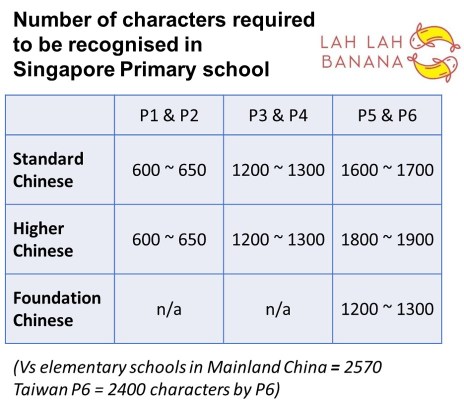
The Singapore standard Chinese curriculum aims for recognition of 1,600 ~ 1,700 Chinese characters by the end of P6, with 60% of these also able to be written. It’s slightly higher for Higher Chinese (up to 1900 characters), and it’s lower for Foundation Chinese (<1300 characters). There’s a full character list here from the MOE of what is expected at each year level.
Number of characters required to be recognised by year level in Singapore Primary schools
In contrast, the Mainland Chinese Primary (or Elementary) curriculum explicitly requires 2570 written characters by Primary 6, and infinitely more to be recognised. The Singapore expectation of 1600~1700 characters in P6, equates to about Grade 2 in Mainland China.
After I drafted my post, I saw an interesting post by Guavarama comparing characters learnt by grade in Taiwan schools by grade. With the expectation for 2400 recognised characters and 1800 written characters by the end of primary school in Taiwan, it’s less than mainland China yet, still well beyond the Singapore system.
What do the numbers mean in reality?
Comparison of amount of characters needed to be effectively literate in Chinese
What can help a child to become more literate in Chinese?
I feel that encouraging a child to become literate in Chinese is highly important in the bilingual journey.
It’s not just about the numbers of characters which a child can recognise. But if you’re reading this and wondering how to catch up on the character recognition, my suggestion is that instead of focussing on number of characters learnt, focus on number of books to read each week or number of minutes to spend each day reading. It’s a more tangible unit to measure. And through good literature, the literacy will come.
For younger children (pre-primary) “Graded Readers”
There are a few great beginning systems out there which track numbers of characters taught and systematically introduce new high frequency characters. I would encourage anyone with preschool children / P1 to give this a good shot:
Sage Books – covers first 500 characters across 25 books
Le Le Reading series & Odonata series – covers first 1300 characters across 300 books
Disney Reading series – covers first 2000 characters across ~100 (?) books
Rainbow Bridge classic ladder series – covers first 1500 characters across 120 books
All of the series mentioned above are sets of levelled readers, with large sized texts and great pictorial prompts for words. They get progressively harder through the series.
For older children (P1 to P3) “Bridging Books”
The difficulty for us has been finding interesting literature for an older child, especially when their English reading is so far ahead of their Chinese level. The ‘beginner’ books are just boring, with limited storyline, and can make reading more of a chore than anything else.
We started with Le Le series / Disney (which was vaguely more interesting for a P1/P2 child), and then put a lot of effort into finding engaging ‘bridging’ readers – short books that introduce new characters (maybe 10-15% of the characters in a book are new to the child), but with interesting storylines.
“Bridging books” is a term coined for books which span the space between learning to read, and reading to learn (or literature for literacy, versus literature for leisure). These types of in-between books aren’t exactly easy to find on the shelves of the local library (especially the simplest books), unfortunately, as the appeal is a very niche one – since for children from fluent Chinese families, most of these books would be too simple.
I’ve followed advice of a few passionate bilingual overseas bloggers (especially Motherly Notes, and Hands-On Chinese Fun) who have trodden this path ahead of me, and I essentially replicated their Chinese book collections. Some of these books have been winners, and some my kids have been less enamoured by. Others still, they’re too difficult and we’ll try them out again in a few months. I’ve put the links to these at the bottom of this blog.
For the ones they love, I have bought the whole series. For the ones they’re less interested with, I at least encourage them to finish the book if the reading level is appropriate. We’ve generally bought a single book / borrowed it from the library first to make sure if it’s a winner or not. The trick it to understand what your child likes. Across my three children, there are very different reading interests.
List of Simplified Chinese Bridging Books for Children
Sharing below are the series of ‘bridging’ books which we have tried – most of these have no pinyin (or else only have pinyin for the hardest words), so that the focus is on character reading.
I’ve attempted to sort them from easiest to hardest. The characters required is just my best guess – no I haven’t gone in detail and compared all the book text with characters lists! It’s something I’d love to do though 😊 In many cases, I find it’s not just the complexity of characters, but also the length of the text also, and how appealing the graphics are. We use our Youdao pen to fill in the gaps for new characters, since as an illiterate parent, I’m not much help.
Another good tip it to find Chinese versions of English series which your child may have enjoyed and read a few years earlier. They can relive it again in a new language!
For the books with names in blue, these are ones we could find at the Singapore local NLB library. I’ve also highlighted which sets Luka reads, because this is a helpful aspect for non-native parents.
Book Name
Comment
Characters needed by child to read?
Little Bear series 小熊看世界
15 books. They are really aimed at toddlers, but they are easy/cheap to source and could be a good start to a home library. Luka will read them too.
500 ~ 700
Little Mouse Series 可爱的鼠小弟
22 books, only several lines per page. Easy-to-read storylines and beautifully hand-drawn illustrations. Only drawback is font is quite small.
600 ~ 700
Magic school bus bridge books 魔法校車第二輯 (桥梁版).
There are lots of Magic School bus sets. These 24 are the simplest. Luka will read them too.
600 ~ 800
Elephant and Piggie set 开心小猪和大象哥哥
27 Books. Lots of repetition and fun! These aren’t technically bridging books, but they are winners for kids. Most can be read by Luka. There are occasionally some tough characters, so you may need a dictionary-pen on hand.
600 ~ 800
Little Fox series 小狐狸的故事
5 books. Simple story with nice pictures.
800 ~ 1000
The Angry Prince 生气王子
Comes in a set of 3 others by author, Lai Ma. This is a picture book not a bridging book. But the language is good for independent reading
800 ~ 1000
Love Reading Bridge Books 爱之阅读桥梁书
20 books. Long stories (30 pages, and lots of words, but not yet a chapter book). Story is interesting enough for child to want to keep reading.
800 ~ 1000
Wilma the Elephant 大象小不点
5 books. A little harder, but it is Luka compatible for audio. Also, worthwhile for a child to read the English version first.
800 ~ 1000
Marching penguins 企鹅机动队套书
11 books. Beautiful illustrations.
1000 ~ 1200
Dumpling Series 爱悦读: 小豆包系列 (简体桥梁书)
10 books with a fun storyline about food.
1000 ~ 1200
Frog & Toad 青蛙和蟾蜍
4 books. Same as the classic English series, but in Chinese. Essentially these are early chapter books – so less pictures, more text. Luka will read them though.
1000 ~ 1200
Little Monsters series 小妖怪系列書
4 books, intricate pictures. Not long, but concepts/phrases are more complex than other picture books
1000 ~ 1200
Silly Wolf Series 笨狼的故事 (簡體,简体书)
10 books. These have pinyin. The characters are printed in larger size than most books printed in China.
1000 ~ 1200
Laura’s Star Series 劳拉的星星
12 books. These books are long (~6000 characters) but the vocabulary isn’t too hard, and the pictures are lovely. Luka reads it.
1100 ~ 1300
Mi Xiao Quan School Dairies 米小圈上学记
12 book. These are really nice set – fun storyline about a boy who goes to school in China. The first couple of sets have pinyin, and then it stops. Luka reads a few of these books.
1000 ~ 1500
Les P’tites Poules 不一样的卡梅拉
40 books. Illustrations are really witty, and have great appeal for older children. Luka will read some of these books.
1100 ~ 1300
The Martine Series 玛蒂娜故事书系列
60 books. There is an abridged set of ten books (~2 lines of text), and then the full 60 detailed set (5 – 7 lines of text). Admittedly the pictures are beautiful (from 1950s) but the story is more boring. Luka reads this.
Abridged books: 800 ~ 100 characters
Original books: 1100~1300
Princess Black Series 公主出任務
5 books. Same as the classic English series, but in Chinese. Essentially these are early chapter books.
1100 ~ 1300
Butt Detective 屁屁偵探绘本
7 books. These are picture books (not the official bridging book set – which is only in Traditional Chinese). These have some harder terms, but kids will find it hilarious. The name is off putting, but thankfully the rest is quite clean. Luka will read this! The pictures have exquisite detail – very Japanese. We devour these.
1200 ~ 1400
Nate the Great 消失的画
8 books. Same as the classic English series, but in Chinese. Essentially these are early chapter books. The set we ordered has English version at the back, and Chinese version at the front, so both stories in one.
1200 ~ 1400
Chinese Bridging Books for Children
For more detail of books in the above table, including photographs, please see my more detailed more here on Chinese Bridging books for children.
There are also some seriously great reference sites on building your own home library of Chinese books. Here are the blogs where I found most of our book ideas from, and I’m grateful for their generous sharing:
Note these bloggers are overseas, so not everything they mention is as readily available in Singapore. But these are certainly my go-to sites and where most of the inspiration behind our own home library has come from.
Enjoy the journey
I hope this has helped you to put Mandarin into perspective. Most importantly is that your create a family and schooling situation where the child loves the language and wants to learn it! I hope that you can achieve that in your family. For us, it’s been a joyful experience.
I would love to hear what’s been helpful on your journey, or if there are specific books or tips which you would recommend too.
If you have reached the end of this, and still wanting to read more, some other posts of mine which you may find relevant include:
This is a mini post. A post about the recently launched Luka Mini.
Luka Mini is a simpler (and cheaper) version of the Original Luka Reading Companion, and it stacks up well against its forebears. I wasn’t expecting it to be as good as it is – particularly give the significantly lower price point. It’s a great entry-level reading robot for toddlers / very young children, as it has reduced functionality and optionality, but the same ability to read physical picture books with high audio quality.
Firstly, if reading this, and you haven’t gotten on board with the Luka-craze yet, please read my earlier blog post about what Luka Reading Companion is. If you are already aware who this intelligent bilingual reading robot is, then read on to see how the latest model compares.
This post contains a detailed review and comparison of Luka Mini against Original Luka and Luka Hero, and covers:
We were blessed to have a Luka Mini join our family a month back, as a beta test for Luka Reads. Within days of it arriving, my kids were asking if I can buy one for them, and I think they do have a good point. If we didn’t already have an Original Luka, this would be my choice for the entry-level product for a toddler. However, it certainly doesn’t replace our much-loved Luka Hero (which is significantly more helpful for an older child).
The Luka Reading Robot Full Product suite
There are five main versions of Luka:
Luka (launched July 2017): the original picture book reading robot – with ability to read story books in Mandarin and English (over 70,000 titles), play lots of Chinese audio/songs, and conduct short conversations using AI voice recognition. My original review was on this model.
Luka Baby (launched July 2018): simpler version of Original Luka, without the voice interaction, and main focus on stories and songs.
Luka Hero (launched August 2018): Same as the original Luka, but with AI image recognition, to support finger-point reading of any Chinese/English words, and more advanced voice recognition detects pronunciation and intonation of a child.
Luka HeroS (launched April 2019): The backend is identical to Luka Hero, but in a different “outer shell” to look more like a space cadet. This version of Hero comes with a series of online interactive English lessons and English videos (note – it’s aimed at Chinese market, to teach them English, which is the opposite of our reasons for purchasing Luka!).
Luka Mini (launched July 2020): an entry level version of Original Luka, with the key focus of reading picture books. Design wise, it has been specifically simplified for younger children: it doesn’t have the LED eyes from the original, and it comes with a with a drop-resistant shell, with low centre of gravity and big buttons for little fingers. Functionality wise, options such as changing the language, or AI-chat functions are more limited. This is the topic for this blog post.
Luka Hero, Original Luka, and Luka Mini
Why Mini?
In terms of product positioning, the Luka Mini is being marketed as “a story machine which can also read physical picture books”. So, it’s designed to be rivalling cheaper indestructible Chinese story machines such小牛津帽T熊 vs. 幼福忍者兔 vs. Food超人. These machines are literally just audio storytellers, but Mini obviously has the additional function to read physical books (which for me, is much more important).
In my humble opinion, Mini also rivals its sister product Original Luka on several fronts in term of most basic use, making it a suitable choice for a baby/toddler. Summary of detailed pros and cons are listed below.
Mini is a toddler-sized Luka, which is easier to cuddle and more robust against dropping.
Pros of Mini (versus Original Luka)
Mini offers quite a few kid-friendly differentiating features to Original Luka, which are:
Kid-friendly buttons: the Luka Mini has a series of labelled buttons on its stomach which make it much simple for a younger child to press, rather than Original Luka which involves clicking on the secret component of the wings and remembering which side does what. This makes it more approachable for a young learner.
Ability for parent to send a voice message to Luka: The Mini has the function for a parent to record a short voice message to their child, which can be played by pressing one of Mini’s buttons. On the Original Luka model, this is restricted to “text messages” (ie a written message which Luka will read out), but it’s not possible for the adult’s voice to be recorded. This is a nice touch – as the microchat function can help a baby to also talk remotely to the baby.
Night light: in the form of the unicorn horn, with adjustable light level and timer. We actually use our Original Luka as a nightlight (using the big eyes …. it’s a bit of a hack!), but Mini has this specifically built-in.
More child-proof design: Drop resistant plastic shell is softer, and more durable (doesn’t make such a big bang when it drops). Moreover, the centre of gravity is lower, so it doesn’t tumble as easily, and the ‘wings’ provide a source of shock absorption. It has large sized clear labelled buttons for little fingers. Finally, the ‘on/off’ switch is functioned by turning it clockwise, rather than pressing the tail it in/out, so it doesn’t accidentally turn on/off if Luka is placed in a carry bag or placed on a slanted surface.
Speaker hardware: according to the marketing materials, the speaker module it uses is designed and manufactured by European company AS Audio, which is better for protecting a child’s ears, as the sound level doesn’t go beyond international safety standard of 85 decibels.
Battery lasts a lot longer: since Mini doesn’t have the huge over-sized and overly cute LED owl eyes. It can go for weeks!
Chinese/English language swap is restricted to only the adult app: This is both a pro and a con. On Original Luka, the language can be changed by clicking Luka’s forehead. I understand some parents of young kids found this feature frustrating as their children would deliberately keep switching it to English, and it was a game of ‘fastest finger’ to change the language back again. For Luka Mini, this issue is removed, as the language is controlled by the parent’s phone app, and nothing else. On the other hand, our family love this function of Original Luka, because the children often read a book page in Chinese, and then again in English, so clicking the head to swap languages is perfect.
Pictures above show the on/off button at the back, and buttons at the front, which are easier for small hands to navigate.
Cons of Luka Mini (versus Original Luka)
The features which have been taken out from Luka Mini, but which are aspects we enjoy in Original Luka are:
Ability to play different versions of the books – Mini simply reads the story books, whereas in Original and Hero, there are options to have ‘role play mode’ and ‘singing mode’, where Luka narrates the books differently (or puts the text to music, and sings it as song lyrics!). This is a feature the kids love, but I don’t think it’s essential.
DIY picture book recording is not possible on Mini – in the original Luka and Hero versions, it’s possible for an adult to pre-record their own story books into Luka, for a child to read along to. This is a lovely feature of the Original product to allow grandparents or friends to record stories for children, or do it indeed in another language like Cantonese, Malay, etc. It’s not possible in Mini.
More limited interactive chat functions – the original Luka and Hero are endearing for their inane chatter, and occasionally unnecessary flatulence. The Mini doesn’t have this. Moreover, Mini is more limited in the voice commands which can be given to it. The voice commands in Mini cover a limited range of Mandarin topics (and non in English), whereas Original/Hero have seemingly endless ability of AI-chat in Mandarin, and a good range in English too.
More limited audio content: The Original and Hero have a much wider range of songs and podcasts (not limited to nursery rhymes and children’s songs like Mini is).
Luka Mini: Cute to cuddle, great with books, but doesn’t replace functionality of Original Luka
Head-to-Head Comparison of Original Luka, Hero and Mini
This table compares the key features across Original Luka, Luka Hero and Luka Mini. For Mini especially, I’ve highlighted in green where I think it’s a benefit, and red where it’s reduced functionality from the Original.
Comparison of what Luka Original, Luka Hero and Luka Mini each do
Which Luka is right for our family?
Which one is witch?
For very young children / babies:
Most of the good story reading aspects of Original Luka have now been replicated into Luka Mini. So for someone with a baby/toddler, or primarily wanting the Luka for book reading, the Mini has you all covered. If you fall in love with Mini, then you’d probably want to seriously consider upgrading to Luka Hero a few years later, as it’s got a lot more features to continue enjoying, especially the broad range of audio/podcasts/music and AI Chat.
For older children:
Skip the Mini. Whilst Mini has many of the functions that Original Luka has, it’s Original’s random chatter and big eyes which make Luka really engaging. In that sense, Mini is lacking in personality and whimsicalness, whereas Original/Hero offers both of these. For an older child, I think engaging it what you want. Original Luka also has a function to record your own books, which is a nice feature, especially if you want to add in a new language to Luka or bring to life stories which your child has written/drawn!
Original Luka is really an excellent choice for any bilingual family, especially if the main focus is on listening to picture books being read, and for the rich audio options. However, for families where parents don’t speak Chinese, Luka Hero gives some interesting applications for older children, such as reading individual characters, or use as a dictionary to look up words (handwritten or printed).
The Luka Hero is leagues apart – both pricewise and functionality-wise – for good reason. Luka Hero has “Point and Read” and “Read and Repeat”, and also uses its large eyes to cleverly display Chinese characters / pinyin / English definitions. This means it can recognise any Chinese/English printed text or neat handwriting, which serves to assist an older child as a dictionary function, or assist in independent reading. I’ve written a detailed review of how Luka Hero compares to Original Luka in a separate post.
Luka Hero’s LED eyes make it an advanced model for older children.
Where to buy Luka, Luka Mini and Luka Hero?
Luka Reads is the official distributor in Singapore, Malaysia, Hong Kong, Australia and New Zealand. For those countries, the international shipping fee is absorbed. Through their website, it’s also possible to order into other countries, if international shipping is paid. Luka Reads provides 1 year warranty and exchanges on any faulty devices.
If you purchase Original Luka or Luka Hero through their main website and enter my promo code as “Lahlah20off” for $20. Thank you Luka Reads team for blessing my blog readers (note: no sales commission/$ to me, just a gift to you!).
JD.com is a Chinese bookstore which ships globally, including in the US. They stock several versions of Luka at great prices, so if you’re brave enough to order through a Chinese website, you could give it a shot. Some mothers from Motherly Notes recommend this method. Otherwise the minefield of Taobao is where we bought our first one from. Neither of these methods will come with the local warranty or support though!
Have fun with Luka!
I hope this post helps you to understand the differences between Luka Mini and other models. I’d love to hear what you’ve discovered too! Please do share – either in comments below, or drop me a note.
If you’re interested to read more about Luka, some previous posts which I’ve written that you may like are:
DISCLAIMER: I’m grateful that we have had Luka Mini to borrow, thanks to the lovely team at Luka Reads – since we were existing avid Luka fans, and I’d already written several blog posts on our other Lukas.
The views shared in this review are my own genuine, unbiased opinion – as is everything contained on this blog. There are no affiliations, sponsorship, commissions, behind this post nor anything on this blog. It’s a passion project, not a business or source of any income.
This post is an exciting collaboration between me (LahLahBanana) and Maggie (PandaMama). Maggie and I met online. After chatting, we couldn’t help but realise how similar we are, yet so different when it comes to raising bilingual children. We’re like role reversals – an Aussie mum in Asia (that’s me) and a Chinese mum (Maggie) in Australia, each is doing the same thing – raising bilingual girls and blogging about it.
Brief bio of PandaMama & LahLahBanana:
PandaMama (Maggie): A Chinese who’s married to an Aussie. Together they’re raising a little girl in Australia. Maggie is bilingual with Chinese as her first language. Due to lack of access, Maggie has started teaching her daughter Chinese since 2019 while working full time. She enjoys sharing her tips and resources via her blog Panda Mama Chinese.
LahLahBanana (me, Emma): I’m an Aussie mother living in Asia, who cannot speak a word of Mandarin. But I’m passionate about raising my three non-native children bilingually, making the most of living in a language-rich environment and ensuring my children become fluent in Chinese.
With such unique experiences and backgrounds, we decided to come together and share the honest truth about raising bilingual children by answering the following five questions. Here they are:
How do you make learning Chinese part of your lifestyles?
What are your biggest struggles in raising bilingual children?
How do you think the struggles will change as the children grow older?
What resources have been most helpful for your children to learn Chinese?
What do you think your children will say about your effort?
Be warned. This will be a LONG post, because we’ve each answered five questions about rearing bilingual Chinese-English kiddos, in our different circumstances. We hope this post would be helpful for you to see our journey from two sides.
Both of us are probably considered a little weird for the lengths we’ve gone to in rearing our children bilingually. But this cross-post is to show you that it is 100% possible regardless of what our backgrounds are, the environment we live, and indeed whether we speak the Chinese language.
So here goes with the questions…..
1. How do you make learning Chinese part of your lifestyles?
Maggie: Since I decided to systematically teach my daughter Chinese from home in May 2019 when she reached five, we have set up and gradually accustomed to a daily routine to have a dedicated 30 minutes Chinese learning session in the morning before my daughter goes to school.
But that doesn’t mean we don’t learn Chinese at other times. The Chinese learning at our home takes place in all shapes and forms, and it’s deeply ingrained in our lifestyle. Apart from reading stories, watch cartoons, play games, make conversations etc. in Chinese, I also like to observe what’s around us, what’s age-appropriate and what my daughter learns from school. I’ll then create bilingual teaching resources around them. That way, she can correlate things in Chinese and English.
Initially, I had no clue what I was doing. I learned as we progress. It’s nearly a year and a half now since we started, I feel confident because I see the results in my daughter.
So yes, for anyone who wants to embrace teaching Chinese at home, be prepared that your lifestyles will change. Why? Think about it. You’ll have less time socialising or sleeping in because you need to utilise these times for your child’s Chinese learning while balancing your work. You’ll likely make new friends because their kids are learning Chinese too. All these things could change your lifestyle. But, trust me, it’s worth it because what’s more important than your child’s well being and positive development?
Emma: Living in Asia, we thought this is an excellent opportunity for our children to learn Mandarin. The more we read up about language learning, the more we saw the importance of making this language a lived experience. Our ultimate goal to for the children to be truly bilingual, rather than it being a language learnt only in the classroom.
Chinese is not naturally part of our household – it’s not a language which I speak, nor my hubby speak, nor any of our parents. So, it’s necessitated a very systematic approach to embedding the language in our lifestyles. We have tried where possible to make this part of our lifestyle, rather than something extra.
Apart from the children learning Chinese as a subject in school, the main aspects are:
Focus on Chinese audio options – We have Mandarin audio as the default language for our PayTV channels (which includes Disney Channel, Dreamworks, CBeeBees in Chinese), and we generally have music and story reading on in the background whilst the children play. Thankfully living in Asia, there are plenty of TV and radio channels available, so we make the most of this luxury.
Nightly reading in Chinese – We also read a lot of books each evening – including in Chinese. I think to become literate in the language is really important for a child. This may sound odd, since as a parent I cannot read it myself, but we’ve put in place infrastructure to help us get through this as best possible – I spent hours researching books that the children can read independently. We try to learn one new character together each day.
Practical conversations with native Chinese speakers – Initially I tried doing this with some friends where we live face-to-face, but it was too easy for this to slip out of the calendar, or slip into English. So, we now do this via Skype at a regular timeslot with a lovely woman who lives in mainland China and speaks zero English. It’s become a really fun part of our routine. Also where possible I schedule the children’s extracurricular classes in Mandarin, so things like piano class, art class, swimming etc we try to get Chinese speakers. I did a post extracurricular activities in Chinese here.
2. What are your biggest struggles in raising bilingual children?
Maggie: We’re a bi-racial family with two different cultures. I lived in China for 30 years before moving to Australia. I’m very much a Chinese so teaching the Chinese language and cultures is a no-brainer.
But, my child was born in Australia, and she’s a little Aussie to the core. She doesn’t understand why she needs to learn Mandarin Chinese. That’s not the worst. My biggest struggle is that we don’t have the Chinese language environment for her to practice what she’s learned at home.
Because of that, I find she forgets the Chinese we’ve learned before, and I have to teach her again. So it’s like I have to do twice the work if not more to get the one job done!
As frustrating as it is, I know I have to keep at it, and never give up because that’s what separates a winner and a loser.
Emma: The biggest struggle at the moment has been having enough time to devote to Chinese learning. I wish there were 48 hours in the day! For me, everything takes a lot longer because I cannot simply look at a book in the library and know if it’s appropriate for my child. I need to come home and research it. As the children get older, it’s taking longer as there are less accessible learning resources which are adequately pitched for an older child’s interest ….. it’s easy to find simple books focusing on the first 1000 characters, but the level of narrative isn’t enough to keep a 7 year old interested, when their English reading level is so much beyond this.
Also for the children themselves, time is becoming an issue too – since there are many other “important things” to add to this list that their peers do – like sports, music, time with friends etc. That’s why, where possible, I’ve tried to tie Mandarin into these everyday activities, so the children don’t feel they are missing out. Even their computer games are in Chinese.
Whilst we live in a Chinese-speaking country, knowing Chinese is certainly not a necessity in the lifestyle we live. So, we have to keep reminding ourselves of the great benefit it is to be bilingual, and that it’s worth the effort.
3. How do you think the struggles will change as the children grow older?
Good question. I never thought about this one. My daughter is six and is an only child, so I don’t have experience of raising children older than she is. I imagin that I’ll have to adjust myself to suit my daughter’s changes and to deal with the old and new struggles.
I believe everything is manageable. We need to find the right pressure points and come up with solutions. When she gets older, she might not want to learn Chinese. I’m not going to force her with a big stick. I’ll continue to show her the “cool stuff” she can enjoy by knowing the Chinese language.
My logic is simple. If a child is fun with doing something, she/he will continue to be drawn back to do it again. That’s why I’ve made a personal mission to teach my daughter and for Panda Mama blog to “help kids discover fun ways to learn Chinese”. I firmly believe the fun factor is the most significant driving force for kids to pursuit any skills. It’s up to us parents to come up with the ideas to make learning fun for our little ones.
Unavoidably, there will be new struggles, particularly when she reaches the teenage years ( I know I was out of control in my teen years). Whatever that might be, I need to show her the P.E.A.C.E. (presence, engagement, affection, calm, and empathy). I learned these terms from a book I’ve read The Power of Showing Up by Daniel J. Siegel.
I’ll continue to educate myself by reading parenting books so that I’m better prepared when the challenging situations arise.
Emma: There’s a great blogger I follow called Oliver Tu. He has successfully raised a pair bilingual and biliterate children in Chinese whilst living in the US (now both teenagers). He explains the most difficult part as “the child’s psychological willingness and acceptance in engaging in such instruction (in Chinese), particularly toward the tween years”. My eldest is only seven, but I can only guess this is coming.
Oliver shares that “it is up to the parents to construct or deliver an ambience for the child, so that the Chinese language provides meaningfulness, joy, laughter….”. He has coined a term “Chinese Language Ecosystem” (CLE), to describe the positive energy that children need, to want to continue to be on the receiving end of bilingual education. He says “the CLE is much much more difficult to deliver than the Chinese instruction per se, particularly in this era of instant connectivity and available online instruction.”. So this is a reminder to keep persevering with making language learning fun, relevant, and real outside of the classroom.
I hope that as my children grow, that they can see the relevance and importance of Chinese to their futures, and will continue to embrace learning and loving the language.
4. What resources have been most helpful for your children to learn Chinese?
Maggie: Being a native Mandarin speaker, it’s a massive advantage for teaching Chinese at home because I know what’s right and wrong. As someone who’s learned English as a second language at age 24, I also know what to focus on to help my daughter master Chinese, her minority language.
So far, I haven’t purchased any Chinese textbooks or sign my daughter in with any online courses because I don’t see the point, and I enjoy to create my own and teach her myself.
Having said, we do read a lot of Chinese books, including those I translated and written. I also like to seek inspirations from other teachers, teaching concepts and make them suit us at home.
Emma: As a non-Chinese speaker, I’ve needed to find quite specific resources to assist my children. This has been especially tough with my children starting primary school, as the language is taught as a ‘mother tongue’, not as a ‘second language’. It’s been a steep learning curve for us all. I think for someone starting out on the journey, my main recommendations would be:
Optical reading pens: There are some excellent optical reading pens in the market which we’ve benefited from – as they can help to read individual Chinese characters, to enable my children to read independently from a young age. These also help me as an adult to read the school newsletter and whatsapp messages from the laoshis!
I’m not a big fan of screen time, so having devices which can read ordinary picture books in Mandarin has been a lifesaver too. My children can borrow a book from the school library, and we can read it at home just like other families can – albeit with some robot assistance!
Graded Chinese readers: these are book sets specifically written for a nascent reader, using limited level of basic vocabulary, and lots of repetition. These readers are my “go-to” for book reading, because even though I cannot read it myself, I can understand where the curriculum is going, and how it builds up. These are like the equivalent of “I can read” books in English. Without a firm foundation in Chinese reading and writing, I don’t think a child can progress much further, at least in a local primary school environment.
iPad apps: I found a few simple iPad apps with vocabulary which align with physical books we are reading. This was helpful to reinforce pronunciation, stroke order, and make the language more fun (in the absence of having an adult who can bring it to life….).
Audio stories which match real books: I’m not a big fan of screen time, so having a device which can read ordinary picture books in Mandarin has been a lifesaver too. We all sit around for evening story session, and we listen to our robot reading the story page-by-page. With the device we have, it can also read aloud may of our existing English books in Mandarin, which is a thrill. The narration is beautiful too. It’s amazing what a little robot can do! It’s not knowing my children can borrow a book from the school library, and that we can read it at home just like other families can – albeit with some bot assistance!
5. What do you think your children will say about your effort?
Maggie: The answer will depend on what I do today, I suppose. I hope my daughter would say “my Chinese is good is because my mum has taught me”. I don’t want her to regret and say “I wish I learned Chinese or I wish my mum had insisted”.
I’m like most of the parents. We don’t do this for the sake of our children returning us favours. We do this because we believe it’s best for our children. Our children may not appreciate what we do right now. One day, when they become mums or dads, they will.
I hope my effort can have a positive impact on her, and she can continue to do the same to her children and lead to a meaningful life.
Emma: LOL! They’ll probably say I’m crazy! I try to get involved in the learning, despite my obvious disadvantages…. like I do drill them on their tingxie (Chinese spelling) each week, as they roll their eyes at me and correct the pronunciation. I agree I’m a little extreme, perhaps nutty.
I hope they’ll also say that it has opened-up their world and futures, and that it was worth all the effort. All too often I hear adults saying they regret not learning a language in their younger years – indeed, I’m one of these adults too! We’re doing this in the hope that our children will not say the same thing.
We’ve definitely taken this bilingual parenting by non-native parents approach much deeper than most of my friends, but we’ve discovered a beautiful new community of like-minded parents around the world who are also doing the same thing.
And that’s a wrap!
Wow! We hope that you’ve enjoyed getting to know each of us a little better. This is a post to show you that with determination, strength and love to your children, YES you can raise bilingual children wherever you are. We’d encourage you to start this journey, and indeed keep it up. It’s a gift to your children and the world.
We leave with you with this quote “学如登山” (xué rú dēng shān / Studying is like climbing a mountain)……… it takes effort, but the view just keeps getting better, and you’ll go places others have never reached!
We’d love to hear from you too, so please reach out and share how you’re going on your bilingual journey, or if there are more things you’d like to be reading.
In recognition of World Mental Health Day, for the month of October I am sharing a weekly post relating to Chinese books which we can enjoy with our children, to improve their mental health and resilience.
This week’s post is about Kindness and Peace-making books.
Thankfully, there are SO many great books on these topics, that it’s difficult to choose our favourites – but here are the top 8 from our bookshelf relating to Kindness, Peace and Unity.
Why is it important to read books which teach about kindness and peace-making?
One of my favourite quotes of all time is:“In a world where you can be anything, be kind”.
Kindness – the quality of being warm-hearted and considerate – is an important character trait for children to understand and develop. It has been scientifically proven that there are many benefits to being compassionate and empathetic. Moreover, it’s contagious!
Some concepts are really hard to teach, especially when it comes to social/emotional areas. As a mother, I love using books as character trait conversation starters. The picture books selected in this post teach children about kindness through a variety of approaches – such as stories, poems, use of metaphors, or profiling peacemakers. These books provide lots of opportunities to talk about what being kind is about, and hopefully build an early foundation to instil and inspire empathy.
I feel these are the types of book that we need to be reading TOGETHER with our kids, no matter what our language ability. A story creates a safe space for the discussions and conversations about what our children are seeing, hearing, thinking and feeling – and opportunities for practice. Coincidentally I also noticed that all the books we’d shortlisted for this post are American books, translated into Chinese – so there are plenty of options to read in either Chinese or English.
Most of these books also have an audio option to listen to them in either language, through Luka the Robot Reading Companion or use of reading pens. One tip if reading these books as a non-Chinese speaking parent with an older children would be for the adult to read the English, and then see how many of the Chinese characters the child can understand.
I feel that it’s important to cultivate a habit of kindness in our homes, and raise happier kids, and a more peaceful world.
The shortlisted 8 books are:
Peace is an Offering 最棒的礼物
The Giving Tree 爱心树
The Peace Book 和平书
How full is your bucket? 你的水桶有多满?
I am Kind 我 很友善
Pigeon Finds a Hotdog! 鸽子捡到一个热狗!
Should I share my ice-cream? 要不要分享冰激凌?
When I care about others 我会关心别人
So here’s to peace, good reading, and good Chinese!
最棒的礼物 Peace Is An Offering
Author: Annette LeBox Translated by: 林芳萍 Country of original publication: U.S.A Language: Simplified Chinese ~ Pages: 40 ~ Lines per page: 1-2 ~Pinyin: No ~ Audio available: No ~ In Singapore NLB: Yes (English version only)
This is a comforting poem, which simply and beautifully illustrates how we can share peace with one another. A diverse group of children are able to find peace in everyday things, from warm sunlight though to sharing cookies. Little readers are taken on journey to discover how simple small acts can bring peace to an individual. Peace can be shared such as through an invitation to a party, or giving a muffin, a hot meal, or wiping someone’s tears. It’s a lovely list of peaceful ideas, and a great reminder that peace is all around us in very accessible ways, if we chose to see it or create it. This book is timely reminder to take delight in the small things!
爱心树 The Giving Tree
Author: Shel Silverstein Translated by: 傅惟慈 Country of original publication: U.S.A Language: Simplified Chinese ~ Pages: 64 ~ Lines per page: 1-17 ~Pinyin: No ~ Audio available: Luka compatible and Ximalaya ~ In Singapore NLB: Yes (English and Mandarin versions)
This is a classic story form 1960s of kindness, generosity and friendship. It’s a simple, but beautifully written story, which my kids ask for it over and over again. A simple narrative, with black and white line drawings, which tugs at the heart strings. There was once an apple tree, and she loved a little boy – he would come to her to eat her fruit and swing from her branches. The selfless tree shares kindness and gifts with a boy as he grows old, generously, and gives until she has nothing more to give. It’s a parable of unconditional love. For me, it also speaks to the consequences of when we fail to mutually care for one another, or take a friend for granted, despite our best intentions.
I know this is a controversial book – and many hate it. I did happen to see a more modern alternate ‘ending’ to the story, which is an interesting spin, and perhaps a good conversation starter for older children.
和平书 The Peace Book
Author: Todd Parr Country of original publication: U.S.A Language: Simplified Chinese & English (Bilingual) ~ Pages: 30 ~ Lines per page: 1-2 ~Pinyin: No ~ Audio available: Luka compatible (in Chinese & English) ~ In Singapore NLB: Yes, but only in English (although Luka will read this in Chinese)
In Todd Parr’s trademark cheerful style with bold pictures, this book defines the meaning of peace for young children. Through simple prose, peace is explained in terms of helping a neighbour, offering a hug to a friend, keeping streets clean. The books turns an immaterial concept into concrete examples of peacefulness which children can emulate. The book will give you a big laugh (“peace is having enough pizza in the world for everyone”), and leave you with a warm heart. The concluding message of hope is that “peace is being who you are”.
你的水桶有多满 How full is your bucket?
Author: Tom Rath Country of original publication: U.S.A Language: Simplified Chinese ~ Pages: 30 ~ Lines per page: 1-4 ~Pinyin: No ~ Audio available: Ximalaya ~ In Singapore NLB: Yes (in both English and Mandarin)
This books simplifies the well known “Bucket of Happiness” concept into something simple for children. We only have the English version of this book, however our Luka reads this version in either Chinese or English.
The concept is that everyone has an “invisible bucket”, which is used to hold good thoughts and feelings. When you do something kind, you help to fill someone else’s bucket as well as you own. Through this visual representation of “kindness”, we can understand how words and actions make others feel, and aim to fill our imaginary buckets every day with positive words and actions, and not to let it spill with hurtful things. It’s simple, and teaches kind words, sharing, and respect. Let’s all be bucket-fillers.
There is another very similar book “Have you filled a bucket today?”你把水桶加满了吗? by Carol McCloud translated by 张宏武, also with Chinese and English audio through Luka.
我 很友善 I am Kind
Author: Habbi Habbi Country of original publication: U.S.A Language: Simplified Chinese-English (Bilingual) or English-Spanish ~ Pages: 10 ~ Lines per page: 4 ~Pinyin: Yes ~ Audio available: yes, through Habbi Habbi Reading Wand ~ In Singapore NLB: No
This is a simple board book which shares short relatable situations which illustrate acts of kindness. This includes welcoming a new child to class, donating money to charity, visiting a sick grandparent, forgiving a bully, and sharing our favourite things. These are powerful examples of kindness, that encourage kids to consider the needs of others.
Habbi Habbi are unique bilingual board books, well suited to toddlers and also beginning Mandarin readers. As with all the Habbi Habbi collection, I am Kind book celebrates values such as diversity and inclusion, comfort with emotional expression, self-confidence and worthiness, resilience, and empathy. This can be seen through the illustrations – which show diversity of faces and races – and the very intentional choice of words in their phrases.
Author: Mo Willems, Country of original publication: U.S.A Language: Simplified Chinese Pages: 34 Lines per page: 0-3 Pinyin: No Audio available: Luka compatible (English only) and plenty of Ximalaya readings in Mandarin ~ In Singapore NLB: Yes (in English and Mandarin)
This is a book from the super-funny 6 book series 淘气小鸽子 The Pigeon, by acclaimed prize-winning author Mo Willems. Mo Willems books in general are great for digging deeper into emotions – and this set in particular is excellent, as in the text size, font and colour, you can see the character’s surprisingly realistic emotions. In fact, pages contain nothing more than a simple hand drawn pigeon, duck, and this oversized text.
When the infamous Pigeon finds a delicious hot dog, he wants to shove the whole thing into his beak. However, a shrewd and hungry duckling also wants a bite. I thought twice about whether to include this one or not – as I do feel the duckling was rather unfair to Pigeon, and I don’t like the concept of a child having to share, just because someone else wants what they rightfully have. However, I decided to include it, as it’s a situation that many a child will face. Pigeon understandably loses his temper, and wrestles with this minor moral dilemma – to share, or not to share. Ultimately, we see the two birds happily sharing Pigeon’s prized processed-food possession.
要不要分享冰激凌?Should I Share My Ice Cream?
Author: Mo Willems, 戴永翔 (translator) Country of original publication: U.S.A Language: Simplified Chinese Pages: 57 Lines per page: 0-3 Books in the series: 17 Pinyin: No Audio available: Luka compatible and plenty of Ximalaya readings ~ In Singapore NLB: Yes (in English and Mandarin)
Sometimes making the choice to be kind is not an easy one, and I feel its important to read books which acknowledge this. You can’t go wrong with this book from the Elephant and Piggie series, also by Mo Willems.
Elephant and Piggie is one hilarious book set, with many great titles focussing on feelings and kindness. Gerald is a caring and careful elephant. Piggie is a joyful but not-so-careful pig. Piggie cannot help smiling; Gerald worries a lot.
In this book, Gerald has a big decision to make – but will he make it in time. For my kids, sometimes the decision to be kind doesn’t get more difficult than deciding whether to share your lollies or ice cream with a friend. My favourite line in “Should I share my icecream” is when Gerald rationalises his decision to not share: “Sharing a flavour Piggie does not like would be wrong.” This story is about the challenges of doing the right thing, and making things right.
我会关心别人 When I Care for Others
Author: Cornelia Maude Spelman Country of original publication: U.S.A Language: Simplified Chinese & English (Bilingual) ~ Pages: 26 ~ Lines per page: 1- 4 ~Pinyin: No ~ Audio available: Luka compatible (in Chinese & English), and Ximalaya ~ In Singapore NLB: Yes, in both English and Bilingual-Chinese version
This book is part of the ‘My Feelings’ 8 book set, which assists children in understanding and describing their feelings. Indeed, their author is herself a social worker. It isn’t so much of a story, as a self-help book for kids which provides relevant examples of what it feels like to care for others. The accompanying illustrations are simple and sweet, showing an empathetic cat and bear in various situations.
The full books in this series are:
《我好害怕》When I Feel Scared 《我好难过》When I Feel Sad 《我觉得自己很棒》When I Feel Good About Myself 《我会关心别人》When I Care for Others 《我好嫉妒》When I Feel Jealous 《我好生气》When I Feel Angry 《我想念你》When I Miss You 《我好担心》When I Feel Worried
Where to buy great Chinese children’s books?
This post is not intended as an advertorial, however readers tend to ask me where I got our books from. So here are some leads, hopefully with the most cost competitive options (if you have better suggestions, please let me know!):
In Singapore: Most of the titles listed in this post are available from My Story Treasury (online) if you’re looking for a one-stop solution. My Story Treasury is a lovingly curated collection of Chinese picture story books for kids. Remember my blog readers have a 10% discount if you use “LahLahBanana10” at checkout from their store. There are several other fantastic children’s bookstores in Singapore too who stock some of these books. Buying local is totally the best.
In Australia, Hong Kong, Malaysia, New Zealand, and Singapore: Most of the titles are available through Luka Reads (online). Luka Reads is the official retailer of Luka the Reading Robot in Australia, and they also stock great books which are Luka compatible. If you use “LahLah20Off”, you’ll receive a $20 discount.
In United Kingdom / Europe:De Ziremi is a new online bookstore for Chinese literature for children. Their collection is growing daily, and they’re hoping to stock some of the titles in this post. They also have several other interesting books on generosity (such as Max Lucado’s All You Ever Need你所需要的). If you quote “LAHLAHSPECIAL” on checkout for anything from their store, my blog readers will receive 10% off. This is a really kind gesture from the four sister team behind De Ziremi.
On Taobao – if you really must do this option, look at the end of my Taobao post for recommended bookstores through Taobao’s TMall. We have bought some great books from Taobao, but we’ve also bought some disasters!
8 books for children on peace, kindness and unity with Chinese and English translations
Take care of your own mental wellbeing!
I hope you and your family will spend some time this month reflecting on emotional resilience, and building this into your bilingual journey.
As you read and enjoy these books together, remember to talk about how the characters in the story spread kindness and peace, and identify practical ways to cultivate this into your personal lives.
I’d love to hear from you if you have other suggestions on bilingual books on feelings and emotions which your family has enjoyed, or comments you may have on the topic.
DISCLOSURE: I am grateful to My Story Treasury in Singapore for giving our family four of the eight books reviewed in this post (Peace is an Offering, The Giving Tree, The Peace Book, and When I Care About Others).
Please know that I only recommend learning resources on this blog which our family believes are genuinely helpful….. there’s no affiliation, commissions, or money being made here at all! It’s simply the passion of sharing!
Do you know what all the features of the Luka Reading Robot? Luka Reading Companion and Luka Hero are two extremely clever robots, known for their ability to read over 70,000 Chinese picture books page-by-page, allowing a child to experience quality bilingual Chinese literature recorded by native speakers. But, aside from book reading, this robot can do SO many more things. (There is also a more basic model called Luka Mini, which doesn’t do much more than reading.)
This post will cover our favourite features and things to use our Original Luka and Luka Hero for (apart from the obvious book reading function which I covered in an early post). These non-book reading features are:
Listening to Chinese podcastsand streaming Chinese pop songs
Chatting and conversations with the AI Chat-bot, especially trivia questions
Night light and lullabies
Games using Luka Hero “Read and Repeat” function
Games using Luka Hero “Point and Read” function
Using Luka as an English-Chinese dictionary
Luka Singing & Role Play modes
If this is the first time you’ve heard about Luka, I suggest reading my original review, as book reading is indeed the main intention of Luka.
Note – these post is referring to the Original Luka and Luka Hero which are sold in Singapore, through LukaReads. There is a slightly different version of Luka which is sold in the US, and my readers have given feedback that the US-model is slightly different and doesn’t do all these other ‘non reading’ options. So please don’t think your Luka is broken – it might just be a different model, if you’re reading this from outside of Singapore.
What else can Luka Hero do apart from reading Chinese books?
Here’s our list of the things we love about Luka Hero (aside from the basic book reading function), for kids from babies to tweens:
1. Chinese podcasts and hip-hop music for kids with Luka Luka
Luka hands-down beats streaming from Ximalaya or iTunes through the phone. It’s the easiest way to get your child listening to Chinese podcasts for kids, the audio for favourite movies (like Frozen or Lion King) in Chinese. In fact, we know families who have bought Luka only for the audio function! Simply talk to it like you would for Google’s Alexa, and request for the themes and topics you’re after. Alternatively, the app itself gives the ability to search by name/topic or select from their predetermined library of audio options, including setting your own playlist. Thankfully the battery goes for hours.
Given that Luka is accessing only Ximalaya FM for this – not the whole world wide web – I feel confident that Luka’s content will be family-appropriate.
Whilst we specifically enjoy podcasts, there is also excellent kid-friendly music using this function available for the whole family – spanning from nursery rhymes and lullabies, through to Mandarin pop and hip-hop for older kiddos. There’s also great classical music and Chinese orchestral selections which as an adult I find appealing too.
The audio options with Luka are limitless ….. anything on Ximalaya can be streamed!
2. AI Chatting and Trivia with Luka
It’s possible to really chat to Luka, and find out funny facts, using our Chinese vocabulary. Questions asked like “Why is the earth round?”, “Why is the sky blue?”, “What is the North Pole?” can all be answered by Luka, if you know how to ask her Chinese (if not…. change your base settings to English, and ask her that way ….. but it kinda defeats the purpose for our family).
Luka also has great sound effects, so a child can say “Luka make a dog sound” and she barks, or “Luka make the sound of waves” and you’re transported to the beach.
It seems there’s no topic too extreme, as Luka even has sensible answers to “How many Emperors were there in the Qing Dynasty”, “What are the customs for Spring Festival?”, “What’s the opposite of lazy?”, “What time is it in Australia?”, “What is the P.M2.5 today?”, and “I don’t want to go to school today!” and “Can we go hiking on the weekend?”. You can tell my kids really test out poor Luka.
Example of the types of topics and questions which Luka Hero can answer!
3. Night light with lullabies with Luka
For us, it’s the best night light we’ve had (we’ve tried a few, from star projector machines, to nursery eggs, and sleep training devices). There’s wealth of music to choose from, including traditional English and Chinese songs, along with classical music.
It’s just such a simple solution – the level of music is adjustable to being infinitesimally low and it can use an existing playlist; the light is dull and soothing, with small flickers as Luka blinks. Also, it doesn’t connect to any power socket, so I feel it is much safer leaving it in the corner of the bedroom and it’s not restricted by cord length. It’s also portable for sleeping in other places.
Finally, from my phone, I can program to turn off the music and the light….. additionally, I can send a message so that Luka will talk to the child if they’re not sleeping, to remind them to “go to sleep” or “I love you”, etc.
It’s worth noting if you use Luka for this function, remember to activate “night mode” on the app, to ensure the brightness of Luka’s eyes is reduced and that system events are not announced. The app also allowed you to set start automatic start and end times for night-mode activation, so it doesn’t need to be done manually each time.
Good night sleep with Luka
4. Games using “Read and Repeat” Luka Hero function
Games is our latest discovery! We have some Idiom Smart Flashcards which enable a child to point to different parts of the card, and Luka will interact with the user to tell different stories, explain the characters, etc. Luka invites the user to say out an idiom, and then Luka rates your fluency (with one or two stars, and sometimes a special bonus image). It’s a nice feature to encourage the competitive juices amongst our kids, and get them actively using Mandarin, through reciting idioms. There are others games and books available with this feature.
5. Games using “Point and Read” Luka Hero function
My kids also like to use Hero to challenge each other about what different random Chinese characters are, and take guesses, and let Luka be the judge.
Recently we made our own DIY snakes and ladders board game with different characters on each square, and Luka does a great job of being referee. We also did DIY sentence builder with magnetic tiles. We’re looking forward to integrating Luka into more of our homemade craft adventures.
6. Using Luka as an English-Chinese dictionary for story composition
Luka Hero has become my daughter’s pal for story writing. When she’s unsure of how to write a word in Chinese, she simply writes down the English word, and Luka recognises her handwriting (it’s a good incentive to write neatly!), and then Luka’s eye show up with the corresponding Simplified Chinese character. It’s not always perfect, but it’s a fast and fun alternative to using the dictionary. For a young writer, this is a nice feature. (Although, our Youdao Smart pen, I think will take over this function from Luka Hero as my children progress through Primary School). It also works the other way around, so Luka can help revise Chinese flashcards too.
7. Luka Singing and Role Play modes
It’s just so cute! Many of the Luka compatible books have an alternate translation where the words are either sung out, or acted out, as opposed to following the text. My children are always delighted to find a new one. Dr Seuss is excellent for this, and so are Eric Carle books. When used with Luka Hero (as opposed to original Luka) this really brings the books to life, as a child can tap on the pictures in the book and hear them speaking. Be sure to check your books whether this is an option.
Select “Role Play” mode in the AppLuka has Role Play, Singing, and Point Reading modes, to make the book experience more entertaining and interactive.
For us, we’ve been getting Luka out at birthdays too. With just a simple request, and she’ll play the birthday song for everyone to join in with. Luka can do K-Pop too! My wordpress blog – being a freebie account – won’t let me upload my own videos. But look at this one below from Little Day Out of Luka singing a song request.
Luka sings K-Pop
How does Luka Luka or Luka Hero compare with other optical reading devices and pens?
Our family has a lot of Chinese reading pens and devices!!! If you want a head-to-head comparison, please see my earlier review here.
Different reading pens and robots suit different learning stages, ages, family situations, and intended learning outcomes. I’ve put together a diagram showing how we see them all fitting together.
Comparison of different Chinese reading pens and robots
Luka Reads is the official distributor in Singapore, Malaysia, Hong Kong, Australia and New Zealand. For those countries, ther international shipping fee is absorbed. Through their website, it’s also possible to order into other countries, if shipping is paid. Purchase through their main website and enter my promo code as “Lahlah20off”. Thank you Luka Reads team for blessing my blog readers!
JD.com is an Chinese bookstore which ships globally, including in the US. They stock Luka at great prices, so if you’re brave enough to order through a Chinese website, you could give it a shot. Some mothers from Motherly Notes recommend this method. Otherwise the minefield of Taobao is where we bought our first one from. JoJo Learning also stock a slightly different version of Luka in the US.
What other fun features of Luka do you know?
Luka has a myriad of other hidden gems, like a slot machine game if you shake her around, and “Magic voice” if you press her nose three times. Then there’s ability for a parent to record their own story for a child, or send personal messages from their phone to Luka to amuse the child. There’s plenty of cuteness and cleverness in this little robot. We’re still discovering more, since most of the detailed Luka literature is written only in Chinese.
There’s a great list of ‘how to’ Luka videos in English at this link, which might give you more inspiration on what’s possible. I also whilst randomly googling found a video explaining different features in English here (it’s very old ….. and only looking at English features only, but if you think this was possible in 2018, imagine how much better it is now! Certainly the narrations have become less robotic since then, and Luka’s capabilities are 3 times better in Chinese than in English in any case!):
I hope this post helps you to understand what else you can do with your Luka, beyond reading. I’d love to hear what you’ve discovered too! Please do share – either in comments below, or drop me a note.
DISCLAIMER: I’m grateful that we have Luka Hero to join our family. The Luka Hero was kindly given to us by Luka Reads Singapore – since we were existing avid Luka fans, and I’d already written several blog posts on our original Luka (which we love a lot, we we did overpay for via Taobao. I don’t want the same thing to happen to you!).
The views shared in this review are my own genuine, unbiased opinion – as is everything contained on this blog. There are no affiliations, sponsorship, commissions, behind this post nor anything on this blog. It’s a passion project, not a business.
If you have a Luka Reading Robot, you shouuld consider getting the Luka Idioms Smart Flashcards 哆学成语智慧卡.
Chinese idioms, or 成语 (chéng yǔ), are short (generally) four-character Chinese phrases which offer gems of wisdom – usually accompanied by fascinating origin stories. They are really meaningful for children to learn, especially as can be common kinds of phrases which will sound strange, if one doesn’t know the real context behind them. In English, think of the equivalents like “letting the cat out of the bag” or “the elephant in the room”. They also give a great insight into Chinese history.
Most parents will tell that these Chinese phrases can be a challenge for a student to learn; I agree. Aside from needing to be able to recognise the individual characters, it goes beyond the literal translation to understand the full expression. Unlike English idioms and proverbs, what surprises me is how many idioms the Chinese language has which are ingrained into daily life! Apparently about 500 – 600 chengyu are commonly used in newspapers and magazines.
My daughter first started becoming interested in idioms through reading Mi Xiao Quan series, but I was at a loss to explain them further. A few weeks ago, we discovered that there are Luka compatible idiom cards, which can really bring these important phrases to life.
What are the Luka Idiom Cards?
Firstly, if you’re reading this, I assume you know what Luka the Chinese Reading Companion is. If not, you can refer to my earlier posts.
The Luka Idioms Smart Flashcards sets 哆学成语智慧卡 are designed to help a young learner understand some of the more common Chinese idioms. We have Set 1 and Set 2, each of which comes with 50 cards (so in total, 100 idioms). They are compatible with Original Luka, Luka Hero, and Luka Mini models.
The cards are good quality, large sized (about 4 times the size of a usual playing card), coloured cardboard, with the idiom and picture on one side, and further explanation on the alternate side, with some simple related activities/questions.
Only the Luka Hero (on right) will read the Idiom cards. It doesn’t’ work with Original Luka (shown on left).
These compact, bite-sized stories are a great way to learn new phrases, and understand more about the history of the language. Many of the idioms are also based on specific episodes in China’s past, so they embody elements of history lessons too. I feel they also help a child to understand that abstract concepts can be used to describe situations.
Using these flashcards with Luka is like killing two birds with one stone: the child picks up new phrases and learns about ancient Chinese history! The cards are fully interactive with Luka, including the ability for the child to read the idiom and get a ‘score’ for their accuracy.
Pros of Luka Idioms Smart Flashcards 哆学成语智慧卡
The cards bring the idiom to life – with an audio and visual element, with one idiom per card. The cards break down the idiom explaining how to make sentences and simple word play (synonyms, antonym, etc).
Uses the Luka Hero “Point and Read” function – click on the people/animals, and they speak; click on the words, and they’re read out; click on the card icons, and you’ll get explanation, background story, etc.
Uses the Luka Hero “Read and Repeat” function: it asks the child to repeat the idiom, and then plays the child’s recording back to the child, and gives them an accuracy score. It’s a fun way to get the child speaking, not just listening.
No screen time (although they do come with a QR code for further related videos … see here for an example).
Contain followup activities and discussion point – The reverse side of the cards have an example of how to use the idiom our daily lives, for example (“Share with your mum and dad an example of something you do through ‘thick and thin’”)
Many games could be played with the cards – once a child knows a good amount of the idioms, it would be possible to design card games using them (e.g. match together all the similar idioms; find the idiom the fastest, etc)
Front and back of the idiom cards. Luka will interact with each of the illustrations, words and ‘buttons’ on the card.
Cons of Luka Idioms Smart Flashcards 哆学成语智慧卡
Luka only will read one side of the card – the reverse cannot be read which is a shame, as it has some nice activities on there.
The idioms can be quite complex and could need adult explanations – if being used in a household where the adult isn’t able to understand Chinese, it could be of less use.
It’s a very mixed bag of idioms – These cards contains 100 idioms, Some chéng yǔ are more common in spoken language than others; some are more metaphorical than others. It would be helpful for the parent to look at the idiom first and decide whether it was likely to be understood by your child. Also, consider checking with for lists of common idiom on the internet, to see if the ones you’re using are actually likely to be encountered in your child’s reading or spoken exposure.
How do the idiom cards work with Luka?
These idiom cards can be read with Original Luka, Luka Hero or Luka Mini.
You can click the idiom itself, and learn how it’s pronounced. You can click the individual characters, and learn their meaning, and other similar words. The cards have the ability to listen to your pronunciation, and grade what’s been said. At the bottom of the card, it recounts the story, the meaning, and additional background on how to use the idiom in different situations and contexts. All in all, it’s quite a neat way to dig deeper into an intangible idiom. My kids’ favourite aspect is clicking the illustrations and repeating what the protagonists say.
Here are some examples of what you can discover.
Luka Hero with the idiom flashcards (note how big they are…. 16 cm x 12cm)
Idiom: 游刃有余yóu rèn yǒu yú Handling a butcher’s cleaver with ease
Meaning: to do something skilfully and easily
Story: A chef slaughters his cattle for the King, and his technique in doing so was very skilled. He was able to move his sword blade skilfully through the crevices of the cow, without any obstacles. The King was dumbfounded and praised the chef.
Idiom: 黔驴技穷 qián lǘ jì qióng Donkey has exhausted its tricks
Meaning: Someone at their wits end / or If you have no strength, you’d better stay out of trouble
Story: In ancient times, Guizhou Province had no donkeys. One day, a man full of far-fetched ideas shipped a donkey to the region. But soon he soon discovered the donkey was no use, so he took it to a mountain and left it there.
A tiger saw the donkey and thought it was a mysterious beast, and hid in the forest. The donkey brayed, and the tiger thought the donkey was going to bite him. But the donkey did nothing more.
The tiger soon got used to the noise, and moved closer. At last, he decided to provoke the strange beast. The donkey couldn’t put up with this, and gave the tiger a kick. But the kick didn’t hurt very much. Finally, the tiger knew this donkey was weak. He sprang on the donkey and ate him up!
Idiom: 朝三暮四. zhāo sān mù sì. To say three in the morning and four in the evening
Meaning: Describes indecisiveness and fickleness (English equivalent is a bit like “to blow hot and cold”)
Story: During the Warring States period, there lived a man who loved taking care of his pet monkeys. He was thankful to have such animal, and we would feed them the food reserves meant for his family in order to keep his monkeys healthy, fat and happy.
However, this man’s family eventually began to lose money, meaning that there was less for the monkeys. One night, this man decided that he would discuss this matter with the monkeys, and he proposed that he give them three chestnuts in the morning and four chestnuts at night. Upon hearing that their food rations were decreasing through the day, the monkeys were angered.
The man then changed his proposal: the monkeys would receive four chestnuts in the morning and three chestnuts at night. Hearing that they would get to eat four chestnuts in the morning, the monkeys assumed that their food reserves increased and happily agreed to the man’s conditions.
Where to buy from?
In Singapore, Malaysia, Indonesia, Hong Kong, Australia & New Zealand: The Luka Idioms Smart Flashcards are available through Luka Reads. Luka Reads is the official retailer of Luka the Reading Robot in these countries, and they also stock great books which are Luka compatible. If you use “LahLah20Off”, you’ll receive a $20 discount off Luka or Luka Hero orders too (except promotions).
In United Kingdom / Europe:De Ziremi is a new online bookstore for Chinese literature for children. Their collection is growing daily, and they stock the idiom cards are part of their collection. If you quote promo code LAHLAHSPECIAL at discount, you’ll receive 10% off any order (not just these cards).
In America: My readers have said that the best price option is likely through the online Chinese store JD.com. Alternatively, Taobao. If you really must do this option, look at the end of my Taobao post for recommended bookstores through Taobao’s TMall. JoJo Learning also import Luka into the USA.
Still wanting to know more?
If you still have questions, shoot me a message or leave a comment below and I might be able to help. Since you have read this far, you might also be interested in related blog posts I have such as:
DISCLOSURE: I am grateful to Luka Reads in Singapore for recommending the idiom cards, and providing them so I can write this review. Please know that I only recommend learning resources on this blog which our family believes are genuinely helpful….. there’s no affiliation, commissions, or money being made here at all! It’s simply the passion of sharing!
World Mental Health Day is observed on 10 October every year, with the overall objective of raising awareness of mental health issues around the world.
In recognition, for the month of October, I am going to share a post each week relating to bilingual books in Chinese, which we can enjoy with our children, to improve their mental health and resilience. Thankfully, there are SO many great books on the topic, that it’s difficult to choose our favourites from the bookshelf to include.
The topics will be Feelings (this post), followed by Kindness and Peace (next week), and finally Growth Mindsets.
In this post on Feelings, I will review three book sets:
1) 我的感觉 My Feelings – Bilingual (Set of 8)
2) 淘弟有个大世界 Todd’s World (Set of 8)
3) 情感 Book of Emotions – Habbi Habbi
Why is it important to read books about feelings?
Kids experience complex feelings just like adults – they get frustrated, excited, nervous, sad, jealous, worries, embarrassed, angry and the list goes on. However, usually young children don’t have the vocabulary to talk about how they are feeling – which is why reading books together is a good starting point.
These books recommended in this post provide lots of opportunities to talk about feelings, and also identify feelings in others. But beyond recognising the feelings, the best part is these books give ideas about how to manage our feelings in positive and constructive ways, which is a skill for life. Research has proven that children who are able to identify, understand, express and manage their feelings will experience long term benefits to their mental health and wellbeing.
I’ve deliberately chosen books in this post which contain an English translation also – because I feel these are the types of book that we need to be reading TOGETHER with our kids, no matter what our language ability. Experts say that when acquiring a second language, one of the hardest things to do is express our feelings – these books will help. Each of the books mentioned in this post is bilingual (i.e. it contains both Chinese and English text), and also has an audio option to listen to them in either language, through Luka the Robot Reading Companion or use of reading pens.
Ideally, one would be teaching about emotional intelligence to our children on an ongoing basis, observing and identifying emotions in situations, and options / outcomes. Sometimes this isn’t always possible. Sometimes emotions are too difficult for a parent to explain. And sometimes, language is a barrier. These shortlisted books below are great for discussing emotions together.
One tip if reading these books as a non-Chinese speaking parent with an older children would be for the adult to read the English, and then see how many of the Chinese characters the child can understand.
So here’s to good health, good reading, and good Chinese!
淘弟有个大世界 Todd’s World (Set of 8)
Author: Todd Parr Country of original publication: U.S.A Language: Simplified Chinese & English (Bilingual) ~ Pages per book: 30 ~ Lines per page: 1-2 ~ Number of Books: 8 ~Pinyin: No ~ Audio available: Luka compatible (in Chinese & English) ~ In Singapore NLB: Yes, but only in English (not the bilingual version, although Luka will read these in Chinese)
These are wonderful books to jump straight into conversations about emotions and how to feel good. These come in a set of 8, and I’ve selected two books specifically to include in these post, being 感觉书 The Feelings Book and 感觉真棒 The Feel Good Book.
All of Todd Parr’s books have bold, brightly coloured line illustrations – similar in style to much adored Maisy books – with simple text, holding meaningful messages. That’s Todd Parr’s trademark. This set is no different.
The Feelings Book encapsulates a wide range of moods which a child may experience. It’s targeted at a pre-schooling audience, and with a little dose of humour will encourage a child to recognise how they feel (or want to act) in different situations.
“Sometimes I feel silly”
“Sometimes I feel like eating pizza for breakfast”
“Sometimes I feel brave”
The “Feel Good Book” is a good follow-on to the “Feelings Book”. This book contains a laundry list of feel-good things which children can try, and keep in their toolkit of bringing happiness. From having a ladybug land on your hand, to making new friends, rubbing a dog’s belly, and more. Unfortunately, several of these suggestions are not always possible in a COVID world (like rubbing noses, a big hug, a kiss, etc), but this is why we need to read this book even more. Since some of the most basic ways to feel better and show care might not be possible these days, this books shows there’s always another way to cheer ourselves up.
Both of these books will give you a big laugh, and a great chance to share important conversations with your child.
The full books in this series are:
《不一样,没关系》It’s Okay to Be Different 《没关系》The Okay Book 《感觉书》The Feelings Book 《感觉真棒》The Feel Good Book 《我不怕了》The I’m Not Scared Book 《地球书》The Earth Book 《和平书》The Peace Book 《读书真好》Reading Makes You Feel Good
我的感觉 My Feelings – Bilingual (Set of 8)
Author: Cornelia Maude Spelman Country of original publication: U.S.A Language: Simplified Chinese & English (Bilingual) ~ Pages per book: 26 ~ Lines per page: 1- 4 ~ Number of Books: 8 ~Pinyin: No ~ Audio available: Luka compatible (in Chinese & English), and Ximalaya ~ In Singapore NLB: Yes, in both English and Bilingual-Chinese version
This set is well known in English, and often used by family counsellors to assist children in understanding and describing their feelings. Indeed, their author is herself a social worker.
They are specifically designed to show a young child what a particular emotion feels like, how to cope with it, and how to assist others who might have this feeling. The books assist in nurturing the emotional intelligence (EQ) of a child, and scaffolding their resilience.
Whilst these books aren’t exactly ‘fun’ to read, we’ve brought them out on more serious occasions when one of the family is experiencing a particular feeling, and assist us in solving the problem. They aren’t so much of a story, as a self-help book for kids. The language and scenarios are simple enough for a child to relate to, and I’d view them as a helpful aid to have on hand. We have had some good reflections using these books in a ‘quiet corner’.
For example, the 我好难过 (When I Feel Sad) provides relevant examples of when people can feel sad (rejection, being ignored, etc), and a few suggestions on what a person can do to overcome this. Whilst it’s not exhaustive, I feel it’s enough ideas to encourage a child to start brainstorming how they could cope. It ends with an understanding that it’s completely okay to feel sad sometimes, and that sadness won’t last forever.
The accompanying illustrations are simple and sweet, showing a little hamster family in various situations.
The full books in this series are:
《我好害怕》When I Feel Scared 《我好难过》When I Feel Sad 《我觉得自己很棒》When I Feel Good About Myself 《我会关心别人》When I Care for Others 《我好嫉妒》When I Feel Jealous 《我好生气》When I Feel Angry 《我想念你》When I Miss You 《我好担心》When I Feel Worried
Habbi Habbi: Book of Emotions 情感
Author: Habbi Habbi Country of original publication: U.S.A Language: Simplified Chinese-English (Bilingual) or English-Spanish ~ Pages per book: 10 ~ Lines per page: 2 ~Pinyin: Yes ~ Audio available: yes, through Habbi Habbi Reading Wand
Habbi Habbi are unique bilingual board books, for nascent learners. This book belongs to their set of Phrase Books. It covers some very atypical feelings from the usual books, grouped as synonyms and antonyms from calm to angry, and powerful to vulnerable, and finally worthy/valued.
The Habbi Habbi Reading Wand brings extra vibrancy to the book, including a musical tune paired with each emotion, and plenty of contextual phrases about each feeling.
As with all the Habbi Habbi collection, The Book of Emotions celebrates values such as diversity and inclusion, comfort with emotional expression, self-confidence and worthiness, resilience, and empathy. This can be seen through the illustrations – which show diversity of faces and races – and the very intentional choice of words in their phrases.
None of the books mentioned above are typical story books….. as in, they have no plot or storyline. If you’re looking for good bilingual story books, with plots and characters which create room for open-ended discussions on emotions, do consider:
Additionally, if you’re looking to make a learning module out of ‘emotions’, another good tool is the Le Le Chinese Readers. I mention these books, as I know many readers own this set of 300 books for early reading. The set (especially the red and yellow ones) include several books on ‘feelings’ which make a nice topical study using more basic Chinese vocabulary that a preschooler would be able to read themselves. This is a good option for creating a broader study around the topic – the pictures are realistic too, which aids in discussion facial recognition of emotions.
Where to buy great Chinese children’s books?
In Singapore: Most of the titles listed in this post are available from My Story Treasury (online) if you’re looking for a one-stop solution. My Story Treasury is a lovingly curated collection of Chinese picture story books for kids. Remember my blog readers have a 10% discount if you use “LahLahBanana10” at checkout from their store. There are several other fantastic children’s bookstores in Singapore too who stock some of these books. Buying local is totally the best. I am grateful to My Story Treasury for recommending to our family the Todd Parr and Cornelia Maude Spelman sets, and providing them so I can write this review.
In Australia & New Zealand: Most of the titles are available through Luka Reads (online). Luka Reads is the official retailer of Luka the Reading Robot in Australia, and they also stock great books which are Luka compatible. If you use “LahLah20Off”, you’ll receive a $20 discount.
In United Kingdom / Europe:De Ziremi is a new online bookstore for Chinese literature for children. Their collection is growing daily, and they’re hoping to stock some of the titles in this post. They also have several other interesting books on emotions (such as Everyone《想哭的时候》 by Christopher Neal). If you quote “LAHLAHSPECIAL” on checkout for anything from their store, my blog readers will receive 10% off. This is a really kind gesture from De Ziremi.
I hope you and your family will spend some time this month reflecting on emotional resilience, and building this into your bilingual journey.
I’d love to hear from you if you have other suggestions on bilingual books on feelings and emotions which your family has enjoyed, or comments you may have on the topic.
DISCLOSURE: I am grateful to My Story Treasury in Singapore for recommending to our family the Todd Parr and Cornelia Maude Spelman sets, and providing them so I can write this review. Please know that I only recommend learning resources on this blog which our family believes are genuinely helpful….. there’s no affiliation, commissions, or money being made here at all! It’s simply the passion of sharing!
There’s something intriguing about Koala Know’s online Chinese classes.
I wasn’t looking for another class for my kids, but after hearing how Koala Know’s curriculum had been so carefully and scientifically put together, my curiosity was piqued to learn more. After observing ten classes, I must say, I’m seriously impressed!
This post is our honest review of Koala Know, and how it compares to other online Chinese classes our family has tried like Lingo Bus, Lingo Ace and Vivaling. This blog post covers:
1. Introduction to Koala Know 2. Curriculum of Koala Know 3. Differences from other online Chinese classes (eg Lingo Ace, Lingo Bus etc) 4. Pros & Cons 5. Signing up – in Singapore or online
What is Koala Know?
Koala Know is an online Chinese language learning service, designed for children aged 4 to 12 years old – it’s engaging, cleverly designed, and very reasonably priced. My kids have done a few online classes taught in Chinese – both language related, and non-academic classes which I’ve reviewed previously – but Koala Know is a little different.
Koala Know uses “character roots and trees” – or perhaps what someone with an engineering or IT background would call “systems thinking”, to base their syllabus around. This to me, is a key differentiator between Koala Know and other curriculums which I’ve seen. The main focus is on characters – how they came to be, and how they fit into the Chinese language and interact. It’s done in a simple, elegant and powerful way.
The company was founded in 2018 in Los Angeles, and globally has more than 10,000 students in 60+ countries. Why the weird Australian name? According to the founders, KOALA stands for “Knowledge Of A Lifelong Advantage” – I totally agree with them a good grasp of Chinese is key differentiator for the future.
Koala Know Curriculum
“Systems thinking” is a mindset change from linear to circular understanding. And, that’s exactly how the Koala Know curriculum comes together. Instead of having classes either following the local school curriculum (like Lingo Ace does), or topical themes (eg colours, animals, birds, like Lingo Bus does), Koala Know uses a linguistic lens to design their syllabus.
“Systems thinking” is about understanding how the individual constituent parts interrelate, and fit together – in this case, Chinese characters. For anyone who has taken this topic at university, words like ‘synthesis’, ‘interconnectedness’ and ‘feedback loops’ are likely themes you studied for an exam. Systems thinking uses these themes to untangle puzzles and work within the complexity of life on Earth. Such processes are being used now to solve the world’s biggest problems like global warming, carbon footprints, income disparity, and racism. And, evidently learning languages
Koala Know is applying systems thinking to Chinese linguistics. They have developed a proprietary curriculum which untangles Chinese characters based on ancient principles and systematically enables the child to use the language in non-linear ways and interconnect feedback loops. Does that all sound too overwhelming? Well, it’s delivered in such a smooth and entertaining manner that the child would have no idea how much effort has gone into the backend.
The first stage of their curriculum focuses on “Character Tree Theory”, to teach 90% of the roots in Chinese, and derive many words, idioms and cultural stories. The stages beyond this are comprehensive study of Chinese linguistics, learning how the characters/words they already learnt are combined to form phrases and longer literature.
To support this, there are optional theme-based classes each month (eg festival related topics, or real life issues) for students to use their language and theoretical knowledge to a broader level.
What are the “Character Roots and Trees”?
The core principal of the Koala Know curriculum is creating Chinese character trees – whereby a part of a character, or radical, is used as the “root”, and then a series of other words / characters are grown from this. It’s a modern spin on a system by Chinese philosopher Xu Shen’s in which he derived a method of analysing Chinese characters, as documented in his ancient text Shuowen Jiezi (說文解字 literally “Discussing writing and explaining characters’). This book, written in ~100AD, is credited as one of the first dictionaries in the world and divides 540 characters roots to explain the original of >9000 Chinese characters.
Character roots from Koala Know lesson. Image source: Koala Know Singapore.
Koala Know draws on on Xu Shen’s “character roots”, with individual lessons focussing on each root. Each lesson uses animation to show these Chinese ideographs evolving from their ancient to modern forms, and then identifies the words and contexts where these roots have grown. To me, this interesting “breaking down” of the characters creates a powerfully deep understanding of Chinese characters.
(As a side observation: yes there are other online classes that have animations of characters in their curricula. However, these need to be taken with some caution. The shape and structure of a Chinese character can represent its meaning – but some learning materials do give misleading illustrations of this. We’ve seen animations other online trial classes which have been engaging, but they haven’t all been classically correct. This could be teaching bad habits for students who will be going deeper with their Chinese studies.)
Here’s a simple example of what is taught in “Grade 2” Koala Know:
The word “home” 家 (jiā) … is perhaps one of the most well-known Chinese characters. The lower part is 豕”(zhì) which means pig. People used to raise pigs at home (pigs are said to be the first animal which Chinese ancestors domesticated and kept as livestock), so having a pig under a roof “家” indicated that it was a place where people also lived, thus a “home”. Sometimes in ancient oracle bones from Shang Dynasty, one can even see versions of 家 that depict a house with two pigs inside!
Evolution of the simplified Chinese character 家 , from bronze, to oracle bones, through to ancient seals. Courtesy of The World of Chinese website.
In Koala Know, the syllabus explains this about the original character. However, others online classes (and flash cards) use animations which don’t bring out this context. It hides the cultural context of the Chinese character and makes it harder for a child to go on and self-study later in life. If the animation is correct, a child can easily learn many more characters.
The symbol, “家” then forms a place in many related words like 家庭 (jiā tíng = family), 老家 (lǎo jiā = home town), 农家 (nong jia = farmer); 专家 (zhuān jiā expert, people who are specialized in a field); and domesticated animals 家畜 (jiā chù = livestock) and家禽 (jiā qín = poultry), just to name a few.
(It’s interesting to note that symbol 牢 …. being a cow “牛” under a roof “宀”….. is the term for prison cell or jail!)
For contrast, see this image below from another online class which puts a graphic around “家” which brings out ‘family’, but doesn’t explain the try building blocks.
From another online class….. probably not the best way to learn “jia”.
Here’s another example, for Grade 1 Koala Know:
The characters for “above”/up” 上 (shàng) and “below/down” 下 (xià) are categorised as ideograms in Chinese. Ideograms express an abstract idea through an iconic form. If you combine the two character together, you get “卡” (kă) which means “stuck”, as in, “stuck in the middle”.
How else is it different from other online classes?
1. It’s not just a lesson, it’s an entire online platform: Koala Know isn’t just a lesson carried out through Zoom or Skype. It’s an entire platform, filled with learning resources, books to read, and cleverly curated lessons. Other online classes we have tried use Powerpoint-based materials, however Koala Know has their curriculum fully delivered through elaborate, proprietary animations and interactive classroom games (eg the child can click on the screen and play a game with another child), which are shared over the screen.
2. Classes are aimed at truly bilingual speaking children: Whereas services like Vivaling (which we really love!) and Lingo Bus are targeting international children who learn Mandarin as a second language, Koala Know is aiming specifically at families who already speak Chinese, and wish to dig deeper into the beauty of the language, along with history and culture. Of course, like our family, despite not being culturally Chinese, my kids had a relatively solid foundation of Chinese, and Koala Know suits them well.
3. Quality of full time teaching staff: Research suggests an important variable in any students’ learning is the quality of their teacher. It was encouraging to see that even in the promotional materials for Koala Know, they state their teaching staff are fulltime and fully trained in Koala Know pedagogy. In fact, it takes six months of full-time training of their staff before they can teach on the platform. This demonstrates Koala Know’s commitment to its team of staff, and I didn’t read anything similar on other platforms.
4. Format of class – balanced between interaction and theory. In the other online classes we’ve done, they’ve either had no real interaction between other class participants, or, it’s been an ongoing game / ‘competition’ with trophies awarded for the fastest correct response. Koala Know does have some competing games (not as many as other classes we’ve done), but it also encourages real co-operative participation between classmates, eg in some activities they make up a story by each doing part of it, and the teacher guides them to take turns, listen and respect each other. The same student cohort is fixed for each class too, which helps create this supportive class environment.
The Koala Know class is interactive involving writing, speaking, singing and games.
Pros & Cons of Koala Know online classes
Pros
The lessons are fully recorded and able to be played back through their platform
Fixed teacher and small class size (maximum 3) to promote interaction
Essentially a one-stop-shop stand along syllabus: Effective curriculum, delivered in an engaging manner, which logically links between characters, words and context
Classes involve both speaking and writing
25 minutes length, which is realistic length for a child’s attention span and shorter screen time than other options
Interactive platform loaded with additional features to use outside of the class, including book reading, thematic and cultural classes, and fun interactive “games” as homework
Simple to book classes at convenient times (it runs 24/7) in comfort of your own home. However, note that class time is fixed once set by the parents, to the teacher and other classmates are consistent.
Customer service based in Singapore (or US, or China … depending on your region)
Cons
Online learning may not suit all children – eg a quieter child may not speak up in an online format… this is true of all online platforms, not just Koala Know. However, the Koala Know structure of having the same teacher and classmates (in contrast to say Lingo Bus or Vivaling) actually helps to facilitate a more shy children to make good use of the online format.
Not for beginners – it’s for a child who is already bilingual in Chinese, and wanting to explore to the next level, especially from a literacy perspective. It doesn’t just simply mirror the Singapore school curriculum.
It does involve screen time – that said, Koala Know do offer in-person classes in Singapore with the same curriculum
It wasn’t as instantly “fun” as other online trial classes we have done – things like Lingo Ace (with lots and lots of games) and Lingo Bus (with plenty of rhymes and songs) are certainly more fun play for a child. Koala Know has a more academic / theoretical focus and instilment of values. In a nutshell, I imagine Koala Know is like the “Berries” of online tuition options.
Based on our experiences of four lessons so far, I feel that Koala Know is an effective and engaging alternative to Chinese tuition and enrichment centres in Singapore. It would also be excellent for homeschooling. In particular, it’s an excellent starting point for preschoolers to get a firm grounding in radicals and character components, to enable future literary development.
Method for teaching the character 山 (shān), meaning mountain, and the related uses for the character. Image source: Koala Know Singapore
What other online Chinese Classes have we tried?
During COVID lockdown of 2020, and we were lucky enough to try out a few very interesting online Chinese learning classes, as summarised in table below. For more info on these options, so my earlier post.
Lingo Ace
Lingo Bus
Koala Know
Viva Ling
Student age
6 – 16
5 – 12
4 – 12
3 -18
Teacher background
Singaporeans with teaching certificates
Mainland Chinese with higher degrees
Mainland Chinese with higher degrees
Large mixture to choose from
Able to choose teacher
No
No
Yes
Yes
Class size
Up to 4
Up to 4
Up to 3
1
Class timing
55 minutes, twice a week
25 minutes, once a week
25 minutes, twice a week
Flexible – 15 minutes through to 60 minutes, as regularly as wanted
Price (without promotion)
S$240 / month (8 classes)
US$200 / term (10 classes)
~US$699 for 36 lessons
US$18 per 25 minutes
Effective Price per class
S$30
US$30
US$19
US$18
Effective Price per minute
S$0.55
US$1.20
US$0.78
US$0.72
Requires software installation
No – web interface
No – web interface
No – web interface
Zoom
Homework
Yes – written homework
Yes – written homework
Yes – but done in form of online game
Optional
Comparison of online Chinese classes for children
In summary, whilst all the online classes are very different, with different pros and cons, I feel Koala Know is a wonderful way for bilingual children to dig deeper into the language, and explore beyond what they probably have been taught within the traditional classroom.
Koala Know in headquartered in California, with all online teachers in mainland China. In some geographies, they also have “Koala Clubs” which provide a physical presence. In Singapore, Koala Know are implementing an online-offline model. Parents can choose a combination of both online classes, and physical in-person classes. The Koala Know Singapore Centre provides customer service, along with offline activities like story telling sessions, workshops, structured language courses, and onsite trial classes for the online programme.
We visited their new centre in Novena (my 3 year old literally ran into a corner of the reading room, sat on a chair and starting reading books), and I enjoyed seeing their classrooms and browsing their well curated Chinese learning products and books being sold. This is actually where our super awesome Youdao dictionary pen came from, which I reviewed earlier.
Free class trials are possible to sign up for through the Koala Know website – however if you are in Singapore, I caution you against doing this directly through the website. In Singapore, I would recommend directly contacting their Singapore Centre to understand the options and ensure you get a sales consultant who speaks good English!. Details here are Koala Know Singapore 考拉华文乐学园: Business number/ WhatsApp is 92963558 and Facebook .
What about you?
Which online classes have your family tried and enjoyed? I’d love to hear your view on Koala Know or other options which you have tried. We’ve also heard great things about Instant Mandarin and Wukong Chinese, although we never got around to trying them. I guess when you’re onto a good thing, why change, right?
All feedback and comments are welcome! Let’s continue the conversation and the learning.
Necessary Little Disclosure: I only share products and services we have personally used and love. We were lucky enough to get a free trial class with Koala Know (as we also did with Lingo Ace, Lingo Bus, and Vivaling). I would advocate that you also make the most of the variety of free trials available, to choose what works best for your family. The free trials are available to anyone, not just bloggers!
Please know that I only recommend learning resources on this blog which our family has, and believes are genuinely helpful….. there’s no affiliation, commissions, or money being made here at all! It’s simply the passion of sharing!