Skritter review: app to learn Chinese characters and tingxie

Skritter is the main app my kids use for learning how to write Chinese characters and revising for their weekly spelling tests (aka tingxie 听写).  It allows spaced learning of character lists, in an interactive way, and progress tracking.   It’s an effective and enjoyable way to assist in writing of Chinese characters, and the added bonus is that it can be aligned to whatever syllabus or vocabulary lists your child is already learning from.

About one year ago I wrote a long guest post on Bilingual Kidspot with a review of the Skritter app. This is a more technical post updating on how we’ve continued using this clever app for a third year.

How we use Skritter app

Using Skritter enables my daughters to practice tingxie by themselves and develop confidence in character learning.  We’ve used the app successfully for ages from Kindergarten through to upper primary – and it’s really a lifesaver for a family where the adults don’t speak/read the language.

At the start of each school semester, I will upload all the weekly tingxie characters, along with some selected words that these characters are contained within (eg instead of adding just 你, I would add 你好, or instead of 下, maybe 下午).  Each of my children then use this app for 5 – 10 minutes a day, to practice the characters and learn new ones.

The first step is to “Learn” the words, where Skritter will read the word in a sentence, and demonstrate the right stroke order. 

The second step is to “Test” the words, where the child is asked the meaning, the tone, and writing of the character.  The app is very flexible, so it’s possible to turn off the reading and meaning components and just focus on one aspect (eg character writing, or tones) which is primarily what we do. 

The final step is the “Due Cards” will automatically appear from the learned vocabulary list, at regular spaced intervals for revision of the older characters, to jog memory and improve active recall.  There is a progress monitor to show how many characters have been learnt, and how they’ve been retained (or forgotten).

For example, after using Skritter daily for ~3 months, my daughter was able to pick up a new 250 characters (and many more words, since words are compounds of several characters), and finally achieved nearly full marks for her tingxie tests in school. Previous to this, she had been almost failing.  After one year, the learned character list reached >1000 characters, and most of them had been retained.  Three years later, we’re still using it.  It’s been very positive. In the last 12 months, we managed to use the app for 315 days out of 365, which was a pretty good effort I felt.

Skritter Chinese progress meter
Screenshot of the Progress Tracker from one of our Skitter accounts. You can see in this that “Definition” and “Reading” progress curves flattened out, because I switched off those aspects from being tested

Pros of Skritter

  • Helps a child to take control of their own learning:  Tingxie (Chinese spelling) is one huge area where I have felt limited ability to help my children, as a parent who cannot speak or read the language.  Skritter has been a godsend, as it’s a tool for helping a child to memorise and revise vocabulary, meaning, tones, and stroke order and track progress.
  • It works:   Clever algorithm behind the software, claims that it allows you to remember more than the 90% of the characters through spaced repetition system to ensure previously learnt characters are not forgotten.  I’ll vouch for this.   
  • It works in multiple languages from the one account:  Skritter apparently works equally well for Simplified Chinese, Traditional Chinese characters and Japanese characters too.
  • Learning to write Chinese is a key step to bilingualism:  For most schools (in Singapore), Chinese language is taught in large classes, and is primarily textbook based.  It’s been shown that for classroom-based learning, if a child can actively and independently read in the language, the journey becomes less of a struggle.  WRITING Chinese is an important step in learning to read because if you only learn how to recognise the characters (i.e memorise from the textbook) but aren’t able to reproduce them from scratch (i.e writing them out), it’s easy to get confused.
  • Bite sized, structured learning with spaced repetition:  Skritter gives an efficient structure for learning, as a child can clock in everyday, do the homework (about 10 minutes) and get instant feedback. The Spaced Repetition System is a really important part of the Skritter algorithm, as science has shown the regular exposure to a new concept helps to engrain it in the memory and aid in rapid recall (which helps well beyond just cramming for this week’s upcoming spelling test and forgetting it again).
Skritter Chinese spaced repetition
Image: from Skritter website, demonstrating the importance of space repetition (google it if you want the really detailed scientific research behind this)

Below is a screen shot of how this spaced repetition works in practice, showing the words my daughter has just reviewed, and the frequency for when their next review is upcoming. This is determined based on the previous review/test outcomes when this character has appeared, and how recently the character has been learnt.

Screen shot of our Skritter iPad list showing due dates for character reviews

Cons of Skritter

Anything that improves learning tingxie is likely to be positive, and I cannot think of a bad thing to say about Skritter. However a few considerations to keep in mind:

  • Good old pen and paper can do the trick ….  Many people have nailed Chinese without using any apps.  However, this will only work if you’re a parent who can supervise  and ensure the stroke order and execution being practised is the right way.  For our family, this was impossible.
  • Cost:  There are cheaper apps like Pleco, Memrise and Anki which you might consider (somewhat clunkier).  Then again, the best things in life are seldom ever free.
  • It’s about intrinsic self-motivation:  Skritter isn’t at all fun.  Fun apps for learning characters are things like iHuman, Wukong Literacy, 2Kids or Maomi.  Skritter is not gamified learning nor does it have any motivational aspects (like earning bubbles or gaming time).  It’s simply digital flashcards with some clever user interface, and some occasional videos.  Have the child’s buy-in, and be aware of burn out  Be sure to have your child self-motivated to want to use this app, as a study tool to help them do better in their tingxie.
  • Focus on the reason for learning – there is a “cheat” mode, which you should avoid letting your children find out at all costs!
Skritter due cards
The Skitter study screen from PC – the only “fun” but is the random phrases of encouragement which sometimes appear at the bottom

How to get the app

Skritter is a paid app – most good apps for Chinese learning are paid ones.  There is a free trial period (one week, full features), and then monthly subscription is about US$10 – $15/month, with lower price for longer periods. There’s currently a bit of a hack, whereby you can maintain access to the app even after the trial period finishes, but you just cannot add in new words (so download it, trial it, and then add oodles of wordlists!).

Go to the Skritter website and check it out for yourself!

Tips for using Skritter app

  • Input words/phrases not just characters: Typically the “vocabulary lists” provided by schools in Singapore are characters, as opposed to words or real vocabulary!  Don’t simply focus on inputting and memorising these ~10 characters per fortnight…. It’s better to look at the characters in a more fulsome context, and create words or phrases using them.  Without doing this, your child will learn characters without knowing many actual words, since words are made up of combinations of characters. 
  • Don’t input too may words all at once or they’ll be a tsunami of “Due Cards” for the child each day.  Skritter can be addictive at the beginning and it could be tempting for your child to get weeks “ahead” of the weekly spelling lists.  However, if you learn too many characters too fast they may soon be overwhelmed. It’s better to keep a slow pace, and sustain for the longer term.  Keep the number of due cards to a manageable level.   
  • Writing and reading are not the same thing: I’m now contradicting myself because I said earlier that writing characters helps in reading comprehension, which it does, for an older child.  However, I personally feel just like phonics in English, for a pre-schooler, it’s best to start off just with reading, until at least 100 or so characters are recognised and short phrases/sentences can be read.  Chinese characters are somewhat easier for a really young child to grasp than English, because they’re pictorial.  But for writing, they’re very much harder due to the stroke complexity.  Hold off on Skritter, and consider an app like Maomi Stars or Hongen Shizi, which focuses on character recognition over writing.
  • Leverage existing character lists from other users or the Skritter default lists: There are some great wordlists already all in there, including HSK lists. In fact, there are hundreds of textbooks and thousands lists., added by both the Skritter team and benevolent individuals. One interesting one is Hacking Chinese’s list of 100 most common radicals.
  • Check that your settings are right for your child:  There are different options for stylus input versus finger input, and also ability to set different levels accuracy for the stroke recognition (eg I have a different setting for my 4 year old versus my 8 year old).  You can also set the retention rate (e.g. 97% or 87%) which varies the spaced recognition algorithm.  A lower number is more efficient, whilst higher ensures your remember more.   Also, cancel the definitions or tones etc if your child doesn’t need these aspects.
The writing experience can be set to reasonably resemble handwriting when accessed from a tablet/phone device
Skritter Write Chinese
For a younger child, they may find it easier to have more limited access (eg only drawing the pinyin tones for a character)

Frequently asked questions on using Skritter to write Chinese

A few questions I’ve been asked quite a few questions about Skritter, so here are answers to some of the main ones:

Can there be multiple users on the same Skritter account?
Technically yes, anyone can use the single account.  However it’s not ideal because the progress tracking and the spaced recognition won’t work so well.  It’s ideal to have one account per child.

How can I set up multiple accounts with only one email address?
I don’t think you can; you need a separate email account to register each account.  HOWEVER, this is all you’ll need the email for (and for the annual renewal invoice).  After that, you can log in just with a username and password.

Can I use multiple accounts on the one PC or tablet?
Yes, it’s easy to log in and log out.

Can I add customised word lists?
Yes, this is the main reason we use Skritter. You can enter custom lists as either characters or pinyin.  It’s possible to search for a character/word and use the pre-defined definitions in Skritter, or alternatively you can add you own definition and new phrases.

For us, I make a new topic for each school semester (eg Primary 1A, Primary 1B, etc) and then within each I separate it into smaller sections for each week of the syllabus.

Skritter with MOE word list tingxie
This is how I have set up each Singapore MOE Chinese spelling list

Can I add the same customised word lists across multiple accounts or share with friends?
Yes – put the list you want in the first account, and then you can copy the link.  Then log into the other account and paste the browser link.  The other way is to publish the list (eg make it public to all) and search for it, but if you do that, you can never change the list again!

Can I add word lists in bulk?
Yes, if you have a list of characters with spaces in between, simply copy and paste the string of characters and it will add them all as separate words to learn.

Can I test writing without the tones and definitions?
Yes, Skritter is able to test writing, reading, tones and definitions in isolation, so not all characters need to be used for every aspect.  Each list can be set up differently – for example, we have it set for writing and tones for school words, and then definition for some of the idioms.

What’s the difference between the two Skritter apps in the app store?
For Chinese, the difference seems to be more of a formatting thing that anything else.  The same login will work on both of them.   We found the older version is slightly easier to ‘tests’ of specific words from but has less optionality.  The newer version (called Skritter: Write Chinese) is better for due cards and tracking progress.  There is a totally separate app for Japanese (but uses the same login).

Is it different on tablet/phone versus PC?
Yes – although you can use Skritter on a desktop computer, it is difficult.  Can you imagine writing the characters with a mouse?. It’s much better as a mobile app, with input from finger or stylus.  The PC version is helpful for a parent to upload wordlists or check progress of a child.

Can I install Srkitter on more than one device such as iPad and PC, or two iPads?
Yes, that’s how we use it! No issues.

Is having a stylus essential?
No, in fact we bought one just for Skritter, and kids prefer it without it.  Writing on the screen is not a substitute for writing on paper. So I’d recommend before a school tingxie test, it’s a good idea to get the child to do one run through using real pen and paper too.

Is there a way to practice particular troublesome characters over and over, without impacting the grading or the spaced recognition for other things in Skritter?
Yes, in the app you can search for a character in a list, and then open the practice scribble pad (option at top right corner which has a pen drawing the letter “S’).  I haven’t seen this option available on the PC version.

See the top right icon which I’ve circled in red – this let’s you get to the scribble pad

If a list has characters / words that the child has already learnt in Skritter (eg from a different list), does the app duplicate these in the testing and space recognition?
There is an option to de-duplicate lists if needed (in Skitter speak, this is called the “rejuvenate” option). It can be good in reducing number of cards, but also not ideal if you want a child to learn a specific set of words, including some words they may have seen previously, as ticking this box removes it from the list of cards to learn.

Is there an easy way to grab the Chinese text from printed tingxie lists in the Singapore MOE school textbooks?
Easiest way is if you can get a PDF or soft copy of the book (some schools or publishers do have this).  Aside from that, try the app “Text Scanner – extra text from images” by evolly.app.  It works slightly better than camera option on Google Translate.  But if you’re a parent who doesn’t read Chinese, beware of some words which may have been mis-scanned, no matter what app you’re using.  It pays to check over these, or ask your child to review them.  Another alternative (and good spoken practice for a child) is they can attempt to put voice audio input into Google translate, and give you the characters that way.

Is there an equivalent app to Skritter for learning English spelling words?
No, but then it’s solving for a different equation. English is a phonetic language, so the basic building blocks are learning the phonics.  After you learn a few dozen combinations, then you have the main language keys to decode most test (in contrast to Chinese where just about every new character needs to be learnt first. It’s not akin to learning the English alphabet at all)!

There are some apps I know of which are like spelling bees (eg SpellWizard or Spelling Bee), where you can enter in words lists, and it tests the typing/spelling of them.  But not really the handwriting and pronunciation aspects, and certainly not a spaced recognition concept. 

Other questions?
The app is always getting better – we’ve seen this from the past three years we’ve been using it.  Their team is proactive and user-oriented.  Skritter maintain an excellent Q&A on the Skritter website too, so be sure to search there and see what you can learn from their rich experiences of their user community.

Other Chinese learning tools you might like

If you have arrived at the end and found this helpful, maybe there are other posts on my blog you might also enjoy.   Our family is one where no parents speak Chinese, so we have explored a lot of fun ways to expose our children to the language.  If you’re considering Skitter, there are also other great technologies and online classes too which you want to consider, such as:

Geniebook Chinese review

This Geniebook Chinese review is NOT a paid or sponsored review (nor is anything on my blog actually, for your peace of mind).

What is GenieBook?

GenieBook is a powerful online platform to help Primary 1 to Secondary 4 students, filled with live classes, quizzes, and tonnes of revision worksheets, generated by AI to tailor for your child.   It’s a Singapore-based start-up, and aims to help children learn smarter and do better.

We started using Geniebook last year due to COVID (as did many other parents, I’m sure).  Her school didn’t offer any live-lessons during the Covid shutdowns, and Geniebook had interactive classes daily, so it was a no-brainer for us to join to continue her learning.  We do pay for it ourselves (it’s a lot of $$) and this review has no sponsorship, nor affiliation.  In fact, I don’t even think anyone at Geniebook will know which parent is writing this 😉 

Up until  2022, Geniebook only had Science, English, and Mathematics.  However, they’ve just this year launched for the first time a Chinese package, and this review is our honest thoughts after checking it out.

How do we use it?

My daughter doesn’t attend any formal tuition centres.  The enrichment we do is music and art.  Then we have Geniebook.  Actually, we probably make a whole lot less use of Geniebook than we could or should because I’m pretty laissez-faire about academic work. 

Geniebook has three main components:

  1. GenieClass: Live interactive classes (sort of seminar style, with ability for child to answer questions and earn points throughout)
  2. GenieSmart: AI generated revision worksheets (combination of multichoice, and descriptive answers, which are then marked by MOE-qualified teachers and feedback given).  A one year subscription gives  300 worksheets per subject, with 15 – 20 questions per sheet.
  3. GenieAsk: Ability to get live help with homework questions, and also some class quizzes/competitions

We decided to trial Geniebook initially for the online classes, to fill the gap created by the sudden school closure, and me not being familiar with the Singapore syllabus.  The great thing about the live classes is you can join any from P1 through to Sec 4, and they’re offered every day of the week and fixed times with fixed teachers, very much like tuition.  I think most people probably join for these classes.  My kids weren’t fans (they’re very much like a typical school or tuition class addressed to a large group) and I could live without this too.  However, despite this we signed up for the full year package because of all the other features! 

Geniebook Chinese live class
Screenshot from a P3 live class

We’re a little unconventional.  We primarily use GenieBook for the personalised worksheets.  These AI-generated worksheets are essentially a replacement for any revision book purchase from Popular, but have the added bonus that they’re marked by qualified teachers, and they focus on the questions where the child really needs to practice thanks to smart AI.  Additionally, unlike textbooks at Popular which somehow often seem to either have outdated questions, or worse still WRONG answers in the back of them, these questions are kept up-to-date with the Ministry of Education syllabus (I would know as over a decade ago I co-authored some secondary school assessment books which are still sold in Popular today despite several syllabus changes and I cringe when I discover this).

With GenieSmart, unlike assessment books, the correct model answer is given instantly after each question (followed by a teacher marking what the child actually did a few hours later).   The real bonus versus an assessment boos is that for every correct question, the child earns “bubble points” which can be exchanged for all sort of tings from fluffy toys and fidgets to mobile phones and Xboxes.  That’s the carrot that has kept my daughter going and going.  Not all worksheets are equal either – a child earns more bubbles for trying out topics and concepts which they are weaker in, which is a nice encouragement and motivation (I prefer this to the Koobits type rewards where kids just get more screen time with gaming interface).

In short, as a parent, I really like GenieBook because it lets me meaningfully assist my daughters with their homework/revision at their own pace, with less effort of needing to find and mark the questions, nor the physical book storage space required.  My daughters love it because they feel more confident in their learning, and get rewarded with things they really want to buy.

What is GenieBook Chinese?

Geniebook Chinese live class
GenieBook live Chinese class for P3

The Chinese Package contains the flagship three products from the GenieBook offering, but is available currently only for P3 & P4:

  • GenieClass Chinese: Live interactive classes (sort of seminar style, with ability for child to answer questions and earn points).  The Chinese class has not one teacher, but TWO teachers throughout, making it a very interactive 55 minutes with lots of role play and dramatization, built around a thematic story.  It’s an immersive Chinese environment, which all instructions also in Chinese, which is a few steps better than classes in local primary school, I would imagine. 

    Whilst my children do not really enjoy the GenieBook Science and Mathematics classes, the Chinese one was very tolerable, and it’s a handy source for increasing Chinese oral exposure.  The online classes are offered twice a week for P3 and P4 , and children can attend both levels.   The weekly class content follows the themes from the Singapore MOE syllabus, but GenieBook has written their own customised stories, so it’s not fully repetitive of the local system.  It’s taught a week in advance, so it’s basically an soft introduction to what the child might learn in formal school that week.
  • GenieSmart Chinese: AI generated revision worksheets (combination of multichoice, and descriptive answers, which are then marked by MOE-qualified teachers and feedback given).  A one year subscription gives 300 worksheets, with ~15 questions per sheet.  In total these are pulled from a databased of ~25,000 questions.

    One thing to note with these Chinese questions is that they cannot be copied and pasted into Google translate.  So a child cannot take a short cut and cheat to get the answer.  Conversely, it makes it difficult to explain the question if the child cannot understand a character in the question, and the parent is not able to assist either.  If you have a product like the Youdao pen (or Google translate photo on your mobile) it’s possible to scan the character and get around this. 

    For GenieSmart assessment sheets in Science / Math, there is an equal mix of MCQ OEQ style questions. However, for Chinese, ~90% of the questions asked are multiple choice, which makes them slightly easier in a way, however less like all possible typical exam questions.
  • GenieAsk Chinese: This is essentially a written chat forum with 30 kids, to stimulate a ‘class’ style environment. It gives the ability to get live help with homework questions, and ongoing class quizzes/competitions.  Teachers are there live each afternoon, and they’re very encouraging with their comments and games. For example, the students who earn the most bubbles in month receive extra rewards, and there are Kahoot quizzes too. For a child who actually does get homework from school, this could be a nice avenue for assistance should a parent not be able to help.
Geniebook Chinese schedule
Timetable for GenieClass live Chinese classes offered in January 2022
GenieClass Revision worksheet

All the Chinese class teachers are native-speaking Chinese and MOE-trained educators, familiar with the MOE curriculum.   

What do we like about Geniebook?

  • One stop solution: Never need to buy assessment books from Popular again nor practice papers from Jeremy, or even tuition classes  (we actually never bought /went to any of these anyhow, so Geniebook has also replaced my complacency too).     
  • Reflects Singapore school syllabus: All the teachers are MOE qualified.  Exam questions are very similar to school examination questions.   Occasionally late at night I will even speed watch a recorded class session (obviously not Chinese, because I don’t speak it, but for Scince or Math)  on a particular topic when I want to understand myself how to better teach/explain it to my daughter
  • Customised and customisable:  Questions are tailored for level of the child, and become progressively harder as the child achieves each level based on AI.   A parent can choose which topics they want the child to focus on, matching what is being taught in school or upcoming tests, etc. 
  • Fun holiday classes and quizzes:  GenieBook runs some interesting lectures / games / quiz series which are much broader than the school syllabus. I assume they’ll do the same for Chinese when the holdiays come around.
  • Instant “standard” solutions given to all questions:  and then personalised feedback provided later from the teacher too. This is mile better than using an assessment book, especially for a parent like me who cannot correct the Chinese anyway.
  • Assists to identify child’s strengths/weaknesses: it does a pretty good job breaking down progress and improvement areas required.
  • Bubble Rewards:  Kids can claim goodies they earn for completing questions.  Yes, they can actually claim them, and the rewards are sent in the mail a few weeks later.
  • Access to all year levels class:  For the live classes, you can access P1 through to Sec 4 where available (for Chinese it’s only P3 & P4 at the moment, but Math & English have all years).  So a child can listen in to any of these classes to revise or stretch their understanding.  Even a sibling could watch on to these live classes and learn too.
The bubble store is the place to be rewarded after completing worksheets
Geniebook bubble store
The amount of bubbles required to redeem rewards varies …… one typical live class will get the child about 100 buubles, and one worksheet will receive between 20 to 100 bubbles, depending on the complexity.

The watchouts?

  • Child needs to be motivated:  Effectiveness depends on how you use it.  For us, we do sit down together and go through the assessment sheets, and their feedback, as we would with any school work.  Unless a child is very motivated/studious (or perhaps in PSLE / Secondary school), I cannot see how this would work otherwise.
  • Cost:  it is much pricier than just buying assessment books.  Conversely, it’s much cheaper than paying for a tutor or tuition centres.  Depends how you see it and what you value. 
  • Online classes aren’t for everyone:  I have to smile as I type this.  My family typically LOVE online classes and have had great success with other online classes for both Chinese and Spanish, but they’re small group classes, not large style lectures.  My kids are not fans of attending the regular GenieBook style classes.  Our neighbours on the other hand rave about them.
  • Typing on the keyboard:  Typing Math solutions or drawing science models on the keyboard might be tricky with GenieBook …… Chinese is even trickier!  You either need a child who will write these by hand and photograph to upload them into GenieBook, or else get them very used to using keyboard/stylus.  This will be infuriating otherwise for your child and you.
  • The Chinese Package is all in Chinese:  if you cannot read Chinese, you won’t be able to revise the worksheets at all with your child.
  • Don’t stress your child with it:  take it in moderation, just like anything else.  Does it really fit your schedule?  It fits ours, because we’re at a neighbourhood primary school with very little (often no) homework, and we don’t do any other academic support.  Even then, we really don’t use all the features which GenieBook offers.  If your child already does external tuition, and gets homework from this, it seems pretty ridiculous to put GenieBook on top of it! 
  • Minimum package size is a year:  for us, we have no regrets, we’ve been using it more than enough to make it worthwhile.  But 12 months is a long time if there’s a risk your child won’t use it. 

How does GenieBook Chinese compare to other online learning platforms for Chinese?

Fundamentally, GenieBook Chinese is designed to support the Singapore MOE syllabus.  Not many platforms do this at all, and GenieBook does it VERY well.  A lot of thought has gone into building weekly classes and curating sets of questions that mirror the very best of Singaporean test book publishers, and stories/interactive activities following the MOE textbooks 

The only other online learning platform we’ve used which is specifically for Singapore MOE is LingoAce, which is more based around the concept of gamified learning and smaller interactive group classes online.  GenieBook’s strength is written exam preparation and AI personalisation.  LingoAce strength is gamified learning to prepare for orals and composition.  Both probably complement each other well.  LingoAce would be more accessible for a parent who cannot speak Chinese or for a child who need to practice their Chinese speaking.  GenieBook is about written grammar, sentence structure,  tingxie, idioms, and etc.

For anyone outside of Singapore, I feel GenieBook is unlikely to be the solution for you.  It’s designed for a child who already has a good written and spoken understanding of the language, to a Singapore Primary 2 level (about mainland Chinese grade 1) and is learning the MOE syllabus. However, if formal grammar / reading / vocabulary revision is where your child needs assistance, it could be a much cheaper solution to consider than a home tutor or even an online tutor.

Geniebook Chinese topics
Example of the topics covered in P3 GenieBook Science
Example of the topics covered in P3 GenieBook Mathematics, showing scores as well

Did we sign up to the Chinese package?

My family really like GenieBook, and we already subscribe to the Science and Math packages, which are areas my daughter is weaker and does need revision outside of the school classroom.  I’m proud to say that even though we purchased it months ago, we’ve continued using it (almost) daily, and we’ve certainly improved at our understanding of both these subjects – me included.  I think GenieBook really can help a child to get confidence in doing a topic they are weaker in, especially if the parent is diligent to assist and learn together.

For Chinese, whilst I see a great product has been developed in the GenieBook Chinese Package, it’s not something our family especially needs.   To put into perspective, Chinese was my daughter’s best subject last year, and she even scored 100% on her school written exam.  Over-learning or over-revising isn’t something I’m a fan of.  So ultimately after doing the one-week trial of the Chinese package, we have decided not to add it to our GenieBook suite for the moment.  For us, we’re better of getting Chinese input through extensive reading of books for pleasure and less formal 1-to-1 conversations with mainland Chinese speakers (plenty of which are also available online too).

How to sign up?

This Geniebook review is not sponsored or affiliated, so I have no fancy links to offer you to click to get discounts.  However, GenieBook does provide a free 2-week trial for all new signups to their packages (including Chinese) which you can sign up for directly through their website.  If you know a friend who already uses GenieBook, they will usually give some substantial $ to personal referrals, so do your friend a favour and ask them to introduce you to their learning consultant to start out your free trial (and maybe your friend will thank you with a free cup of coffee or even share with you some of their referral bonus). 

As with many online products, the sales experience and after-sales support can make or break the deal.  I don’t enjoy pushy salespeople and I have heard many exist at GenieBook too.  Maybe I’m just lucky, but the learning consultant we were first assigned has been truly excellent,  and very patient in waiting for me to decide to sign up. Ever since, he has always been available by Whatsapp to assist us (including arranging the trial for the new Chinese package too). 

Other Chinese learning tools you might like

If you have arrived at the end and found this helpful, maybe there are some other posts on my blog you might also enjoy.   Our family is one where no parents speak Chinese, so we have explored a lot of fun ways to expose our children to the language.  If you’re considering GenieBook Chinese, there are also other great technologies and online classes too which you want to consider, such as:

If you’re in Singapore and looking to ask questions and share ideas on the Chinese journey, join the conversation with other parents at the FB Group Ni Hao Singapore Primary School learning, which I host along with a few other Singapore-based bloggers.

Note:  These are all my own opinions/thoughts and there isn’t any sponsorship or affiliation or affiliate links  The blog is a passion project, simply sharing things we’ve found useful with others who may be in a similar situation. To stay up to date, you can follow @lahlahbananabanana on FB or IG too 🙂

Chinese Home Library: Best Books of 2020 & 2021

This will be my last (and laziest) post for 2021 …..  a wrap-up of our favourite 5 Chinese books (actually series of books) as voted by each of my kids from the past two years.   I’ve split this into age groups, so you can see what interested my children at different ages and stages.  I’ve also shown the inside, so you can assess whether it might be of interest to your family.

Each of my kids is very different.  The eldest is a real bookworm, who loves mysteries and history.  The middle is an animal and nature lover.  The youngest is a little young to have a preference – whilst she’s still a preschooler, I’m sharing with her lots of books about resilience and diversity, and naturally, some of these have become favourites.

Important note:  All kids are different.  Maybe your family will hate these books; maybe they’ll be too easy.  Parenting isn’t a competition of having the cleanest house, healthiest dinners, earliest bedtimes…. and neither is reading.  This list is meant to be for ideas (I’ve always found ideas of book recommendations from others helpful), and nothing more   There is no need for comparison between the sun and the moon, they each shine when it’s their time.

Our Favourite Simplified Chinese Books By Age

Age 8 – 9 (2021) 

All independently read by my daughter

Top 5 Chinese book recommendations for 2021 from my eldest
  • Zoroli 怪傑佐儸力 
  • Mi Xiao Quan 米小圈上学记一年级
  • Detective Pipi 屁屁侦探推理版 (we have both the picture booksets and bridge books sets; she loves them all, but if you had to force her to choose, she does prefer the bridge books)
  • World History Adventure Comics 寻宝记
  • Mandarin Companion (Secret Garden 秘密花园 , and Sixty Year Dream 六十年的梦 among others)

Insides of our favorite five series

Top Zoroli 怪傑佐儸力 ,
Bottom Mi Xiao Quan 米小圈上学记一年级 (both within Pinyin)
Top: Detective Pipi 屁屁侦探推理版
Bottom: World History Adventure Comics 寻宝记
Mandarin Companion Secret Garden 秘密花园 (left) and Sixty Year Dream 六十年的梦 (right)

Age 7 – 8 (2020)

All independently read, with assistance from optical dictionary pen

Top 5 Chinese book recommendations for 2020 from my eldest
  • Crow Bakery 乌鸦面包店
  • Diary of a Worm 苍蝇的日记
  • Little Fox 小狐狸的故事
  • Frog & Toad 青蛙和蟾蜍 (套装4册)
  • Les P’tites Poules 不一样的卡梅拉

Insides of our favorite five series

Top: Crow Bakery 乌鸦面包店
Bottom: Diary of a Worm 苍蝇的日记
Top: Little Fox 小狐狸的故事,
Bottom: Frog & Toad 青蛙和蟾蜍
Les P’tites Poules 不一样的卡梅拉

Age 6  –  7 (2021) 

All independently read, with assistance from optical dictionary pen

Top 5 Chinese book recommendations for 2021 from my middle child

Insides of our favorite five series

Top: 11 Cats 11只猫系列
Little Brother Mouse 可爱的鼠小弟!
Top: Words of Wisdom 智慧的话丛书
Bottom: Madeline 玛德琳
100 Storey Building 100层的房子系列

Age 4 – 5 (2020) 

Starting to self-read, but with lots of narration from Luka or Le Le reading pen

Top 5 Chinese book recommendations for 2020 from my middle child
  • Elephant & Piggie 小猪小象系列 or 开心小猪和大象哥哥
  • Don’t Let the Pigeon Drive the Bus series 别让鸽子开巴士
  • T-Rex series 宫西达也恐龙系列 (全套7册)  (and other Tatsuya Miyanshi books like Magic Candy Store 神奇糖果店  …. These are too difficult to self read, but fun to listen to!)
  • My Magical Toilet 我的神奇马桶(奇思妙趣三部曲)
  • Le Le Books 樂樂文化

Insides of our favorite five series

Top: Elephant & Piggie 开心小猪和大象哥哥
Bottom: Don’t Let the Pigeon Drive the Bus series 别让鸽子开巴士
Top: T-Rex series 宫西达也恐龙系列 (全套7册) 
Bottom:: My Magical Toilet 我的神奇马桶(奇思妙趣三部曲)
Plenty more picture of Le Le Books 樂樂文化 in my previous posts

Age 3 – 4 (2021) 

Mainly read using Luka or Habbi Habbi wand, or book’s own audio (this is a great age for audio books)

Top 5 Chinese book recommendations for 2021 from my youngest child
  • Angry Price 生气王子 and I am A Fire Breathing Dragon I am a fire breathing dragon, and other Lai Ma books
  • Our World 世界认知纸板书系列
  • Habbi Habbi Bilingual Books
  • Todd Parr Courage & Strength Books  淘第有个大世界
  • I Can Read Nursery Rhymes 我会念童谣

Insides of our favorite five series

Top: Angry Price 生气王子 and I am A Fire Breathing Dragon I am a fire breathing dragon,
Bottom: Our World 世界认知纸板书系列
Top: Habbi Habbi Bilingual Books Starter Set
Bottom: Todd Parr Courage & Strength Books  淘第有个大世界
Top: Eri Carle Sound Books
Bottom: I Can Read Nursery Rhymes 我会念童谣

3 years and below (2020) 

All read using Luka Reading Robot

Top 5 Chinese book recommendations for 2020 from my youngest child
  • Eric Carle books 好饿的毛毛虫, etc**
  • Press Here 点点点, Change Change 变变变, Little Yellow Dot 小黄点**
  • Meg and Mog Series 海伦·尼科尔**
  • Spot the Dog 小玻系列翻翻书:双语故事**
  • Happy Baby Chicks 幸福小鸡系列(套装共6册)

Note: **For these toddler books, actually in fact the first four sets we only have the English copies, and Luka narrates them in Chinese (and English). The fifth book Happy Baby Chicks we borrowed from the local library. My daughter really surprised me when she said this was among her list of favourites. It was a sweet book, but I didn’t realise just how memorable for her. I have no photos unfortunately and they weren’t available this week when I tried to look again for this this post

Encourgaging kids to READ

Maybe we got lucky with the last two years with my kids being prime ages for learning to read, and with the world outside not letting us do too much else. We have spent a good portion of the 2020 and 2021 indoors, snuggled up with books. But it’s never too late to start reading. I found it’s now become harder as my eldest is reaching tween years, and has distinct tastes in books, and yet there’s less information (at least written in English) out there on what to read. As she’s reading independently, there’s always a lurking question in my mind about how much she is actually comprehending too.

There’s a helpful post from Hands-On Chinese Fun about how to improve Chinese reading comprehension for lower primary students, with a lovely approach in it about the child narrating back the books to parents, and turning the reading from passive into active learning.  Well worth a read!    I think this is particularly helpful at the self-reading stage, as a strategy to ensure the reading is being understood.

What else is there to know?

If you’re curious about what else is in our book collection and how I’ve tried to select books, my previous post is an analysis of all the 1100+ books we currently have, and some background into the whys and where they came from.

Actually I’d love to know what your family’s favourite books are! Drop me a line as I welcome all suggestions. I love looking at suggestions from others, and if you do too, I’d suggest checking out Motherly Notes for kids aged 7+, where you can find a huge list of great Traditional Chinese bridging book and chapter book reviews for inspiration. For younger kids, Growing Hearts 123 has nice suggestions for Simplified Chinese picture books and comics.

If you are curious about reading more with your own family, some earlier posts to look at on my Lah Lah Banana blog would be:

Building a Chinese book library at home for children

This post outlines how you can go about creating your own children’s Chinese book collection at home, and what to think about as you do it.

Topics covered:

  • Why encourage your child to read in Chinese?
  • How many books do I need?
  • What types of books do I need?
  • What to look out for in good Chinese book choices?
  • Where to buy Chinese books for children in Singapore?

I only started consciously building a Chinese literacy collection about 3 years ago.  Prior to that, we had less than 10 Chinese books in our house, and none of them were ever read.  

Fast forward three years, and we now have well over 1100 Simplified Chinese books, and each of my daughters reads something every evening (and often many other times throughout the day).   Books have been an invaluable tool in our Chinese language learning.  

This post shares what our library looks like at the moment and how it’s been compiled  (so far …. I envisage our library will continue to be a moving feast).  I’ve always wanted to make a blog post using bar charts, Venn diagrams and marimekkos to put my MBA to good use.  So this is my geeky analysis of our bookshelves.

Why encourage your child to read in Chinese?

Well, why not?

If your child is in a local school in Singapore, they’ll for sure need to be able to fluently read and write Chinse to get through the syllabus.  Trying to achieve a level of literacy without reading any books seems incongruous.

If you are not in such a school situation, and your goal is for your child to have a solid spoken understanding of Chinese (as opposed to literate), I would also contend that literature can assist to play a role in this.  Plenty of research shows it’s difficult to be fluent in a language without literacy unless the language is learned in a fully immersive environment.  I have a separate post on how realistic it is for a child to reach fluency in a non-native Chinese environment.

Ultimately, reading in Chinese goes beyond literacy itself.  Reading books that originate from countries like China and Taiwan (as opposed to books translated into Chinese) can open a beautiful window into Chinese culture and values, and have a profound impact on other aspects of our lives.

How many books do I need?

The practicality and need for this will differ by geography.  Living in a teeny tiny apartment, my objective was to have books that take up less space (not so many hardcover books and titles that can get lots of mileage).  Living in Asia means that there is generally good accessibility of books, including options for borrowing at the library, so I was able to focus more on curating books at home which would be a combination of one or more of the following attributes: (1) cherished, (2) read multiple times, or (3) not available in the local library. 

(As an aside, whilst I love the Singapore NLB, most of what we needed to get started in our Mandarin literacy journey was NOT available in the local library, as I’ve observed their collection caters for either parents who can read Chinese and want to read junior picture books, or else it’s for children who are fluent readers and want to read young adult fiction.  The “in-between” books for nascent and emerging readers were not on the library shelves. ) Author Adam Beck from Bilingual Monkeys has written several books about maximising your child.’s early bilingual abilities and he includes success stories from families around the world.   One thing which sticks with me from his work is the correlation between the number of books a child has access to and their overall language fluency. There are other studies looking at time spent reading each day that draw similar conclusions.

To very badly paraphrase, about 500 books in the target language are needed for a child to have a good shot at fluency. Books add a dimension to language learning through extending vocabulary with everyday conversations do not allow for. In fact, access to books has more to do with comprehension and vocabulary building than literacy (which comes later) and can happen from a very young age. I would certainly credit extensive reading as being key to my children’s progress in Chinese.

Over three years, we’ve now built a collection of >1100 Chinese titles at home, which caters to an age spread of 5 years between eldest and youngest child. This number feels about right for us and it all fits nicely within an Ikea Kallax.

What types of Chinese books should I buy?

Books which your children will like. Period.  There’s no point in having books if they won’t be read.

There are various types of books, and some will be more helpful at different ages of the child, and progression in their language. 

I feel that children should be exposed to (pretty much) all kinds of literature from when they’re very little: both fiction and nonfiction, meaningful and whimsical, and yes some talking animal books are okay too. I’ve largely followed the same principles in building our Chinese book collection as I have with our English book collection, albeit with a much larger amount of resources (being effort + time + $ + shelf space) spent on the Chinese collection.

I did extensive research and compiling of lists before I bought anything. I relied heavily on my favourite online Chinese bookstores who have beautiful collections, and include English reviews for their Chinese books. I also leveraged and very much appreciate the groundwork from the amazing blogs of other bilingual families (especially Nancy from Guavarama, Julie from Motherly Notes and MJ from Hands-On Chinese Fun). who have generously written about the trials and tribulations of their own home collections, albeit in other countries.


There are seven main types of Chinese books for children, and our collection spans nearly the whole spectrum:

Toddlers / Early Language Acquisition
Board Books  (翻翻书 fān fān shū)  

Board books are sturdy books made out of thick and durable cardboard (often wipe clean), with simple stories, that a young child can handle by themselves.  They’re usually designed for a parent to read, so often don’t contain the simplest of written vocabulary.  On the whole, we had very few of these due to their ginormous space and my inability to read the content to the kids. One set that we did intentionally make space for is Habbi Habbi Bilingual Books, which come with a reading wand, for a toddler to self-read through tapping the pages.

Simplified Chinese board books for children
Younger Children / Emerging Language Acquisition
Picture Books (绘本 huì běn) 

Stating the obvious, pictures books have many pictures. The stories can vary in length from a few sentences (best for toddlers), to very long (for older children with a longer attention span). Many of these also have the tiniest font size imaginable. Like board books, these are typically books designed for an adult to read, and the vocabulary can be VERY hard.  This is why it’s difficult to go to the library and choose a picture book and assume your child will be able to read it themselves. 

For us, we would typically use our Luka Reading Robot to narrate picture books.  We’ve found many of the best picture books available in Simplified Chinese have actually been translated from other languages (usually English or Japanese). I’ve also felt that the picture books originating specifically from mainland China tend to often lack the humor or sentiment which my children enjoy in a picture book, or contain morals that don’t always gel with our family values, or a just plain *yawn*.  Of course, that’s an over generalisation, as there are some fabulous Chinese authors we love, such as Lai Ma 賴馬.   

Some of our favourite Simplified Chinese picture books
Early Readers / Nascent Literacy
Graded Readers or Levelled Readers (分级阅读 fēnjí yuèdú)

Graded readers (also sometimes called decodable books in English) are a special sub-category of picture books, which are made up of a limited word selection (often building up progressively) with pictures, to introduce basic literacy to children. Usually, these books come in entire series (like Le Le Chinese, and Odonata or the equivalents in English would be Bob Books or Fitzroy Readers) which would cover the 500 or even 1500 Chinese characters.  Hopefully, the font used will be big and clear, to encourage character recognition by the child.

On the whole, the stories contained in such books will be less interesting than other picture books, but the child will have a sense of accomplishment because they can actually read the book from cover to cover.  Many series of graded readers will become progressively harder, adding new characters and increasing in length throughout the series.

A selection of our Simplified Chinese graded reading books

The charts below are from two earlier posts where I examined levelled readers in more detail. You certainly don’t need ALL these sets. This is just to highlight there are many options out there. The reason why it looks like we have so many of these levelled readers at our house is that a series like Le Le Chinese comes with 300 mini books in it.

Which levelled reader is right for us?
Comparison of character lists contained in Le Le Chinese, Sage and Odonata graded readers. Yes we have all three because they’re all different.

Earlier posts where these graphics came from are comparing popular Chinese readers and character lists from Chinese graded readers.

Emerging Readers
Bridging Books (桥梁书 qiáo liáng shū  or 道路书  dà olù shū)  

This is a genre of books that makes the bridge from a picture book into regular fiction novels.  They’re really designed for those who can read (say >1000 characters) but still need to build up their reading muscle for longer texts, and keep learning new words through spaced repetition and exposure in different contexts.   The books may have a few pictures, but the focus is really on the text, and a child being able to read this by themselves.

These can be for children or adults, and there are specific series which in fact are designed for older learners (such as the easy-to-read novels by Mandarin Companion) which deliberately try to have more complex storylines, despite the character length limitations.   These are the kind of books that are difficult to come by on the shelves of the local library in Singapore, and this is where I’ve put a lot of effort to curate a collection of these that is suitable for my children.

Some of our favorite Simplified Chinese bridging books

Sometimes there are picture book sets (as opposed to chapter books) that could broadly fit this category too (such as Mo Willems’ Elephant and Piggie 开心小猪和大象哥哥).  Thie genre is a little ill-defined, but the intention is first books that a child can read independently after they move away from the training wheels of graded readers.

Bridging books for independent readers
Confident independent readers 
Children’s Junior Fiction (儿童小说  értóng xiǎo shuō) or Chapter Books ( 章节书 zhāng jié shū): 

This is what you’ll find plenty on the bookshelves of the local library if you live in a Chinese-speaking country.  They’re designed for good readers, who are moving into the ‘reading for pleasure’ category.  They’re mostly all text, and the story takes centre-stage.  We’re yet to indulge in any of these, but it’s my hope that my children will reach such a stage in the near future.

Other types of children’s books:
  • Comic Books (漫画 mànhuà) :  Filled with picture comic strips and more limited text, presenting a serialised story. You’d be surprised at how much language a child can pick up from a good comic.
  • Non Fiction (非文学 fēi wénxué) :  with wonderful informative facts about the world, and events, etc.  For kids books, I found that this genre often spans into a blending of fictional and nonfictional elements, such as with Magic School Bus science adventures.  However, there are books like National Geographic which are of course pure non-fiction.
Chinese comics are such a favorite …. I couldn’t take the photo without a child trying to steal a book!

What to look out for in a good book choice?

This is very personal, and reflects a lot about the needs of the family (or the parents at least) as well as their interests.  There are many great books that someone you trust will say is excellent, and it might well be a flop at your house, especially once you get beyond the levelled reading stage. 

However, I’m sure there are even more books out there that are genuine total flops and these books will never be winners at anyone’s house, no matter how cheap or great they look on Taobao. So I’d suggest not to randomly purchase books on a whim, and especially so if you’re not fluent at reading Chinese and vetting the book.

A few high-level observations on how our collection has come together:

1. Choose books which fit their designed purpose

If it’s a picture book, make sure the pictures are beautiful – I look for artwork that stands out and is something we can discuss together, be it watercolour, or intricate pencil drawing.  For us, a large part of finding picture books has been ones that also have audio narration (easiest through Luka), since I’m unable to read them myself.

If it’s a levelled reader, make sure the font is a good size and the child can actually read it by themselves rather than needing Luka to read it.   Avoiding the crutch of pinyin is also a good idea here.  

If it’s a bridging book, make sure it captures their interest in wanting to read more and ideally isn’t cluttered with too much unnecessary pinyin nor English translations.  

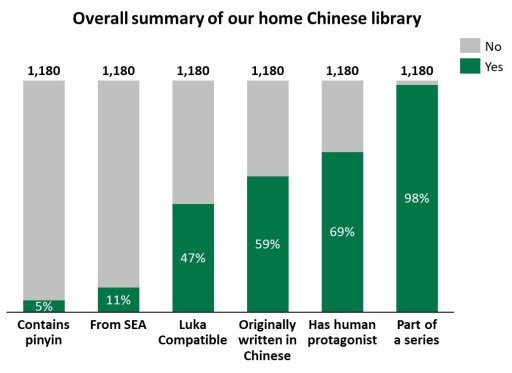
I’ve actively tried to avoid books with pinyin and English, apart from our toddler books, where I’ve found it useful as a non-Chinese literate parent to help connect with the book.  About half of our board books are bilingual and include pinyin, whereas less than 5% of all our other books have pinyin. Another perk – for an identical title, the books without pinyin tend to be cheaper!

Most of our home collection deliberately avoids pinyin

I’ve deliberately chosen our picture books (and non fiction books) to be compatible with Luka Reading Companion

2. Ensure they’re well written (and well translated)

We have an eclectic mix of books, as you can see from the chart below showing all our books by type and author, in portion to how many books we have of each type. In total there are over 100 different authors, and not all can be labelled on this graphic. Do you identify with any of these names?

Books translated into Chinese

This is where I rely on other parents.  Not all books translate well into Chinese.  If they’re picture books, perhaps the rhyming doesn’t work in the translated version (good example here is the Madeline 玛德琳 series…. some of the translations rhyme and others don’t).  If they’re bridging book, perhaps the intended word selection is harder (Nate the Great 大侦探奈特系列 is a good/poor example of this – a book which is designed to be simple in English for a slower reader is really not so simple in Chinese). 

The general rule of thumb I have found is that Japanese books tend to be translated well, as I suppose the language more naturally lends itself to this.  Many Japanese picture books are stunning (both story and illustration-wise) and have not ever been translated into English, so they’re ones we have generally enjoyed the most. In contrast for English books – even if they were award-winning in English –  are a very mixed bag when put into Chinese.

Books written originally in Chinese

Surprisingly (or not), many non-translated original Chinese picture books can also be a little off when it comes to being well written.   They’re either overly preachy/moralistic or a total bunch of nonsense.  On the whole, we’ve avoided picture books originating from mainland China unless they’ve been very highly recommended.   Conversely, for graded readers, given the entire focus is around character selection, it would be weird for such books to have been written first in English. 

On the whole, our books come from a diverse range of origins. This is illustrated by the chart below – this of it as a square pie chart, with the amount of space taken up being the proportion of books on our shelves.

Depiction of the number of books in each category by the original language of the book

Across all book categories, without doubt, our most favourite books which get read over and over are those that are translated from Japanese (be it Zoroli 怪杰佐罗力, Butt Detective 屁屁侦探, 100 Storey Building 100层的房子, Crow Bakery 乌鸦面包店, Brother Mouse, 可爱的鼠小弟, Little Fox 小狐狸的故事, etc).  Second favourites have been books written directly in Chinese (like Mandarin Companion, Mi Xiao Quan 米小圈上学记, Lai Ma 賴馬 books, Monkey King, etc).  Books translated from English or European languages have generally been poorer cousins.

3.  Be mindful of anthropomorphised animal characters

This has nothing to do with the Chinese angle, and it’s all to do with scientific research.  It’s been proven that reading stories that contain human characters (as opposed to talking animals) can significantly increase a pre-schoolers altruistic giving, and promote prosocial behavior.  That’s not me, that’s the doctors saying this. 

The Montessori principle here – for younger readers – would suggest focusing more on books that realistically depict and feature topics they can appreciate and learn from in everyday life (not dragons, superheroes, etc). 

I’ve tried where possible to stick with these guidelines, and give a good balance towards books that do depict more natural interests of a child, including seasons, animal life, places, people, and cultures.  However, there are some very delightful books, like Frog & Toad 青蛙和蟾蜍 , Elephant and Piggie 开心小猪和大象哥哥 , Crow Bakery 乌鸦面包店 etc, which I wouldn’t have ever not bought. They’re wonderful stories which have brought us much joy.

It’s said that nearly 80% of children’s literature contains anthropomorphism. So for our bookshelf to be less than 30% anthropomorphic is bucking the trend enough for me.

Number of books and % where there is no anthropomoprhism
4. Try to support local South East Asian authors and illustrators

This is not always easy, because Singapore is a small island and arguably lacks the creative depth which other countries may have.  However, that is exactly why I do try to find local gems, and these makeup ~10% of all our books.  The scenery they depict and the stories they tell are much more relatable too, meaning they can be endearing reads.  A lot of our books on local festivals and foods are locally produced, and they’re great. 

What I found is that good picture books and readers published in Singapore or Malaysia are relatively easier to find than bridging books (and that’s also reflected on the NLB library bookshelves too). 

Our home Chinese library split by book type and origin
5. Fits the child’s interests

Only you will know your child.

Overall, I like to find books that are fun/enjoyable/moving to read with my children and share valuable life examples, whether that’s done through fantasy, reality, or something in between. 

Sometimes I have allowed books to be read in Chinese that I would bypass in English (such as comics, Diary of Wimpy Kid, Dogman, etc which all they’re friends talk about), because I know it’s something that will actually attract my children to want to read the Chinese version. I’ll do a follow-up post soon with the “Top 5” reads of the year as voted by my children.

6. Contains some Chinese cultural references

By this I mean idioms, references to a festival, or famous poem, historical figure, etc. Actually most of the books originating from China will give a glimpse of this, whether through the depictions or the story.   We’ve really found great things in this category, from historical comics through to the well-written and researched Mandarin Companion stories that cleverly retell English classics (like Jane Austen’s Emma, or The Secret Garden) in a Chinese setting. This is the same reason why I very much prefer my children to watch cartoons originally scripted into Chinese, rather than translated, if good quality ones can be found.

The number of books in our home collection that are originally authored in Chinese
7. Full sets of books

98% of the books we have are from complete series, rather than stand-alone books.   There are a few drivers behind this.

Where I can, I do borrow books at the library first and see if the child enjoys the particular author or series first.   It’s actually quite hard (or time-consuming) to borrow complete sets from the library, and that can frustrate my daughters who enjoy reading things in order once they’re hooked. 

So once I’m sure the child loves it, I’ll buy them all.   The logic is if they love one, then they’ll love them all, and it will keep them occupied without needing to find another new title to check out.  An added benefit is that it’s significantly cheaper to buy books in full sets.

And that wraps up collection of Chinese books, as of November 2021.

Where to buy great children’s Chinese books in Singapore?

Most of our books have come from online stores, although I do love physical book stores (I’m learning to be less self-conscious about asking for help when I step into these places not knowing a word of Chinese).  In Singapore, visiting a bookstore like Maha Yuyi in Bras Basah is a great option for browsing and getting recommendations for all ages – their prices aren’t bad either.

Sources for where all our Chinese books have been procured from

Singapore is blessed by many great online Chinese bookstores, often run by passionate bilingual mothers.  Many of our books came from group buys through such online bookstores. I also scout around secondhand from Carousell and from this FB Chinese book swap group that I started with a few other bloggers, as none of us have endless money to throw at books.  Others have come directly from Taobao and EZ Buy., which is why I’ve included the Chinese characters in this post, to assist you to browse by category if you are trying to search websites divided into book categories.

We also use our local library A LOT.  This post only lists the books we own in the house, but in terms of borrowing, we visit weekly and have a bundle of books each week (typically picture books for Luka to read to us.).  Some libraries in Singapore have better-equipped Children’s sections than others (like Our Tampines Hub).  I did an earlier post on finding great picture books in the local NLB library, including our favourites ones to visit.

On the whole, I’ve found for picture books (fiction and nonfiction) there are many wonderful go-to stores in Singapore.  For graded readers, they’re typically cheapest when direct from the publisher.  And for bridging books and beyond, as much as I’d love to buy them locally, the options have been much more limited.  Best local options for slightly older children’s literature have been Maha Yuyi and Books4Tots (ironic name given they are one of the best for older children’s books too!). If you know of other great sources for tween books, please share with me.

For the books which I’ve purchased locally in Singapore, there’s quite a difference between where to source books foe younger kids and older kids

What else is there to know?

Actually I’d really love to know what your family’s favourite books are! Drop me a line as I welcome all suggestions.

If you want to read more on creating your own home Chinese library, some earlier posts to look at would be:

Note:  These are all my own opinions/thoughts and there isn’t any sponsorship or affiliation from any bookstores., and no affiliate links  The blog is a passion project, simply sharing things we’ve found useful with others who may be in a similar situation.

Chinese Flash cards and Montessori Leitner Box approach for kids

Confused about whether your family need Chinese flash cards? Flash cards are an age-old, scientifically proven method to aid in memory recall and can be used for a variety of purposes – most commonly either for acquiring new vocabulary or learning to read in English. They do work. For learning Chinese, flash cards actually work equally well. But finding good flash cards seems more elusive. This post gives some ideas on things that have worked for us and other families.

Why do flash cards work for Chinese?

in general, flash cards work because they can allow a learner to interact with new information in a way that is very tangible, and easier to retain than other methods. It allows fast access to words, which can be recalled, and this then reinforces the neural connection in the brain.

A very targetted set of words can be used with the cards, and easily repeated until the muscle memory sets in. Flash cards, if used consistently also aid in ‘spaced repetition’ which is a concept whereby spacing out the internals between studying certain information can help the brain to recall that information. The concept of ‘spaced repetition’ is not unique to flash cards, as it is also how many of the well-known Chinese graded readers, like the Montessori-inspired Sage 500 Chinese Books, are designed.

One of the greatest things I like about flash cards is that a child (or groups of children) can also use them for play, or for self-practice, without the need for adult support in many instances – provided the flash cards are well designed. This means a child can become self-sufficient and study independently. Often my kids will play their own games with flash cards, if I leave a pile out as an invitation to play.

Since Chinese characters in general don’t follow ‘phonetic’ rules, flashcards can effectively be used for a much longer period (eg throughout primary school) than flash cards would typically used for an English learner (eg confined only to preschoolers). That explains why Chinese flash cards are part of the book lists in Singapore schools for Primary 1 and Primary 2 students. Mastering Chinese literacy requires (essentially) memorising characters, and this is a critical element to becoming a successful reader. Note, I didn’t say to rote memorise characters, this isn’t what I’m advocating.

Types of flash cards for learning Chinese

We have quite an eclectic mix of flash cards, from the school-issued MOE flashcards to DIY self-printed cards, and even digital flash cards collections.

I’d group Chinese flash cards into four main types:

1. Picture vocabulary flash cards

These are useful for specific objects like animals, fruit, household objects, etc, for a learner to make a connection between the characters and the object. I’ve seen some cleverly designed cards which even turn the character shape into a similar picture, to aid in mnemonic recognition. We have some lovely Oracle Bone cards from My Story Treeasuy which do something similar too, and I’ve seen some from Chineasy too.

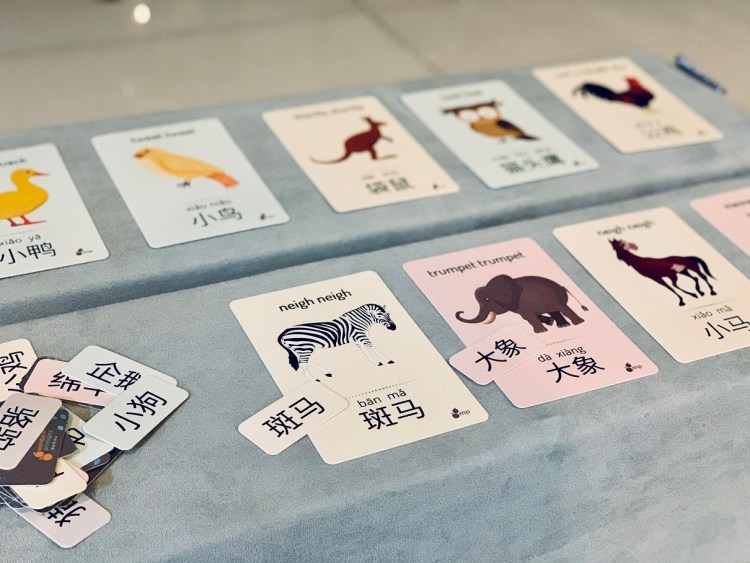
The most beautiful and jkoyful set I have seen at the Habbi Habbi Bilingual Flashcards, each with 50 double-sided cards.  These cards are hands-down the most durable flashcards we’ve ever used (and we’ve used heaps ….).  They’re thick cardboard, Montessori friendly (12 x 9.5cm in size), and constructed from glossy wipe-clean material.  They’re compatible with the Habbi Habbi Reading wand which adds a fun audio component too.

One aspect with picture cards that I really like is when the pictures are culturally specific, since it’s a nice way to explore Chinese cuisine or festivals etc with a child too. For Chinese language though, this type of flash card vocabulary learning is largely limited to younger kids and beginners.

2. Chinese Character-only flash cards

These flach cards have only Chinese characters. In the most simple form, these are the Singapore MOE flash cards which have a Chinese word on one side, and literally nothing else helpful (no English, no Pinyin) . These are good for passive review – for a child to review what they’ve learnt. They’re hard for someone who hasn’t learnt the character, as there is no context given as to the meaning or pronunciation. I wouldn’t actively choose these cards, but we needed them for primary school, and ultimately need to use our Luka Hero Reading Robot to help translate them.

Some really nice chatracter-only cards at the Le Le Chinese flash cards, which contain single characters on one side and a short sentences on the other, based solely from the renowned Le Le Chinese Learning System which teaches the first ~1200 characters through 300 short stories.

Le Le Character Review Chinese flash cards
Le Le Character Review Cards

3. Chinese Character & English Text flash cards

This category refers to a simple card with a Chinese character on one side and English on the other, with words that go beyond simple pictorial objects.

After wondering why these are so hard to find, I literally resorted to print these myself for my kids. This was my DIY project in 2020, where we printed double-sided flash cards showing the character shown on one side, and the English translation and Pinyin on the other for all the MOE flashcards. Laying it out like this I found is a much more effective approach than having the character only.

There are several great online apps where it’s possible to build these yourself (even for a non-Chinese reading mother), and there are also several great websites where mothers share their own printables to download readymade versions. The hardest part was cutting these all out. I’ve shared more on how to DIY below in this post.

4. Combination Picture, Text, Stroke Order and/or Context Flash cards

Post pandemic, I’ve seen many many great Simplified Chinese flash cards retailing online. It appears many other mothers had the same frustration as me and took it one step further to commercially produce their cards for the benefit of other families. I’m most thrilled about the latest additions to our home flashcard set which are a beautiful set from Mandarin Prodigies, designed by an Australian mumtrepeneur.

These take flash cards to a whole new level and go beyond a simple word + picture + translation. Characters are complex structures and learning characters in a wider context can be a highly effective way to learn. When learning a specific character, I find it’s helpful to stop and “de-code” the character for a bit with the child – e.g. does it look similar to another character already learnt? what are the radicals that it’s built from? do you have any visual hints for how to remember it?

For example:

  • Showing stroke order: these can help a child to practice writing. Stroke order is usually indicated on the cards through use of colours or numbers, and I’ve seen mothers who do a DIY version by using ordinary character cards and added colors dot stickers or paint pen marks. There are many nice Montessori tools for this, including Chinese stroke order sandpaper cards. It good to highlight here the important of WRITING Chinese. My daughter’s school teacher shared that if one only learns how to recognize the characters (i.e memorise from the textbook) but aren’t able to reproduce them from scratch (i.e writing them out), it’s easy to get confused.
  • Showing character radicals/components: allows a character to be broken down into functional (or semantic) components like form, sound and meaning. The characters are built from logic, and understanding this can aid a reader to be more self-sufficient and make connections between characters, or distinguish between those with similar components. I have not seen this done particularly well in any form of flash cards, but there are classes that do this from Outlier Linguistics (for adults) and Koala Know (for children).
  • Showing the specific context for a character: use of an word or expression, is another important layer, as in Chinese the same character can mean many different things in different contexts. I have not seen many cards which do this well – although the latest sets from Mandarin Prodigies are good. We also use digital flash cards through Skritter app for this too. Specifically for idioms, we also have a set that is compatible with Luka.

How to use Chinese flash cards with children

Flash cards are so versatile, meaning there are many great ways to use them. It depends a lot on which methods worked for your child.

At our house, we use flash cards (be it Chinese or other) primarily in two ways:

  1. Learning and revising characters: Our “Leitner system” is the key method for learning new written characters, which I’ll explain later in this post.
  2. Learning new vocabulary/phrases: Especially with the shift to homeschooling my youngest, we’re using flashcards more and more for new vocabularly (eg animal names, vegetable names, etc).

But we’ve also used flashcards for many other things, such a sorting characters into themes, sentence building, sensory play, etc. Occasionally we’ll play memory games or matching games with them too. -we like to do this with the MOE cards especially as we have multiple sets. If the cards show stroke order, they can also be used for character writing practice.

Sometimes we’ll hide them around the house and play treasure hunts. Or, invent a game “how many words can you think of which include this character” and have a competition as a family. For Christmas one year, we made an advent calendar using characters. For something very Singaporean, one hack with have with the MOE flashcards is to encase them in two magnatiles, and display them on the bomb shelter door!

DIY Chinese flash cards

We started to DIY our own flash cards journey because the school-supplied flash cards don’t contain the pronunciation or definition …. so I was flying blind as to whether my daughter was getting the cards right or wrong. After searching the shelves at many great bookstores, we couldn’t find ANY decent Chinese flashcards.  So, we retreated to good old-fashioned creation of homemade cards in various forms.

Print it yourself: Many mothers have created great flash card which you can download and print yourself. For example, Mandarin Homeschool and Guaravarama each have sites where for a minimal amount you can print off from their collections. The main effort is in printing, cutting and sorting (it’s literally painful if you make 1000 like we did) but you could turn this into a fun family exercise.

Design and print it yourself: There are many existing apps that let you put exactly the words and format you want, and print your very own self designs Chinese flash cards in a jiffy. I discovered this is possible from Chalk Academy, and it’s been really helpful. What I think makes a flash card good is:

  • shows the Chinese character, pinyin and stroke order.
  • shows an image that looks like the character, as well as words that contain that character.
  • gives a guide to the meaning
  • Nice to have: pictophonetic / ideograph to explain how the character is created.

I think the easiest two websites to DIY printables yourself are Arch Chinese (paid) or Anki (free).  Whilst Arch is a paid service, I’m pretty sure you’ll fall in the love with the results! It has an easy system to input a wordlist and create cards that show character (and picture image if desired) on one side, and then definition, pinyin and pictograph on the other. It’s all automated. In terms of a flash card, you couldn’t ask for much more! You can also print writing sheets, etc  They do look beautiful right?

Digital flash cards: for this, we use Skritter app. Skritter is a digital flash card app (for Chinese or Japanese), enabling spaced repetition of user-selected tingxie and idioms. Once a child knows >500 characters, it’s much easier to keep track and do spaced repetition when it’s all digitally in an app, rather than physical cards. For my elder two daughters, they use Skritter daily. Whilst we love Skritter and it’s nice to use this technology to revise for weekly tingxie and practice stroke order, I still think for a younger child nothing beats the old-fashioned physical flashcards and time learning/playing with a parent! 

Leitner System for flash cards and spaced repitition

I had an old post on my blog from early 2020 and ‘Leitner Box’ was one of the most regularly searched for terms for people to get to my blog. This is an expansion on how it works.

The Leitner system is a widely used method with flashcards, that has it’s origin from a German scientist called Sebastian Leitner in the early 1970s. In this method, flash cards are sorted into group according to how well the learner knows each card, and arranged in a series of boxes. This enables spaced repetition to occur at different intervals across different boxes. I’ve seen all sorts of fancy setups for boxes, many being sold for a ridiculous amount of $$. No surprise, it can also take up a lot of space, especially if implementing these boxes with multiple children. This approach seems especially common amongst Montessori homeschooling families.

Chinese flash cards using the Leitner approach
Leitner Box System credit Zirgeusi

Our “Leitner” system is rather simplified versus the original method proposed by German science journalist Sebastian Leitner in the 1970s.  However, the principal remains the same – a simple system for spaced repetition, where the cards are reviewed at increasing intervals until they become part of the muscle memory (we hope!). I have found this works for a three year old, and equally well with a tween.

  • Set up: We don’t have a “box” per se, but a series of plastic zip pockets (from Popular bookstore).   The zip bags are red, pink, yellow and green.  We use the same system for both English (with our Letterland Flash Cards) and Chinese.  For my elder daughter, I’m also trialing the same concept for mastering key science conapts too, where we’re writing our own concepts on small cards. I’m considering the same approach with our Chinese idiom flash cards, as these are becoming more important with composition pieces in upper primary school.
  • Choosing the words: For Chinese, we don’t just use arbitrary words.  I deliberately choose them for my middle-child based on vocabulary to match the graded readers which we are working through; and for my older daughter, we simply follow the school syllabus, but add in additional words related to the characters being studied.
  • Using the cards: The cards start out in the red bag (‘to learn”), and once reviewed they go into the pink bag (“learning”).  I’ll test 10 each day, and it if the child gets it right immediately, the card moves to the “nearly there” bag.  The “nearly there” bag is tested in full, only on weekend, and a correct answer moves the card into the “final check” bag.  At the end of the month, we go through the “final check” bag.  If it’s right, the card can graduate out of the system! If at any stage, the word/character is wrongly said, it goes backwards into the previous bag. If we were to be doing the full Leitner approach, there would actually be 5 separate stages, not three.
  • What happens when the cards exit the “Final Check“: when cards reach the end of our Leitner System, I put some of the characters virtually into our Skritter app, so that writing and understanding can still be visited again at a later point.  

What else has been helpful for making our Chinese learning journey an effective one?

Flash cards are helpful, yes, but they’re only one tool in the suite. My suggestion is that if you only have limited time, and your child already has working basic vocabulary, then focus first on extensive reading. Lots and lots of it. Find books that are age-appropriate and level-appropriate. The learning will come from the reading, and the flash cards can be a helpful check or tangible reinforcement.

If you got to the end and found this helpful, maybe there are some other posts on my blog you might also enjoy. As a parent who doesn’t speak any Chinese, we’ve relied heavily on online tools, clever robots, and recommendations of others in our Chinese learning journey. Some of my earlier posts are:

I also love learning from other parents -so please reach out through my IG or FB if there are other flash cards and techniques which you have found effective.

Our favourite Chinese learning platforms – update 2 years later

About 18 months back, I put a small post on my blog comparing online Chinese classes for children.  Little did I know that this would become the most popular post on my blog ever, even today.  I felt it’s now worthy of an update, to share how our family’s language learning has continued to evolve online. 

In fact, we’ve been so well supported by what we’ve discovered on the interwebs, that we’ve withdrawn my youngest from her bilingual kindergarten, and moved to homeschool. For my eldest, she’s taken to online learning so much so that she’s now even started learning a third language totally online. 

In terms of pure language learning and acquisition itself, prior to the pandemic, my children learned Chinese only through their respective schools.  We didn’t do other forms of language tuition.  The pandemic forced us online because we were otherwise facing many months with no spoken Chinese throughout lockdown.   After seeing what’s available, and the strength of their curriculums, combined with the price position, online has now become our default medium.

Observations of Online Chinese Language Classes

Different Online Classes suit different children:  Each of my three children has a very different temperament and learning style.  So when you’re asking “Which class is best?” I feel you need to add another three words “Which class is best …. for my child?”.  Whilst not all online classes are good, there a several providers who are excellent, and it really depends on which one clicks with your child’s learning style.  Case in point:  my three children are each doing online classes with a different provider, and they all think what they’re doing is the best.

Language Learning or Learning in the Language? These are very different approaches. There are 1-on-1 Chinese language classes, and then there are also group classes where a totally different subject (eg debating, math, art) is taught with Chinese as the medium of conversation. This specific post is focussing only on the 1-on-1 Chinese language classes, but I have an alternate post listing out the non-academic classes conducted in Chinese. which we have enjoyed over the last 2 years.

Having great bells and whistles on a platform is no replacement for an effective teacher:  We’ve tried various online course providers (in Chinese and also Spanish) and the real learning comes from having a child who is highly engaged in the topic, and not distracted by the videos or games, or something else in the background.  This engagement comes from an effective teacher.   I noticed that services that engage full-time teachers and invest in their training (and equitable salaries) are therefore more conducive to learning than gig-economy platforms where the teachers might be part-time, doing this to earn money in between other studies or priorities.

Different classes suit different children:  I have three children, and we’ve tried a lot of classes. Each child has a very different temperament and learning needs, thus why each child has their own ‘favourite’ class option. Also within the same platform, there are different teachers, so sometimes it could be trial-and-error to find the right match.

Comparison of our family’s favourite 1-to-1 Online Chinese classes

My earlier post gave a head-to-head comparison of various online Chinese language classes which our family had tried.  I would recommend you try them too, to see what is right for your child. The great thing is that there are so many different online options, most give free trials, and it’s worth exploring what will truly suit your child the best.

What we have found right for our three children is as follows:

For my youngest daughter: 

LingoAce: online Chinese learning made fun

Situation for my youngest daughter:   

  • She is homeschooled by a non-Chinese speaking mum, so this oline class is the only form of Chinese teaching -> needs a sound and structured curriculum
  • Multiple short classes (25 minutes) required throughout the learning week to fit our home-school curriculum -> so pricing must be competitive, and scheduling flexible
  • Would like to keep up with Singapore syllabus -> class must cover reading, writing, and speaking.

Overview: LingoAce is a Singaporean company specialising in online classes for children globally, using well-trained teachers in both Singapore and Mainland China.  The online interface is stunning and visually appealing, with trophies and points being awarded interactively to the children throughout the lesson.  Teachers are all smiles, and it’s a fast-paced class.  Their curriculum follows the Singapore MOE Higher Chinese approach or Mainland Chinese Syllabus.  They have a specific Kindergarten programme, which is what my daughter is doing (aimed for K1 & K2).  The platform has lots of other videos and quiz options for practice outside of class. The Kindergarten curriculum is quite strong and standalone, with a largely fixed script, format, and learning objective for each class.  I feel this is all that’s needed to create a P1-ready child. 

Class length and schedule: 25 minutes via the LingoAce portal, and can be scheduled by parents 24/7 with choice of teacher.   Customer service rep is there to assist with the booking as needed, and inquiries, etc. 

Fees: Start from S$21 per lesson for the pre-school program.

Why it’s great:  Short and engaging classes, with a small amount of homework afterward, and access to a great digital platform with books and videos, etc.  This means we can really make the most of the LIngoAce for learning, even outside of scheduled class times.

What to note:  classes are generally cheaper when bought in a large package format; the packages can be shared across siblings (although in our case, the elder siblings have no interest!).  Be sure to use a referral code if you do sign up, as it will enable you some free classes (and give some classes to the referrer).  If you know someone already using it, ask them for their referral code. If not, here is my own referral link .  [ Note I have referral links available for nearly all the online language platforms we’ve tried, even ones we don’t use, so I’m not trying to promote a particular product, just sharing good things which have worked for us.]

For more information: I put a detailed review of LingoAce in an earlier post.

For my middle child: 

GoEast Mandarin: inspiring and effective Chinese teaching

The situation for my middle child: 

  • Child already learns Chinese already inprimary school (1 hour per day in a class of 30; and nothing during COVID school shutdowns) -> looking for something to augment the formal classroom learinng and bring it to life
  • Family doesn’t speak any Chinese at home -> daughter has limited opportunity for 1-to-1 conversation and engagement in Mandarin

Overview:  GoEast Mandarin is a renowned Shanghai-based language school founded in 2012, that offers both online and in-class tuition.  They’re a full-fledged school, with professional full-time teachers, curriculum coordinators, language consultants, student liaisons, etc.    The variety of courses they offer is impressive, from beginners to advanced.  The course syllabus is grouped into the HSK framework (perfect for kids), and you can also customize your own course.    Another great thing about this school is they provide a variety of teaching arrangements – like siblings in an online class together, or parent-child classes, or pinyin-free classes – which is very unique compared to many of the larger ‘off the shelf’ style Chinese curriculum.  The teachers are patient and work at the child’s pace.

Class Length and Schedule:  usually 50 minutes via Zoom, at a fixed time each week (although they will offer a 25-minute option also at request).   Limited time slots available, during Chinese business hours.

Fees: Customised, and available on request

Why it’s great:  The standout feature of GoEast is their TEACHERS.  They’re passionate and skilled (with proper university teaching credentials), and a notch above anything we’ve experienced in any other online courses we’ve done (and we’ve done quite a lot).    We’d trialled a few different online options, and nothing really ‘clicked’ with my child until GoEast. She’s not a child who enjoys competition or fast pace, so many of the fancy large-scale Chinese learning platforms with animations and point-scoring throughout the class didn’t appeal to her.  We were delighted when we discovered GoEast Mandarin – where the focus is on having excellent teachers.  These teachers are able to tailor their curriculum to suit the child, and they also speak well in English, allowing me as a mother to describe what I want in the classes and receive feedback. 

What to note:  Their staff are all passionate about language learning, and speak both English and Chinese, so it’s simple to arrange and curate with them, even for a non-Chinese speaking parent.  GoEast Mandarin is currently offering a limited period free no-obligation 1-on-1 trial, which you can access here. (no affiliation, no benefit to me here through recommending)   It’s a generous opportunity, so do give it a try.

For more information: I put a detailed review of GoEast Mandarin in an earlier post.

For my eldest child:

VivaLing: Chinese coaching at your fingertips

The situation for my elder child

  • Child is now upper primary school –> requires short adhoc assistance with homework questions (composition, orals, etc) since no Chinese speakers in the house. 
  • Child already does many other non-academic classes taught in Chinese like debating, art, math, etc so is conversationally strong–> child doesn’t want any more grammar or formal teaching

Overview: VivaLing is an online platform connecting language learners (children and adults) with qualified native-level language coaches, for real-time virtual classes.  They offer courses in 5 languages,  including Chinese.

Class length and Schedule:  Ranges from 15-minute to 60-minute options carried out via Zoom.  Sessions can be as many times as preferred during the week. Siblings can also be grouped together. Timing is flexible and booked by the parent through their portal.  The same teacher can be selected, and only 24 hours notice is required for cancellation.

Fees: From US14 for 25 minutes – can be scaled up or down from here. No subscription, package, or commitment is necessary.

Why it’s great:  We’ve now used Vivaling for 3 years.  It’s a service we can book at short notice and there’s no need to buy any big package.  My daughter has a great rapport with her Coach and looks forward to the sessions, which we schedule as needed.

What to note: There is no curriculum, and these classes are expensive compared to other DIY platforms (like iTalki and Preply) but the appeal is being able to have 15-minute ad-hoc chats, and also knowing that the teachers are appropriately trained.   I’m able to directly email the Coach in advance with the school homework or questions my daughter has.   There has been very little interaction with any customer service, and the whole thing is DIY, even payment through Paypal. The system is smooth – we book, we do the class, and we get sent a weekly email summary of the class and a video replay of the class.   If you message me, I’m happy to share our family’s personal referral code for these classes which will give you a free trial.

How should we decide which online Chinese learning for our family?

Well, don’t just take my word for it… Try it for yourself FOR FREE! All of the above-mentioned classes which I have recommended (and many others) offer you a free no-strings-attached trial. It’s not a privilege reserved for bloggers. Try to use someone else’s referral code too, to get the most benefit.

To help narrow down the options here is a graphic of the different courses we’ve tried and how they fit together on a 2 x 2 matrix. Maybe this can help you out in considering which 1-to-1 class is most appropriate for your needs. The other consideration would be the flexibility and the cost, but that’s too much for me to put into one chart!


FAQs on online Chinese classes

Readers often email me to ask a lot of questions about online Chinese classes. Below are the most common questions, so here is sharing answers for all. If you have other questions, feel free to comment below or message me!

What is the difference between Preply, ITalki and VivaLing?

Answer: They’re each are DIY platforms for linking lots of language teachers with students, and they each have multiple languages offered. The difference between ITalki and Preply are pretty small; VivaLing is a different league.

iTalki and Peply are like a mass marketplace, with different prices offered by different teachers, and no standard approach to class structure or timing. You can scroll through through hundreds of teachers, read their bios, watch their videos, read recommendations and find one who you hope is best.

VivaLing is much more standardised, with a standard price for all teachers, and a common teaching approach., and standard requirements for the formal training of their coaches. At sign up, you will submit a form of your needs and child’s learning style, and they will curate a list with a handful of suggested coaches.

All the platforms (Talki, Preply and VivaLing,) have classes carried out via Zoom, and you’ll be in direct contact with the teacher for feedback afterwards, etc. iTalki and Preply can be MUCH cheaper if you find a good teacher. We didn’t have great success.

What is the difference between LingoBus and LingoAce?

Answer: Not much. They’re incredible similar, from their platforms, pricing, teaching style, quality of teachers, and even their logos look the same! Key difference is LingoBus is based in mainland China and LingoAce is based in Singapore. Therefore, through LingoAce you can also get classes that follow the Singapore system (as well as mainland Chinese, as an option too). On top of this, LingoAce classes go up to the Primary 6 Mainland Chinese curriculum, whereas LingoBus stop at about Grade 4 (but higher classes are being added). Finally, LingoAce also offers physical classes in Singapore for blended online/offline learning for upper primary levels.

I would say apart from this, the differences are too small to notice ……. if I had to name one other difference, it would be that LingoAce has more homework than LingoBus. Good or bad, depending on your needs.

How does it compare to GenieBook Chinese?

They’re not really comparable. Very different concepts. I have reviewed GenieBook Chinese separately, and no, we didn’t sign up for it. It would suit a child who likes typical Singapore-style tuition classes or needs a reading revision, but doesn’t like reading books!

What about other online platforms for learning Chinese?

Answer: Refer to my earlier post for detail about the following classes from early 2020.

Should I choose a native-speaker option or an international class option in the platform?

Answer: Most of the online platforms offer a stream for native / heritage speakers, where there is a focus on reading, writing, grammar, etc too. The international / non-heritage streams focus mainly on conversational skills. It depends on what your intention. Consider reading my earlier blog post on whether reaching fluency is a realistic goal for non-native Chinese children, and how important literacy is in the bilingual equation.

What does the referral code do?

Answer: Most large online language learning platforms (and even some of the smaller providers) offer free trials, with or without a referral code. However, if you join with someone’s referral code, they’ll usually offer a discount to you (or additional classes) in the event that you sign up for a package. It seems a very Chinese way of doing business, I feel. Usually, the person sharing the referral code will also receive a free class or credits too, so if you know someone using the platform, do them a favour and ask them for their referral code (and if you use my codes, I thank you! My kids enjoy the learning! I do have collected codes that I can share for many of the courses we don’t use as well, as given to me by other parents, which helps you but obviously has no benefit to my family).

Is there a concern about data privacy, especially with the videos of children being recorded during the classes?

Answer: By nature of these classes being over video, there could be recordings of your child retained by the company, and it’s worthwhile to think where these might be stored or what they could be used for. Video recording will contain a lot of information about your child (audio, visual, demographic, learning patterns etc) which can all be very valuable in the wrong hands. Privacy laws and Child Protection regulations differ by jurisdiction, as does their enforcement. It’s worth noting you wouldn’t EVER want to agree to T&Cs which you cannot personally read yourself, so be wary if you’re clicking a check box about disclosures and acceptances when you cannot read the accompanying policies because they’re written in Chinese. Ideally choose a company which at least has a sub office or presence in your own country (or state), so they should be more aware with the local requirements.

If the classes are conducted over Zoom, it’s unlikely to go far and you’ll know whether the class has been recorded. But if it’s on a private app or platform, you cannot be so certain. If in doubt, ask the company about their policies, and perhaps you make a decision not to use them, or keep the camera off. For us, we do not use the real names of our children on online platforms.

Are there online options that teach Mandarin in Traditional Characters, not Simplified?

Answer: Yes, LingoAce offers the same classes using Traditional Chinese too. In addition, fellow blogger Ms Claudia Lee Kimura recommend Kelly’s Education for Traditional Chinese. It’s apparently an equivalent to LingoBus.

What else has been helpful for making our Chinese learning journey an effective one?

If you got to the end and found this helpful, maybe there are some other posts on my blog you might also enjoy. As a parent who doesn’t speak any Chinese, we’ve relied heavily on online tools, clever robots, and recommendations of others in our Chinese learning journey. Some of my earlier posts are:

Who said primary school in Singapore is stressful?

What if we didn’t have so many exams?

Earlier in the week, I finally sat down to add the dates of the ten different primary school exams which my 8 year old daughter has upcoming. It made me reflect, is this truly necessary?   I had a half-wicked thought – what if I didn’t diarise the dates.  What if I didn’t remind her about the exams, and we treated it just like a normal school day.  Would my daughter’s performance be any different, and more importantly, would her attitude to learning and life be any better?  Are we placing more emphasis on grades or the learning being them?

Well maybe the Singapore Ministry of Education was listening to my inner thoughts (and for sure God heard my prayer for direction), because this morning, they announced a cancellation of all exams for Grades 3 and 4. Is this a laugh, cry, or sigh moment?

Living in an economically developed Asian country, I really shouldn’t be surprised that exams exist – there’s a great cultural significance placed on learning.  Yet, my enduring hope for our children in their education is that that they are happy, healthy, resilient, and grateful for the opportunity to learn.    In fact, to be these four things,  I’ve come to the conclusion that it is almost mutually exclusive of being in the top 5% of any Singaporean school’s student cohort.  I feel it’s near impossible to achieve this level of perfection without compromising on either sleep, recreation, or family time.   Of course, everyone has different priorities and expectations, which explains why the competition is so very tough.  For my kids, therefore, the expectation is that they will do their personal best, and outdo only themselves.  Forget the rat race.

Does tuition have to be the norm?

We’ve been big supporters of a simple education, in a no-name neighbourhood school.  Its been a satisfying and joyful journey to date… indeed a stress-free one.  We have largely carefree evenings, with low-to-no homework, and weekends kept free for family fun and unwinding, without the need to rush between extra tuition classes. We’d love to have more weekend playdates, but it seems most other respectable families are indeed in “tuition” at that time.  Tuition is one of those topics which always rears its head.  For example, when we meet new families (yes, that used to be possible once, pre-COVID), usually an early ice-breaker between the parents is “what tuition (or academic enrichment) does your child do?”.    

When I respond with a nonchalant shrug, there is usually a look of shock from the other party.   It always requires me to further explain that it’s not that we don’t care, but I’d rather save my money they learn Spanish, or map reading than repeating something supposedly taught already in school.  Opting out of academic tuition is, unfortunately, the exception to the norm, and a sometimes frowned upon alternative.  But I’m hopeful the tides are turning. 

The recent banning in China of after school and weekend tuition is an interesting government initiative (err intervention?) to improve quality of life.  I don’t think the same legislative approach would work here (there will always be some children who need extra academic support outside of school, and they may have families who cannot support this learning).  But, I hope parents can realise the unnecessarily vicious cycle that over tuition can create, and the corollary of this being an adverse impact on mental health.

Reminder to self: Replace our FOMO with FIMO ….. Fear of Missing Out, with Faith In Missing Out (as coined by Angie Yeow, in her great parenting book Growing Hearts).

Faith In Missing Out (FIMO) Artwork by Angie Yeow, from Growing Hearts

Would doing less help us achieve more?

I believe in the importance of early-stage literacy and math skills, along with bilingual education.  Singapore school system offers us all of this, and more   But beyond school, there are many other important aspects to life that cannot be taught in a formal classroom.  Moreover, if we don’t nurture these intangibles at home (or make space for it to happen organically), that’s an opportunity lost.  What is a childhood without play and mess, and unstructured times for being bored?  Yes, we need more boredom.  Letting the mind wander is an important lever in mental health for all of us.    According to much research, including here boredom itself can give a child an inner quiet, where they can then focus on self-awareness and imagination.    People would pay for that type of brain enrichment, right?  But it’s free, and ours for taking!   

There’s a great TED Talk by Sir Ken Robinson on “Do schools kill creativity?”.   This talk is not even in a Singaporean context.  I hesitate to think the “process of academic inflation” discussed in the TED Talk is further magnified in our beautiful island state.  Here, it’s the norm that even a child getting 85% test scores, will be forced into tuition just so they can get to 90%.  The latest blog post by May at A Million Little Echoes, asks the question “Who is the culprit for today’s standard in primary school?”.  Her answer is that we need to be brave enough to say “I want to sit out of this race” and maybe a difference will be made. We’re not in the race. 

Yet it’s dawning on me that even with a deliberate disregard on my part for conforming to the norms of tuition and academic enrichment, we eventually won’t be able to avoid the exams of the Singapore schooling system (and the concept of failure at these exams feels like it too would have a lasting mental impact, unfortunately).  I know the system has been improved markedly over the years, with a shift away from stressful examinations, but I’m still miffed at the concept of ever needing to sit ten exams/orals at year-end, for an eight-year-old! 

The key redeeming factor I could see about the exams is that four of the upcoming planned ten exams were for Chinese, which thankfully is my daughter’s favourite subject (which highlights the point that, yes, it’s very possible for a child from a non-Chinese speaking family to thrive and enjoy Chinese, especially if they aren’t scarred from years of inane group tuition.  We’ve found plenty of wonderful, short, one-on-one classes and fun non-academic small group classes like coding, chess, Minecraft, debating etc carried out in Chinese, which can excite a real interest in the language and its practical uses).

Is it helpful to compare?

I sometimes wonder how will the care-free primary school life which I let my daughter lead place her on exams compared to other students from let’s say more affluent/kiasu schools?  Schools where tuition, over-teaching and massive amounts of homework are the norm?  My daughter’s much loved P3 form teacher mentioned earlier this year to the class that “I’ve never known a child from this school who has received a place in the GEP (Gifted Education Programme), so the GEP exam results don’t really matter”.   Is that defeatist or pragmatic?  I still cannot decide.  How can it be, that in an entire primary school cohort there are never any kids in the top 1% of their year level? It’s statistically impossible if all schools are equal.  Or maybe it’s the students, not the schools, who are not equal?  Either way, for my (certainly not-academically-gifted-by-any-account) P3 child, what I’d like to be sure of is that she is mentally resilient, grounded, caring, and ready for the world, regardless of any exams or comparisons.    

So back to my original epiphany: if we were to have a season of exams, would I highlight the dates of the exams on our fridge?  What would I tell my daughter about preparing for them?  What expectations do we set around them?    Is an exam simply like a punctuation mark at the end of a sentence, which is much needed to give meaning to the year of study?  Is it like a piano or Taekwondo exam, where it’s a fun thing to do, and after you pass, you’ll have a great sense of achievement that you truly deserve to move on to the next level?  If we can use this opportunity of the exam period to showcase (a very limited aspect) of how much we’ve learnt over the last year, that’s a milestone to celebrate.

And now, with exams cancelled, should I be telling her they’re cancelled? Or we remain in blissful ignorance of that too? I’m sure she’ll find out soon enough from the teachers, so I’ll leave that to them to communicate. I’ve in fact already heard of some (more elite…_) schools where despite exams officially cancelled by the MOE, parents have already received memos that the children will still be having “alternative assessments” or “practice examinations” on these same dates instead. Talk about following the letter of the law, but not the spirit! Where do these principals get their principles? LOL! Or are they only pandering to the parents’ concerns?

Give our best to the world

Whether exams or no exams, in good times or bad, this post by Growing Hearts is a nice reminder to all parents.   “Don’t just study for the sake of PSLE. Study because we want to give our best, because God has given us a healthy and strong body, mind and spirit to work with.“  

Wishing all parents peace during this potentially trying time.  For those who have just completed PSLE: Congratulations on the achievement, and may you and your child (and your nosey wider family…)  be at peace with whatever the result may be, and the doors it opens.

For those who are about to start exams: Do remember that this season of being a student won’t last forever, and your child(ren) need to know much much more than just how to study.  

For those who are disappointed about cancellation of upcoming exams because you’ve been preparing so hard for them, or enraged now because the end-of-year report card will rely on results from previous in-class assessments where your child may not have been so prepared, please remember that a subject score is neither an indicator of your child’s self-worth nor an indicator of their future.   To score well on self worth and future-proofing, it requires YOU as the parent, with the textbooks closed and your heart open.

Consider using this time which may now be spared from revising textbooks, to revising priorities with your child, and appreciating them for who they are. Instead of reviewing Chinese characters, do a character review with your child. Win the race in life, not the grade on the scorecard.

I would love to hear from you!

For your family, what’s making primary school stressful? How can this system be improved together, for the sake of our children?

If you got to the end, and found this useful, maybe there are other things on my blog which you will also enjoy! Most of my blog is about how a child from a non-Chinese speaking family can learn to love and be literate in Chinese, without excessive tuition! It’s a passion project, just sharing for the sake of helping others in the journey too. Some of my post popular earlier posts are:

Excellent resources for meaningful home learning

This is my list of meaningful home learning and homeschooling resources for families in Singapore. These are strange times we’re living in.  Pandemic parenting is especially hard, filled with uncertainties and missed celebrations.

Despite all the horrid things which COVID-19 has brought the world, I’m most grateful that it’s pivoted us to finding effective ways (read tools, apps, books, and online classes) to learn at home. It was the wake-up call our family needed to find the best learning resources out there and start applying them.  In fact, it was probably the key change which truly enabled all my three children to become biliterate in Chinese.

I hope that this post will help you to also make your home learning experience count, in whatever shape or form it is.

Great resources and syllabus for home learning in Singapore

If you google on Home-Based Learning (HBL) strategies, you’ll find heaps, mainly written by schools, and teachers, or education psychologists about the theory of what works best, and how to set up the home classroom, how to make a calendar, the important role parents play in educating, etc.  I’m not going to delve into this. I’m neither a teacher nor an expert. Nor am I a homeschooling mum (yet….). I’m simply a working mum who likes to learn together with my children at home too.

I wanted to share the specific products, books and online tool which we’ve found most helpful for my Nursery child, Kindergarten child, early primary and middle primary child, after 18 months of research, and trial and error. Simple solutions for busy mums in mixed-age group homes! Note these are whole complete syllabus I’m referring to, not simply tings to tithe you over until school returns.

Before you get stuck in my list, please remember that there  IS NO PERFECT CURRICULUM.  There are many great things out there, and you don’t need them all either, just choose what suits your child and family situation the best.   These lists are not in any way exhaustive. I’m sure there are many equally good things out there.

English Language – home syllabus

Nursery syllabus: Bob Books, by Bobby Lynn Maslen. Sets 1 to 3 for early phonics & accompanying workbooks

  • Best aspects:  Specifically designed to facilitate that “ah-ha” moment, when letters first turn into words, and gets a young child reading sentences
  • Compact size to fit in your shelves, with great accompanying workbooks for writing

Kindergarten syllabus: Fitzroy Readers . Numbers 1 – 20 & accompanying workbooks

  • Best Aspects: uses a phonic approach to literacy and consists of ninety carefully graded story books, with accompanying workbooks

Lower Primary syllabus: Fitzroy Readers . Numbers 40 – 60 & accompanying workbooks

  • Best Aspects: Stories are value-driven, and contain excellent accompany worksheets to teach grammar, vocabulary, composition and beyond.

Apps: ABC Reading Eggs (note this also has printable worksheets)

  • Best aspects:  Cost effective way to access hundreds of online reading lessons, phonics games and books for ages 2–13; well designed to capture attention of the child and includes a weekly writing competition to encourage own compositions and stories.
  • Another similar app is Teach Your Monster to Read, which is free, and funded by the Usborne Foundation

Note: these resources don’t replace reading for leisure!  Of course extensive reading is the key way to inculcate a love for reading and literature….. but it’s ultimately hard to escape needing to learn grammar and spelling rules too!  

Chinese Language – home syllabus

This is in the context of a family where neither parent speaks any Chinese.

Nursery syllabus: Odonata 红蜻蜓学前阅读计划 (Yellow Set) & accompanying workbooks (or potentially Sage 500 if you want to spend $$ and can read Chinse yourself)

  • Best Aspects: systematically introduces new character and vocabulary, and is very affordable compared to many other syllabus.  It can be narrated with Luka Hero, for families where parents don’t read Chinese. It comes with flash cards and it’s own workbooks. The wordlists are also contained in Maomi Stars app, for matching online games.

Kindergarten syllabus: Le Le Chinese (or potentially Odonata or Sage, if you already have upper levels of this)

  • Best Aspects: Carefully crafted collection of 300 readers to enable a child to be comfortable with reading >1000 characters; often has accompaning art/craft/lessons shared in their online support group. Comes with a reading pen for families who cannot read in Chinese, or for children to learn independently.

Lower Primary syllabus: Odonata 红蜻蜓学前阅读计划 (Purple Set) & Mandarin Companion

  • Best Aspects: For a child who reads >1000 words, these books contain longer and more interesting stories.  It’s not quite a curriculum ….  but these books enable a child to learn context, sentence structure, and usage by reading stories; ideally pair it with an app or online classes.

If you’re interested how these Chinese books compared to English ones, here’s how I see the paraellels:

Apps:  iHuman Hongen Chinese (note iHuman also has printable worksheets and supporting physical readers); support with Skritter or Maomi Stars for tingxie 

Note: these don’t replace reading for leisure either!  Check out appropriate Chinese bridging books to enjoy broader literature with your child.

Structured Online classes: As I don’t speak any Chinese, we’ve also found great value in structured online classes in Chinese, especially:

  • LingoAce – there’s an excellent Kindergarten Course following Singapore MOE, and then a primary school course either following Singapore MOE Primary Syllabus or Mainland Chinese Elementary Curriculum.
  • GoEast – this follows HSK / YCT syllabus, and is more customisable than LingoAce.  Great for a child who has a different learning style to the Singapore MOE syllabus.

Mathematics – home syllabus

Nursery & Kindergarten syllabus: Maybe it’s because I’m an engineer and comfortable with numbers, but I think it is completely okay to teach preschoolers math without any curriculum.  Counting can be done using toys, time can be done with your clock, weight can be done whilst cooking, money whilst shopping, measuring through craft.  

Primary SyllabusBeast Academy (for a mathematical child) or Singapore Math (for other children)

  • Best Aspects: Beast Academy is unconventional and challenging program focused on problem solving, with a graphic-novel-style textbook. This will ONLY work if your child mathematically inclined.
  • Beast Aspects: Singapore Math is what our local schools in Singapore teach. Don’t overlook how great your existing school materials could be! Many overseas families go out of their way to learn Singapore Math or Dimension Math (the textbook commonly used in Singapore) and this really makes a great base curriculum also.

Apps:  Matific Galaxy & Mathseeds

  • Best Aspects: Gamified learning which matches specific school years (in US and Australia respectively), step by step learning through games

Online classes:  VIPThink 豌豆思维

  • Best Aspects:  It’s fun and short problem solving classes taught entirely in Chinese, and broadly following Mainland Chinese curriculum (which is similar to Singapore Math)!. 

Other observations:  There are some great “living math” books which would be fun for a family to follow casually and can easily be borrowed from Singapore library (or bought online) such as:

  • Sir Cumference and the First Round Table (there is a whole “Sir Cumference” set)
  • What’s Your Angle, Pythagoras?  
  • The Librarian Who Measured the Earth

Music – home learning

Online classesVIP Peilian

  • Best aspects: It’s taught in Mandarin (seriously the cheapest way to find a music teacher)!  We do these twice a week 😊. We do piano, but they do offer several different instruments, including classical Chinese instruments.

App:  SimplyPiano and Piano Maestro, by JoyTunes

  • Best aspects: Contain videos to learn piano step-by-step, including progressively harder songs (usually from modern pop music) and gives a score and feedback based on how you play

Nature – home learning

This is our most loved topic! 

Syllabus (for all ages)Exploring Nature with Children by Lynn Seddon. 

  • Best aspects:   is a complete, year-long curriculum designed to guide you, step by step, through an entire calendar year. It’s so easy to follow, and there’s also support Facebook Group of parents who share their ideas from this.
  • The book contains extension activities for crafts, writing, science, maths, and more, to extend their nature study through the week.  We’ve been trying to tie this into home Chinese learning, using Ni Hao Science series which covers very similar topics, but in Simplified Chinese.

Final tips for successful home learning

If you’re stuck googling “How can I home school?”, then you’re most certainly not alone.   It is a challenge, especially if you’re also working full time, and trying to do this just to close the gap until school reopens (if that’s you, perhaps don’t invest in a whole syllabus upfront, read my earlier post with some stop-gap measures).   Plenty of great resources are out there.

What we found helpsed:

1. Come up with learning objectives

It’s helpful to really define what outcomes you want from the home learning – is it just temporary measure until school re-opens?  Is it permanent for some aspects/subjects which are not taught in school?  Is it to avoid the need for external enrichment classes?  Is it simply to embed a love for learning in your house, regardless of the pandemic situation or not?  Adapt to your own circumstances. You won’t ever be able to recreate your child’s classroom experience in your house, so try to make your objective realistic.   

For example for us,

  • During first lockdown last year (which lasted 3 months), I decided that for my 4 year old that the ONLY things I wanted to teach her were how to read (in both English and Chinese), and how to ride a bike.  Everything else was ignored.  Even the Zoom calls from teachers.
  • Ongoing for my primary school daughter, I have always said that we would not engage any external tutors as far as possible, and if she needed help, I’d like to be the one which provides the scaffolding and support to help  (this strategy has saved lots of $$ and worked wonder through these endless lockdowns!)

Adapt to your own circumstances. You won’t ever be able to recreate your child’s classroom experience in your house, so try to make your objectives realistic and practical.   

2. Find the right curriculum and/or programs (and ignore the school materials if needed)

Use the resources that your child’s school is offering – online classes, physical books, and other materials if they help.  Adapt them or ignore them if they don’t help. 

I’ve shared a few programs and curriculum in this post which we have used.  Even if you’re only doing this temporarily until school or the tuition centre re-opens, there are so many great things out there that hopefully something will be a great fit for your child’s learning.  Some of these might even be better than the activities which your currently school has given you in take-home kits, or is trying to teach remotely.  Key thing to decide is what learning outcomes actually matters for this period (can you toss any of the subjects out the door for a bit) and then for each subject you want to taught, are you confident enough to teach the subject(s) in question, or you need to rope in help. 

For example, for Chinese and Spanish, I needed online assistance from a native speakers, so of course even the best available curriculum would fall on deaf ears without external support..

3. Follow a daily schedule (as much as you can)

It’s important for everyone’s sanity to know what your approach to the day is.  We simply made a weekly schedule highlighting a few key fixed events (like pre-booked online Chinese class, and outdoors time) and then had a lot of empty time for ‘learning’.  During these times, the children can choose whether it’s math, English, music, etc, but by the end of “school”, they need to have finished all of the assigned work for the day.

4. Look beyond textbooks and revision books and encourage a love for education

For me, the main outcome of learning at home together is embedding skills for life, with a passion for learning.  It’s not about rote learning or memorising to pass formal exams.  There are SO many great things to teach and syllabus to use which go way beyond the revision books which you can buy at Popular.   I hope this post enlightens you on some of these.

5. Practise gratitude

This is a daily reminder for us too. Take the time to appreciate how good your life is – your kids are likely to be awesome too.  There are great teaching materials out there.  You must have great friends, neighbours and relatives that you’re all most probably missing right now in the middle of Covid-19 restrictions.  Convert your stress in the direction of gratitude and perhaps consider getting the kids to write a card, or write a story, do a mini project just for someone your missing, or document their feelings in a journal. 

The road ahead with COVID-19 is long and somewhat uncertain, with schools opening and closing,  but regardless I feel that we can always find opportunities in this crisis to teach our children and model resilient behaviours.   Despite the dreary external environment and likely chaotic internal one, the periods of being locked-in together has created some of the best family moments we’ve had (and some of the worst, but let’s forget that bit).   

It really feels like we now learn significantly better at home than we do in the formal classroom for most subjects.  It’s been a huge positive.  Even before this Pandemic, an increasing amount of parents have opted to homeschool their children.  I must say, I was never one of them, primarily because I don’t feel I’m a teacher (and teaching is a full time job in itself).  Secondly, I was way out of my depth on curriculum.  Yet when left with no choice when schools closed, I needed to get up the learning curve, and was pleasantly surprised at how many amazing out-of-the-box curriculum and remote learning providers exist, providing a viable alternative to home educate.  If you don’t want to fully home educate, you could at least see these as an alternative to formal after-school tuition centres, or opportunities to support your child’s learning more deeply. 

I hope that your kids too will look back on the lessons they’ve learnt at home fondly, and that some of the things on this list can help you make the most of this unique opportunity to be at home and learning alongside your children.

I would love to hear from you!

Which curriculums do you really love? If you have something to rave about, do let me know, as I’m always interested ot hear and learn more.

If you got to the end and found this helpful, maybe there are some other posts on my blog you might also enjoy. As a parent who doesn’t speak any Chinese, we’ve relied heavily on online tools, clever robots and recommendations of others in our Chinese learning journey. Some of my earlier posts are:

Online Chinese Class Review: GoEast Mandarin – Classes for Children

Our family thinks online classes are great!  Finding amazing language classes which interest my kids has become somewhat of an addiction for me as their mother, and has been a huge help in our journey of language acquisition.   

This post shares our wonderful experiences with GoEast Mandarin, which is where my  #2 child (the fussiest of all my kids, who never had quite enjoyed the other online classes we’ve discovered) has now completed half a term 7 classes.  This review shares how we have found these online classes, and why you might want to consider them. 

What is GoEast Mandarin?

GoEast Mandarin is a renowned Shanghai-based language school founded in 2012, that offers both online and in-class tuition.  They’re a full-fledged school, with professional full-time teachers, curriculum coordinators, language consultants, student liaisons, etc.    

The variety of courses they offer is impressive, from beginners to advanced.  The course syllabus is grouped into the HSK framework (perfect for kids), and you can also customize your own course.    Another great thing about this school is they provide a variety of teaching arrangements – like siblings in an online class together, or parent-child classes, or pinyin-free classes – which is very unique compared to many of the larger ‘off the shelf’ style Chinese curriculum.  

The school originally began teaching adults (and still does, with a very popular Business Chinese class), and then in 2014 they set up a course for children and teens.   The children’s classes are purposefully more fun than the adult classes, with a completely different set of teachers and curriculum focused on making Chinese fun and conversational through stories and engaging activities (games, puzzles, drawing etc).

What are the children’s classes like?

In terms of classes for children, they’re specifically designed to be engaging around learning by doing and play, and they’re largely story-driven.  The learning materials (stories, games, etc) are fully written and illustrated by their team.   The teachers are patient and work at the child’s pace.

The class itself is essentially a 50-minute Zoom session with a teacher sharing a PowerPoint slide pack.   If 50 minutes is too long screen time, they also 50 minutes set as 25 + 25 minutes, with a 10-minute break, which I feel is a very nice structure.

There is no fancy web platform, sound effects. and animations, nor trophies flying around the screen.  It’s a very simple set-up.  In fact, when I first saw it in our trial, I thought….. there’s no way this teacher can engage my child for an hour like that!  But Teacher Jenny 老师 did a phenomenal job. She can just talk to children on their level, and adapts activities real-time to suit the child’s learning style and temperament on the day.  Even when Mei Mei and Jie Jie decided to crash on lessons, Teacher Jenny welcomed them into the conversation too.   

The next surprise was after our first class when talking to the teacher (yes she spoke perfect English, which was also a win compared to other classes) when I realised that all the stories, materials and pictures shared on those PowerPoint slides had been illustrated and designed by their own in-house curriculum team.    They base the vocabulary broadly on the YCT exams/books (Youth Chinese Test), but obviously taught in a very different manner (eg they don’t teach the Chinese grammar rules as overtly, or instruct on grammar like they’d teach adults …. It’s done through stories).

GoEast Syllabus for Children

There’s a nice post here describing more broadly how the children’s curriculum is curated and qualities of the teachers.

Prior to our trial class with GoEast, I had shared with the course consultant that I preferred my daughter not to have any English Nor Pinyin used in the class, and they were flexible to cater for this. I also shared that my daughter loves nature, so our first 6 classes were all based around animal stories.  

A slide from the class – the school can remove the Pinyin too!

What makes GoEast Mandarin great?

Whilst I recommend a lot of apps , robots, and reading pens for Chinese learning on this blog, it goes without saying that learning from a REAL person is the best way to reach proficiency, and the more effective the language teacher, the more effective the journey.

For sure, the standout feature of GoEast are their TEACHERS.  They’re passionate and skilled (with proper university teaching credentials), and a notch above anything we’ve experienced in any other online courses we’ve done (and we’ve done quite a lot).    They have a small and highly qualified team of curriculum developers, language consultants and of course teachers.

For the adult’s course, the school is highly regarded as having some of the best teaching quality possible.  In fact, I know of several expats who have flown to Shanghai, simply to experience the in-person classes offered by GoEast.  Similarly, I can see that all their staff seem to be a key strength, in their own areas.

Every interaction we’ve had with the GoEast team has been stellar.  You can just feel that they are true language lovers, and want to share this love with their students.  The teachers themselves are all university degree holders in Foreign Language studies or Teaching Chinese (actually many are Masters and PhD), and on average have more than 7 years teaching experience.  After each class, Teacher Jenny emails me personally with feedback on the lesson, and includes screenshots of the pictures they’ve drawn together too.  One day actually it was my birthday, and the teacher even sent me an email saying “Your daughter told me today is your birthday.  Happy birthday to you and all the best wishes for you”.  Awwww.  My heart melted.

Aside from our class teacher, we’ve interacted with their Student Advisor (Jaap Grolleman), and their Senior Language Consultant (Maria Mao), and it’s touching to be able to see their faces and bio on the GoEast Mandarin main website, and realise it’s like one big passionate, intelligent and kind family.

Another good factor is it’s conveniently hosted over Zoom (although they’ll also accommodate Skype and WeChat too) …. So there’s no need to download an additional app or navigate a website in Chinese and remember your login details.  Moreover, you can be sure the class isn’t being inadvertently recorded and your child’s face/voice data being used for other business purposes or AI model training.

Is this service impacted by the recent bans on tutoring in China?

No.   Although based in China, GoEast is primarily teaching Chinese to children of expats, or Chinese children who have lived abroad and need to up their Chinese to join a Chinese school here. The government changes on for-profit tuition are for businesses who operate after school hours and on weekends, and were mainly brought in to lower pressure for school-going Chinese kids. 

How does is compare to other online classes?

The verdict from my second daughter was that this class is the best of ALL the classes she has ever done (and we’ve tried a lot over the years).  She had an instant connection with Teacher Jenny, and my daughter was very joyful about doing these classes, even twice each weekend!

I’ve sat in on a few of her GoEast classes, and they’re so fun and playful, and really following the lead of where the child wants to head.  My daughter recited the stories learnt in class to her sisters, and share the tips she’s learnt on drawing too.

As a family, you can see from my blog that we’ve obviously done a number of online classes taught in Chinese now from different suppliers, ranging from language, art and craft, to drama, coding, debating and music.  So this is a BIG call from my daughter to name GoEast Mandarin as her favourite.

I want to highlight here that I have three daughters, and each one has very different temperament, and each has a different favourite online Chinese class provider.   One of my kids is happy-go-lucky and just thrives on any classes where she can compete and earn trophies/points/rewards,  another is very systematic and enjoys methodical textbook style learning, and the other is very placid and appreciates human connections.  It’s this child who really suits GoEast, and I knew from our first trial class that it was going to be a good one for her. 

Who would these classes suit best?

GoEast is a really positive investment in Chinese.   To attend these classes is something special, and requires a commitment to wanting to learn the language …. It’s not something you would take on lightly.  Why do I say this?  Most other online Chinese classes we’ve done are 25 minutes, and you can book them online 24/7, do them as and when, and cancel at 24 hours notice.   In stark contrast, the GoEast Children’s classes have more limited timeslots, and last a whole hour (officially 50 minutes, but the teacher has always been generous to keep chatting), and they’re being crafted JUST FOR YOU. 

I feel that GoEast would be best for long-term learner, looking for a warm teacher who is committed to their ongoing learning.   It would also work well for a family with two children of similar language ability, who wanted to do a group class together, as very few other online providers offer this alternative (or a parent-child duo).    

As an engineer, I’m used to saying with projects that “it can be designed good, fast, or cheap.  Choose two but not three”.    In terms of online Chinese classes, I think there’s a similar rule, whereby it’s hard in general to find any service provider who excels at the magic three of having (1) a truly engaging teacher,  (2) customisable curriculum, (3) cheap.   You can usually only get any TWO of the three in any service.    In the case of GoEast’s online classes, it’s really about having unparalleled teaching abilities, and a strong yet customisable curriculum.   The classes themselves are not cheap compared to many other online options, although they are still affordable and I see the quality is worth the price.

For anyone in a non-Chinese speaking country who is serious about their children learning Chinese and needs a skilled native speaking teacher to be their primary language source, this is a wonderful school to be considering.  Even more wonderful if parents need a teacher who can feedback on progress in English!

Perhaps in a country like Singapore, where there are plenty of great (or cheap) in-person Chinese tutoring options, the appeal of online teaching like GoEast is not as attractive. However,  COVID has pivoted many of us to online lifestyles, and honestly, it’s been so simple and convenient to have online classes from home.  Our GoEast classes have been at 8am in the morning, and usually taken over breakfast, which means by 9am we’ve already indulged in an hour of 1-to-1 Mandarin, and are free to enjoy the whole weekend together outdoors playing.

The great thing is there are so many different online options, and it’s worth exploring what will truly suit your child the best.

How to sign up for a free trial?

GoEast Mandarin is currently offering a limited period free no-obligation 1-on-1 trial, which you can access here.   It’s a generous opportunity, so do give it a try.

If you got to the end and found this helpful, maybe there are some other posts on my blog you might also enjoy. As a parent who doesn’t speak any Chinese, we’ve relied heavily on online tools and recommendations of others in our Chinese learning journey. Some of my earlier posts are:

DISCLAIMER:  As with all posts on this website, they are never sponsored nor are there affiliate links.  This is a passion project.  All reviews are genuine and reflect our family’s experiences and views.  We only recommend things we believe in, and think other families will find helpful.  We did indeed receive a free introductory trial from GoEast Mandarin (HUGE THANKYOU to GOEAST!!), and you can too, if you follow the free trial link directly above.

Dim Sum Warriors Bilingual Learning System – interview with CEO

You might have heard of Dim Sum Warriors , or seen their comic books on the shelves of Kinokuniya, but do you really know how great the whole concept is?  Or what translanguaging is all about?

It was a pleasure to be able to interview CEO Dr Woo Yen Yen about her co-creation of the Dim Sum Warriors Bilingual Learning System.  I was heartened to personally experience her passion for bilingualism, and discover just how thoughtfully designed and pedagogically sound their concept is, to make Chinese cool.  It was one of the most fun interviews I’ve done.

Firstly, what is Dim Sum Warriors 点心侠 ?

There’s an app, bilingual comic books, and even a live musical, each broadly based around three young dumplings fighting a villainous giant pot of instant noodles.  It’s all in the name of creating a fun way for families to enjoy Mandarin together.

Their flagship product is the Dim Sum Warriors comics, which was licensed for publication by Scholastic.  After the critical success of the comic books, the Dim Sum Warriors Musical, was produced by one of the most renowned theatre directors in the Chinese-speaking world, Stan Lai, with music composed by Pulitzer Prize winning musician Du Yun.  It sold out on its opening weekend, and has toured 25 cities around China.

Most recently since 2021, the app was officially launched, culminating in the complete Dim Sum Warriors Bilingual Learning System, comprising:

  • Little Dim Sum Warriors Bilingual Tales (simpler than the graphic novels, and designed for younger readers)
  • Dim Sum Warriors Bilingual Comic Jams (live stream, three times a month)
  • Dim Sum Warriors App (combining voiced comics, word recognition games, an read aloud voice evaluation in Mandarin and English)

Who is behind it?

The humble husband-wife team behind Dim Sum Warriors is a well accoladed one, combining their years of professional expertise with their passion for bilingual parenting.

It started off when Singaporean couple Dr Woo Yen Yen and her husband Colin Goh were living abroad in New York and encountered their own bilingual parenting challenges.  To help their daughter, they dreamed up a way to make Mandarin more fun through graphics novels inspired by a common love for food.

Dr Woo Yen Yen is a tenured professor in education, specialising in curriculum development, having started out as a Singaporean MOE teacher herself, and now with accumulated global experience from US, Taiwan and Mainland China. 

Her husband and business partner, Colin Goh, is the Chief of Content and head cartoonist.  He’s an award winning creative, having written comic strips for Straits Times, through to films, plays and books (including two New York Times bestselling books, and a giant stage musical which toured 25 cities). 

Their daughter – the real reason why Dim Sum Warriors was dreamed up  – is now joyously bilingual, and a part of the Dim Sum Warriors creative team, doing many of the voice recordings for the app. 

You can be sure that Dim Sum Warriors Bilingual Learning System has been thoughtfully created from the collective expertise of an accoladed educator, combined with award winning illustrations from her husband, and backed by a team of creative and tech experts.

How Does Dim Sum Warriors Bilingual Learning System work?

The Bilingual Learning System has three key aspects:

  1. Little Dim Sum Warriors Bilingual Tales:  These are physical printed books with hilarious stories in Chinese and English, which are also available in digital format through their app.  The books in the series include familiar scenes like “Papa, I’m Still Not Sleepy“, “My Way is the Best” and “I’m Very Busy“, where the stories are close to real-life family situations, with a humorous and positive character-building storyline. These are really fun as supplementary readers for kids.
  2. Bilingual Comic Jams:  these are livestreamed chat-and-draw along events, which are held to engage the children and help build Chinese understanding through creatively playing with language.  They are held bilingually, and great for learning both English and Chinese effectively.  The intention is to build cultural confidence, global competence and creativity.
  3. Dim Sum Warriors App: the app is filled with games which cover both Chinese and English, including activities to listen, read aloud, record kids’ own voices in both Chinese and English.  The app gives plenty of aural and oral opportunities, and can even highlight mispronounced sentences and fluency. It combines cutting-edge literacy research with vocabulary building games and voice-recognition tech.

The app has already been used by thousands of kids in Singapore, Malaysia and the USA.

The Chinese language options in the app include Simplified Chinese, and Traditional Chinese. Whilst English and Mandarin are the current target language, there is a goal to add Bahasa Indonesia and Malay as home languages into the app too.

My side note here:  when we first tried out the app a year back, I was initially put off by the fact the app is not fully in immersive Chinese.  It actually mixes English and Chinese throughout.  Since I didn’t understand the Chinese myself, I mistakenly didn’t realise how cleverly the English and Chinese dialogues are intertwined, through a pedagogical concept called ‘translanguaging’, which I explored further in my interview with the creators. It’s a very neat concept, which of course is totally lost on a monolingual mother like me. You can read more about it in this article, “What is Translanguaging?” .

Interview with Dr Woo Yen Yen (via Zoom!)

Q. What inspired you to raise your daughter bilingually?

We always wanted to, as we’re Singaporeans.  If we were in Singapore, it would have happened.  But we were in New York.  We had a Chinese nanny, but our daughter had limited opportunities to learn Chinese outside of this.  It changed when my husband and I were creating a show in Shanghai, and she was hanging out in the theatre with us.  There was another child in the theatre who spoke no English, and the two of them managed to strike up a friendship over three months using a digital translator.  That’s when the penny dropped for her.   She was 8 years old.  She’s now 12, and she’s reading novels and comics in Chinese. 

Q. Where did you and your husband grow up, and what languages do you speak?

We both grew up in Singapore.  My home language is Hokkien. My parents were not highly educated, so we had limited English and Mandarin—we had a lot of lovely Hokkien and Cantonese though.  At school we learnt Mandarin, which was also tough, especially as mine wasn’t a literary family at all.

Colin came from a Peranakan home, speaking mainly English and some Malay. Chinese wasn’t a home language, but he learnt it in school.  He doesn’t feel fluent in Mandarin, but continually surprises himself even today that he’s actually using his art to teach others the language.

Q. What is your main advice for achieving success in language learning?

It’s important to bring the language alive.  Textbook learning is tough.  The moment you start playing with the language, it opens up a whole new world.  Being willing to be bad in a language is okay, as long as you’re willing to play.

I’ve stopped saying “I’m sorry my Mandarin is so bad” when I speak to a Chinese-speaking audience.  I won’t say it.  I don’t encourage my daughter to say it.  This preamble gets me into the bad habit of giving myself an excuse not to work hard searching for the correct words in the language, and I end up giving up too easily and resorting to English. So pretend you are good in Chinese and you will start to speak the language much more fearlessly.

Q. How does Dim Sum Warriors Bilingual Learning System play with language?

Our app, books, and the comic jams do a lot of translanguaging…. That’s why all our comics in entirely in Chinese and, entirely in English.  There’s room for immersion, and there’s room for translanguaging. 

When you can play across the languages, you can understand both more deeply and you begin to make the language your own.  That’s why we try to cross between the two and draw out the similarities and differences, and have a good laugh.

For example, we were chatting in the comic jam about “wolfing down a cake” in English, and similarly, in Chinese, there’s a saying “狼吞虎咽” (meaning to eat hungrily like a wolf/tiger).  When you play with puns and realize similarities and differences across languages, you’ll remember it in both languages much better.  

On differences: when we talk about rain in English, we talk about how it is raining “heavily” and “lightly”. What we use is the concept of “weight.” However, in Chinese, the intensity of rain is described by its density and the size of the raindrops “雨下得很大/很密集” or “小雨/毛毛雨”. Once we compare and understand this, there is a moment of “oh, this is interesting”, and we will remember it better in both languages because there is a point of reference.

Q. What inspired you to become a children’s book author?

I think many children’s book authors becomes children’s book authors after they become parents. I’m the same. I think it’s the desire to speak to our own children and to create a lovelier fictional world for them.

My husband and I just became parents,  we were both missing home a little, and wanted to create something bilingual and bicultural for the world that our daughter was going to grow up in.  And just before that, I was practicing Shaolin kung fu, and so decided to do some kind of warrior thing.  We were also regularly going to dim sum in the neighbourhood.  And so, Dim Sum Warriors.

Being a teacher at heart, all our work comes from the perspective of making things understandable and appealing to the audience.

Q. What has been the hardest part about writing Chinese children’s books and designing the Bilingual Learning System?

We’re trying to be very careful with the translation and correct use of both languages, whilst maintaining the fun.  We cannot just do literal translations.  That’s why we have a small and thoughtful team focused on our use of language. 

Our key translation collaborator is Professor Lin Wenchi. He is the Dean of the College of Liberal Arts at National Central University in Taiwan, and is skilled at being able to maintain humour across languages; maintaining accuracy but also authenticity.

It is quite the challenge to maintain accuracy and authenticity as both Mandarin and English are global languages which are spoken differently in different places. We have long and passionate discussions for example, about whether character Baozi learning K-pop rap should be translated as “饶舌” (ráoshé = tongue twister)  or “说唱” (shuōchàng = speak + sing).  .

Q. Aside from your own books, what are some of your favourite Chinese books for children?

We love Mo Willems series in English and Chinese , and recently we have been reading 半个老大(“Half a Gangster Boss”) written by 王文华, about the silly characters in his classroom – one of them is called, “half a gangster boss”  .  Basically we just love silly and light-hearted things. There are also some Demon Slayer anime comic books which are fun and getting really popular in Japan and Taiwan.

Q. How long does it take to typically write a story?

Books can be very fast or slow to write. Usually the thinking is a long time, but once we get the concept, it can be very fast.  For example there is one story in the app called  “There’s a Hole” which came about because we wanted to write about social responsibility for things that happen in the world, such as Black Lives Matter, or climate change, for 5 year olds.  Once we got it, it was literally written in a day.  Then of course there is the time spent fine tuning the language and humour.  A fundamental for any of our stories is that it must be funny.

Q. Which parts of the world are most of the subscribers to the Dim Sum Warriors Bilingual Learning System?
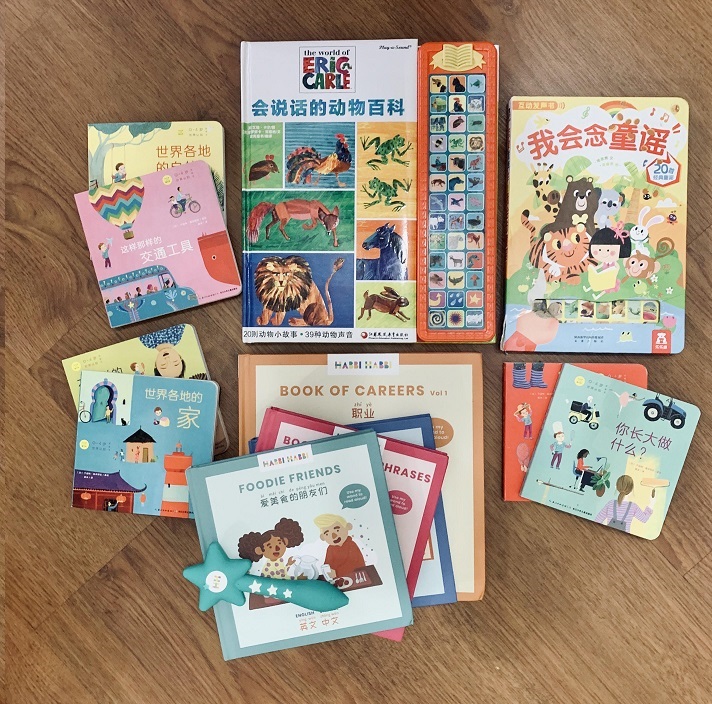
We have spoken to several of the families who have used Dim Sum Warriors and they are currently mostly from Singapore, Malaysia and the USA. Because there are so many ways to use the Dim Sum Warriors App, and it’s supported by different kinds of scaffolding, we’ve had readers who are 6 and readers who are 11 – they appreciate the language and humour in different ways.

The parents we have spoken to tend to be the types of parents who do not identify as tiger parents, who are looking for ways for kids to enjoy language learning in more creative ways. And they all tend to love dim sum!

Special opportunity for your family to try out the Dim Sum Warriors App for Free

The Dim Sum Warriors App is suitable for learning both Chinese and English for ages 5-11.  The good news is that Dim Sum Warriors is giving away 6-months membership for FREE with no strings attached.

The award-winning Dim Sum Warriors App can downloaded here:


Dim Sum Warriors

Hopefully I might see you at one of the upcoming Dim Sum Warrior bilingual jamming sessions!

If you got to the end and found this helpful, maybe there are some other posts on my blog you might also enjoy. This blog is a passion project, where I share different things on our bilingual journey. As a parent who doesn’t speak any Chinese, we’ve relied heavily on online tools, clever robots and recommendations of others in our Chinese learning journey. Some of my earlier posts are: